
- Home
- »
- Medical Devices
- »
-
U.S. Fluorescence Microscopy Market, Industry Report 2033GVR Report cover
![U.S. Fluorescence Microscopy Market Size, Share & Trends Report]()
U.S. Fluorescence Microscopy Market (2026 - 2033) Size, Share & Trends Analysis Report By Type (Upright Fluorescence Microscopy, Inverted Fluorescence Microscopy), By Application (Life Science, Material Science, Semiconductors, Nanotechnology), By Region, And Segment Forecasts
- Report ID: GVR-4-68040-865-9
- Number of Report Pages: 100
- Format: PDF
- Historical Range: 2021 - 2025
- Forecast Period: 2026 - 2033
- Industry: Healthcare
- Report Summary
- Table of Contents
- Segmentation
- Methodology
- Download FREE Sample
-
 Download Sample Report
U.S. Fluorescence Microscopy Market Summary
The U.S. fluorescence microscopy market size was estimated at USD 198.7 million in 2025 and is expected to reach USD 386.4 million by 2033, growing at a CAGR of 8.8% from 2026 to 2033. Key market drivers include investments in biomedical research, increasing adoption of advanced imaging technologies in life sciences, and rising demand for high-resolution cellular and molecular analysis.
Key Market Trends & Insights
- By Type, the upright fluorescence microscopy segment dominated the U.S. fluorescence microscopy industry, accounting for the largest revenue share of 59.47% in 2025
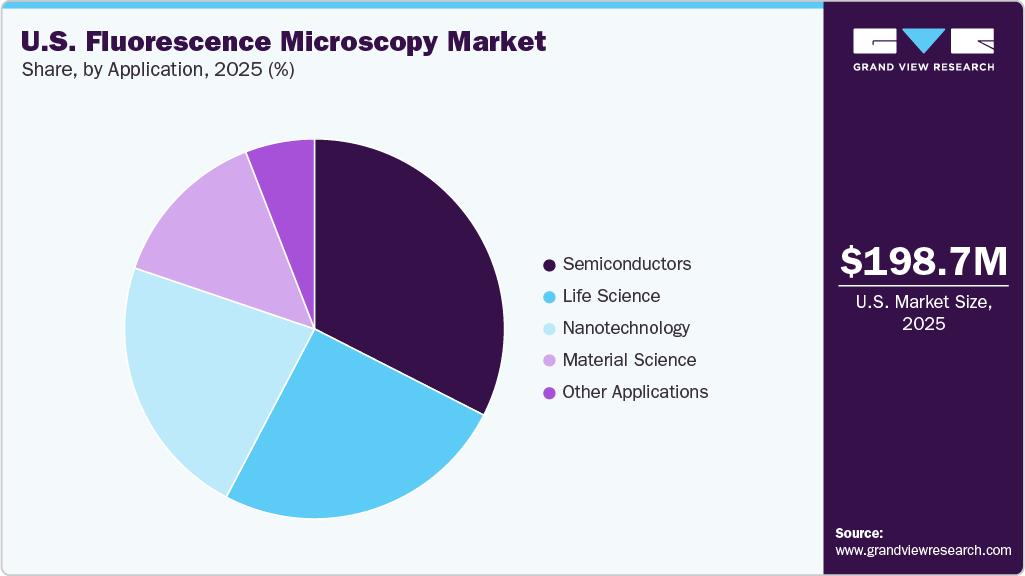
- By application, the semiconductors segment dominated the U.S. fluorescence microscopy market, accounting for a revenue share of 32.5% in 2025.
- By region, The Southeast region dominated the U.S. fluorescence microscopy industry, accounting for the largest revenue share in 2025
Market Size & Forecast
- 2025 Market Size: USD 198.7 Million
- 2033 Projected Market Size: USD 386.4 Million
- CAGR (2026-2033): 8.8%
Significant funding from organizations such as the National Institutes of Health has accelerated research in areas including cancer biology, neuroscience, immunology, and drug discovery, all of which rely heavily on fluorescence imaging techniques.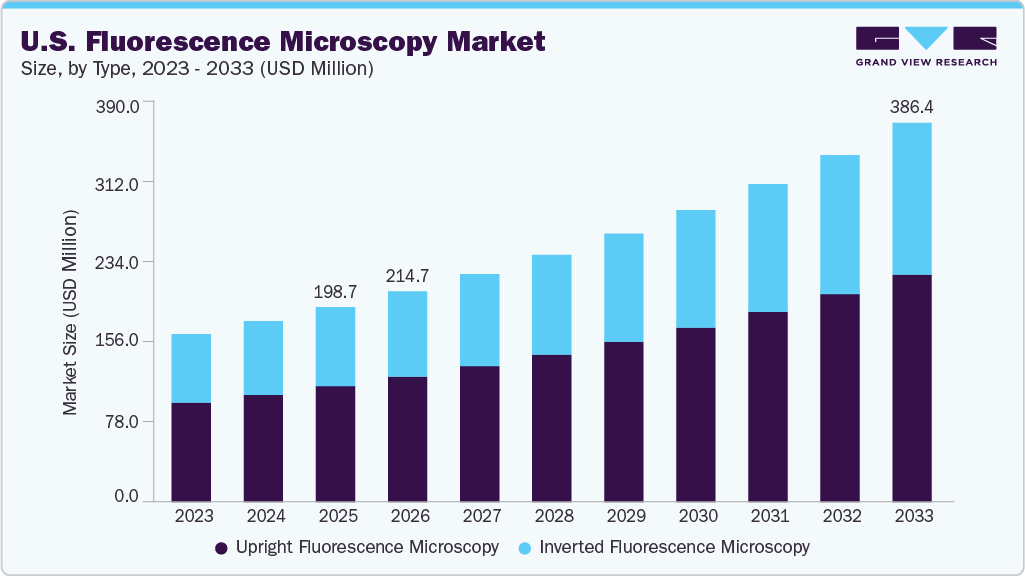
Expansion in Life Sciences & Biomedical Research
The U.S. has one of the world’s strongest research ecosystems, supported by substantial funding from federal agencies such as the National Institutes of Health (NIH), the National Science Foundation (NSF), and the Department of Defense, as well as investments from academic medical centers, biotechnology firms, and pharmaceutical companies.
As research in cellular biology, genomics, proteomics, immunology, and neuroscience becomes more complex and data-intensive, the need for high-resolution, multi-color, and live-cell imaging systems continues to rise. Furthermore, the growing emphasis on precision medicine, translational research, and early disease detection strengthens the reliance on fluorescence-based imaging technologies, thereby driving consistent market growth in the U.S.
For instance, the EVOS imaging systems from Thermo Fisher Scientific (Invitrogen brand) are designed to simplify microscopy workflows while delivering high-performance fluorescence imaging across applications ranging from routine cell culture monitoring to complex spatial tissue analysis. The EVOS portfolio includes digital fluorescence microscopes such as the M3000, M5000, and M7000, which enable brightfield, phase-contrast, multi-color fluorescence, and automated 2D/3D imaging, as well as the S1000 spatial imaging system with multiplex spectral capabilities for studying cellular interactions within tissues. Such innovations demonstrate how increasing research complexity in fields such as cellular biology, immunology, and translational medicine is driving demand for high-resolution, automated, and quantitative fluorescence microscopy solutions, thereby reinforcing market growth in the U.S. research ecosystem.
Rising Demand in Drug Discovery & Development
The U.S. hosts a large concentration of global pharmaceutical and biotechnology companies, alongside leading academic research institutions, all of which invest heavily in R&D to accelerate the development of novel therapeutics. Fluorescence microscopy plays a critical role in this process by enabling precise visualization of cellular structures, protein interactions, and molecular pathways in real time. It is widely used for drug target identification, validation studies, and understanding mechanisms of action at the cellular and subcellular levels.
As of January 2026, researchers at IOCB Prague have developed a novel fluorescent labeling technology that enables scientists to monitor cellular processes and drug responses in living cells with greater clarity and precision. Traditional fluorescent dyes often bind non-specifically and cause entire cells to glow, creating background noise and requiring repeated washing. In contrast, the new fluorogenic triazinium probes remain non-fluorescent until they bind to a specific target molecule. This targeted activation significantly reduces unwanted signals, lowers experimental time and cost, and enables more accurate visualization of cellular structures and molecular interactions. Innovation has strong potential to advance drug discovery, cell biology research, and medical diagnostics by providing clearer insights into how cells respond to treatments at the molecular level.
“A significant advantage of the new technology is its versatility,” says IOCB Prague postdoctoral researcher and first author of the study, Veronika Šlachtová. “Our method works across the visible spectrum, from blue to far red. Thanks to labels of different colours, we can monitor several cellular structures simultaneously within a single experiment.”
Growth of Clinical Diagnostics
The growth of clinical diagnostics is a significant driver for the U.S. fluorescence microscopy industry, primarily due to its critical role in the detection and monitoring of cancer, infectious diseases, and chronic conditions such as autoimmune and neurological disorders. Fluorescence microscopy enables highly sensitive and specific visualization of cellular and molecular markers, making it indispensable in pathology labs, hospital diagnostic centers, and reference laboratories. In oncology, it supports tumor biomarker identification and companion diagnostics, while in infectious disease testing, it aids in rapid pathogen detection and immunofluorescence assays.
Furthermore, the increasing emphasis on early disease detection and the expansion of precision medicine initiatives in the U.S. healthcare system are accelerating the demand for advanced imaging technologies. As healthcare providers focus on personalized treatment strategies based on molecular profiling, fluorescence microscopy becomes a foundational tool for accurate diagnosis, prognostic assessment, and therapy selection, thereby driving sustained market growth.
As per the article published by Photonics Media, the concept of smartphone fluorescence microscopy highlights how portable imaging devices address major barriers in molecular diagnostics, particularly cost, infrastructure requirements, and the need for specialized personnel. Traditional diagnostic technologies are often expensive and confined to well-equipped laboratories, limiting accessibility in resource-constrained settings and even creating affordability challenges in developed countries. By integrating smartphone imaging attachments, researchers can create compact, field-deployable diagnostic tools capable of real-time data analysis and instant communication of results. These innovations enable point-of-care testing and expand access to sensitive molecular diagnostics, offering a practical solution for global healthcare challenges.
Increasing use of fluorescence image-guided surgery (FIGS)
FIGS enhances the surgeon's ability to visualize tumors and their margins during surgery. This is achieved using fluorescent agents that accumulate in tumor tissue, enabling clearer differentiation between healthy and diseased tissue. Surgical microscopes are equipped with specialized modules for fluorescence detection, improving the precision of tumor resection. The integration of fluorescence imaging into surgical microscopes requires advancements in technology, such as improved illumination systems and detectors capable of capturing fluorescence signals. This has led to the development of more sophisticated microscopes such as the Zeiss Pentero BLUE400 and Leica FL400, which are widely used in neurosurgery.
There is a growing need for quantitative fluorescence analysis to enhance the accuracy of tumor detection. This necessitates the development of standardized methods and photostable fluorescent standards to ensure reproducible results across different surgical microscopes. FIGS is increasingly used in various surgical procedures, including neurosurgery for gliomas.
Recent advancements in fluorescence image-guided surgery have led to the introduction of innovative surgical microscopes in the U.S. that enhance the precision and effectiveness of surgical procedures. Some key developments include:
-
GLOW400 3D AR Fluorescence Microscope: This new microscope provides surgeons with enhanced three-dimensional fluorescence visualization, allowing for clearer differentiation of anatomical structures during operations. It aims to improve clinical outcomes by facilitating real-time decision-making in neurosurgery.
-
FL800 by Leica: This device enables surgeons to observe blood flow in real time through both eyepieces and video monitors, significantly aiding in intraoperative assessments. The FL800 utilizes fluorescence imaging technology characterized by high sensitivity and good tissue penetration, making it a valuable tool for various surgical interventions.
- Fluorescence Frequency-Response Imaging (F-FRI): Introduced at a recent conference, this cost-effective imaging modality allows for label-free metabolic imaging, which has shown promise in guiding surgeries and biopsies. It can assess tissue composition non-destructively, enhancing surgical precision.
Market Concentration & Characteristics
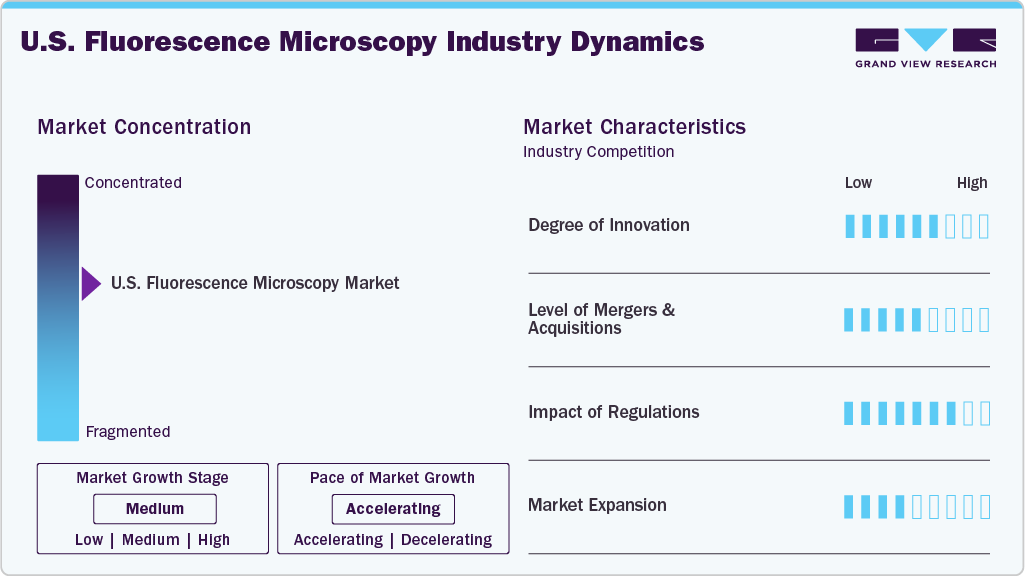
The U.S. fluorescence microscopy market is fragmented, with many small players entering the market and launching new innovative products. The degree of innovation is high, and the level of merger & acquisition activities is medium. The impact of regulations on the market is high, and market expansion is medium.
The degree of innovation in the industry is high. For instance, light-sheet fluorescence microscopy (LSFM) is an advanced imaging technique that enables researchers and clinicians to visualize biological tissues in three dimensions at high speed and minimal photodamage compared to traditional microscopy methods. By illuminating samples with a thin sheet of light, the technology captures detailed optical sections that are reconstructed into comprehensive 3D images, allowing better observation of cellular structures, tissue organization, and disease-related changes.
The market players are leveraging strategies such as collaborations, partnerships, and acquisitions to promote the reach of their offerings and increase their offering capabilities. For instance, in February 2025, Leica Microsystems announced the acquisition of ATTO-TEC in Wetzlar to strengthen its microscopy imaging ecosystem and research capabilities. ATTO-TEC specializes in high-performance fluorescent dyes and reagents for sample preparation, critical components in fluorescence microscopy workflows.
Dr. Jörg Reichwein, CEO of ATTO-TEC GmbH, added: "I am convinced that by becoming an integral part of Leica Microsystems, we will mobilize the right forces to differentiate the microscopy imaging offering further. Direct access to knowledge of subsequent imaging and analysis steps leads to new approaches in developing assays, kits, and dyes optimised for the entire workflow".
Regulations in the industry are primarily governed by the U.S. Food and Drug Administration (FDA), which oversees imaging systems that are intended for clinical or diagnostic use under medical device regulations. Fluorescence microscopes used for in vitro diagnostics (IVD), pathology, or surgical applications must comply with FDA clearance or approval pathways (such as 510(k) or PMA), as well as quality system requirements under 21 CFR Part 820. Moreover, laboratories using fluorescence-based diagnostic techniques must comply with the Clinical Laboratory Improvement Amendments (CLIA) to ensure testing accuracy and reliability.
Market players use expansion strategies to broaden their offerings and expand their reach. For instance, the collaboration between Leica Microsystems and CrestOptics launched in October 2024 focuses on advancing high-performance microscopy by integrating the CICERO spinning disk imaging unit into Leica’s THUNDER Imager Cell system. This integration enhances live-cell imaging capabilities by enabling faster acquisition speeds, reduced phototoxicity, and improved image clarity, which are critical for dynamic biological research applications such as neuroscience and cell biology.
Type Insights
The upright fluorescence microscopy segment dominated the U.S. fluorescence microscopy industry, accounting for the largest revenue share of 59.47% in 2025, and is expected to witness the fastest CAGR over the forecast period. This is due to the expanding scope of life sciences and biomedical research, particularly in cell biology, neuroscience, pathology, and developmental biology. Upright fluorescence microscopes are especially preferred for thicker specimens, tissue sections, electrophysiology studies, and in vivo experiments, making them essential in neuroscience and histology applications. For instance, the upright imaging systems offered by Olympus Corporation (now Evident Scientific), such as the BX53 fluorescence microscope, are widely used in life science research for tissue imaging, electrophysiology, and pathology applications. These systems are designed to handle thicker specimens and complex biological samples with high optical performance and multi-channel fluorescence capabilities, making them suitable for neuroscience and histology studies.
The inverted fluorescence microscopy segment is expected to grow at the fastest CAGR during the forecast period, driven by the rapid expansion of cell-based research, biotechnology, and pharmaceutical development activities. Inverted systems are particularly suited for live-cell imaging, tissue culture studies, and high-throughput screening, which are essential in drug discovery, cancer research, stem cell biology, and regenerative medicine. In addition, the growing focus on precision medicine, personalized therapeutics, and complex 3D cell culture models requires high-resolution, real-time visualization capabilities that inverted fluorescence microscopes provide.
Application Insights
The semiconductors segment dominated the U.S. fluorescence microscopy market, accounting for a revenue share of 32.5% in 2025. This can be attributed to the development of advanced imaging components, including CMOS and CCD sensors, laser diodes, LEDs, and photodetectors. Modern fluorescence microscopes rely heavily on semiconductor-based detectors to capture faint fluorescent signals and convert them into high-resolution digital images with improved sensitivity, speed, and accuracy. For instance, scientific CMOS (sCMOS) sensors provide low noise, high frame rates, wide dynamic range, and large field of view, making them ideal for high-performance biological imaging and real-time analysis.
The nanotechnology segment is anticipated to grow at a significant CAGR during the forecast period, as nanoscale research requires highly sensitive imaging techniques to visualize structures, particles, and biological interactions at the molecular and cellular levels. Fluorescence microscopy enables researchers to track nanoparticles, quantum dots, and other nanomaterials in real time within living cells, which is essential for advancing drug delivery, diagnostics, and precision medicine.
Regional Insights
The Southeast region dominated the U.S. fluorescence microscopy industry, accounting for the largest revenue share in 2025, and is expected to witness the fastest CAGR over the forecast period. This is due to the rapid expansion of life sciences research infrastructure, biotechnology clusters, and academic-industry collaborations. Major research hubs such as Research Triangle Park in North Carolina, the Texas Medical Center in Houston, and growing biomedical ecosystems in states such as Florida and Georgia are attracting significant federal and private investments in biomedical innovation. Increased funding from agencies such as the National Institutes of Health supports research in genomics, cancer biology, neuroscience, and regenerative medicine, all of which rely heavily on advanced imaging technologies.
The Southwest region is expected to grow at the fastest CAGR during the forecast period. This is driven by the states such as Texas, Arizona, and Southern California witnessing strong growth in the market due to the rapid expansion of life sciences research clusters, biotechnology startups, and academic-industry collaborations. Emerging bioscience hubs such as the Greater Phoenix area and Arizona’s optics and photonics cluster are attracting significant investments in translational research, medical devices, and diagnostics, which require advanced imaging technologies for cellular and molecular analysis.
Key U.S. Fluorescence Microscopy Company Insights
Key companies in the U.S. fluorescence microscopy market, including Zeiss Group, Bruker Corporation, Thermo Fisher Scientific, Inc., and Nikon Corporation, play an important role in advancing life sciences research and clinical diagnostics by providing high-performance imaging systems, software, and related solutions. Their focus on innovation, automation, and advanced imaging technologies supports drug discovery, cellular research, and precision medicine, driving growth in the U.S. market.
Key U.S. Fluorescence Microscopy Companies:
- Zeiss Group
- Bruker Corporation
- Thermo Fisher Scientific, Inc.
- Nikon Corporation
- Olympus Corporation
- Leica Microsystems
- KEYENCE CORPORATION
- ECHO
Recent Developments
-
In August 2025, GT Vision launched GX Microscopes XDS400, paired with the pE-300 illumination system from CoolLED, representing a move toward more affordable yet high-performance fluorescence microscopy solutions for research and clinical laboratories. This combination provides reliable fluorescence imaging with improved illumination stability, user-friendly operation, and cost efficiency, making advanced microscopy more accessible to smaller laboratories and budget-constrained institutions.
-
In February 2025, Leica Microsystems announced the acquisition of ATTO-TEC to strengthen its end-to-end microscope imaging workflow capabilities and improve research outcomes. The move also enables the joint development of specialized assays and reagents optimized for Leica systems, reinforcing the company’s strategy to provide comprehensive solutions from sample preparation to image analysis and accelerating scientific discovery and medical innovation.
“With the acquisition of ATTO-TEC, Leica Microsystems is now able to support researchers at every stage of the microscopy imaging workflow," said Dr. Annette Rinck, President of Leica Microsystems. "This can be a key advantage for reliable results, such as in high-plex 3D experiments in cancer research. Our combined expertise will help researchers to reveal the invisible, enable discovery, and ultimately lead to breakthrough research, accelerating therapy development for improving human health.
- In June 2024, HORIBA announced the launch of the InverTau fluorescence lifetime imaging (FLIM) platform, a next-generation system designed to enhance quantitative fluorescence microscopy and molecular interaction analysis.
“InverTau has been developed utilizing our core TCSPC technology and delivers high-quality, fully computer-controlled confocal FLIM images with our intuitive EzTime Image Software,” stated David McLoskey, managing director, TCSPC division, HORIBA Jobin Yvon IBH Ltd. “The platform will allow cell biologists to discover new mechanisms and solutions for human health,” McLoskey continued.
U.S. Fluorescence Microscopy Market Report Scope
Report Attribute
Details
Revenue forecast in 2033
USD 386.4 million
Growth rate
CAGR of 8.8% from 2026 to 2033
Actual data
2021 - 2025
Forecast data
2026 - 2033
Quantitative units
Revenue in USD million and CAGR from 2026 to 2033
Report coverage
Revenue forecast, company ranking, competitive landscape, growth factors, and trends
Segments covered
Type, application, region
Country scope
U.S.
Key companies profiled
Zeiss Group; Bruker Corporation; Thermo Fisher Scientific, Inc.; Nikon Corporation; Olympus Corporation; Leica Microsystems; KEYENCE CORPORATION; ECHO
Customization scope
Free report customization (equivalent up to 8 analysts working days) with purchase. Addition or alteration to country, regional & segment scope.
Pricing and purchase options
Avail customized purchase options to meet your exact research needs. Explore purchase options
U.S. Fluorescence Microscopy Market Report Segmentation
This report forecasts revenue growth at the country level and provides an analysis of the latest industry trends in each of the sub-segments from 2021 to 2033. For this study, Grand View Research has segmented the U.S. fluorescence microscopy market report based on type, application, and region:
-
Type Outlook (Revenue, USD Million, 2021 - 2033)
-
Upright Fluorescence Microscopy
-
Inverted Fluorescence Microscopy
-
-
Application Outlook (Revenue, USD Million, 2021 - 2033)
-
Life Science
-
Material Science
-
Semiconductors
-
Nanotechnology
-
Other Applications
-
-
Region Outlook (Revenue, USD Million, 2021 - 2033)
-
West
-
Southwest
-
Southeast
-
Midwest
-
Northeast
-
Frequently Asked Questions About This Report
b. The U.S. fluorescence microscopy market size was valued at USD 198.70 million in 2025.
b. The U.S. fluorescence microscopy market is expected to grow at a CAGR of 8.76% from 2026 to 2033 to reach an estimated value of USD 386.43 million by 2033.
b. The upright fluorescence microscopy segment dominated the market with highest revenue share in 2025 due to the expanding scope of life sciences and biomedical research, particularly in cell biology, neuroscience, pathology, and developmental biology.
b. The key players in the market include Zeiss Group, Bruker Corporation, Thermo Fisher Scientific, Inc., Nikon Corporation, Olympus Corporation, Leica Microsystems, KEYENCE CORPORATION, ECHO
b. Key market drivers include investments in biomedical research, increasing adoption of advanced imaging technologies in life sciences, and rising demand for high-resolution cellular and molecular analysis


Share this report with your colleague or friend.
Need a Tailored Report?
Customize this report to your needs — add regions, segments, or data points, with 20% free customization.


ISO 9001:2015 & 27001:2022 Certified
We are GDPR and CCPA compliant! Your transaction & personal information is safe and secure. For more details, please read our privacy policy.
Trusted market insights - try a free sample
See how our reports are structured and why industry leaders rely on Grand View Research. Get a free sample or ask us to tailor this report to your needs.












