UK Household Kitchen Appliances Market Summary
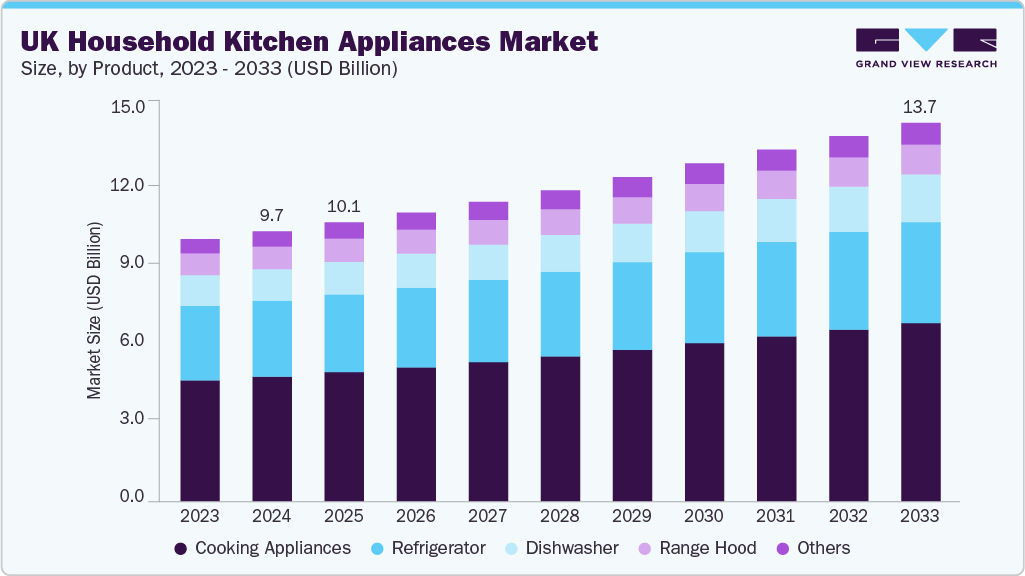
The UK household kitchen appliances market size was estimated at USD 9.75 billion in 2024 and is projected to reach USD 13.67 billion by 2033, growing at a CAGR of 3.9% from 2025 to 2033. The market is primarily driven by changing lifestyles and urbanization, product innovations, and the adoption of advanced technologies and product features.
Key Market Trends & Insights
- By product, the cooking appliances segment held the largest market share of 46.2% in 2024.
- By technology, the conventional segment held the largest market share in 2024.
Market Size & Forecast
- 2024 Market Size: USD 9.75 Billion
- 2033 Projected Market Size: USD 13.67 Billion
- CAGR (2025-2033): 3.9%
The increasing working population, especially younger professionals, and dual-income households, boost disposable income and demand for convenient, functional, and aesthetically pleasing home appliances. A report published by The Guardian in February 2024 noted that as more people worked from home, there was a notable surge in demand for convenient kitchen gadgets, especially air fryers. Smart appliances that save time and energy have become highly popular among home-based workers.
Furthermore, the development of smart, innovative technologies is expected to drive the UK household kitchen appliances industry, with appliances offering connectivity features such as remote monitoring, voice control, and integration with home automation systems. Some examples include smart ovens, refrigerators with inventory management, and AI-enabled appliances.
Rising energy costs and environmental concerns have made energy-efficient appliances a priority. Products with high energy ratings, eco-modes, and smart feedback systems that monitor energy and water usage are increasingly preferred. Induction hobs and eco-friendly dishwashers are appliances gaining traction for their sustainability benefits.
Consumer Insights
In the UK, the purchase and usage of kitchen appliances are increasingly influenced by age, lifestyle, and socio-economic factors. Younger generations, such as Gen Z and Millennials, are tech-savvy and style-conscious consumers. For these groups, the kitchen often serves as an extension of their digital lifestyle, where an appliance’s ability to sync with an app or voice assistant is not just a bonus but an expectation.
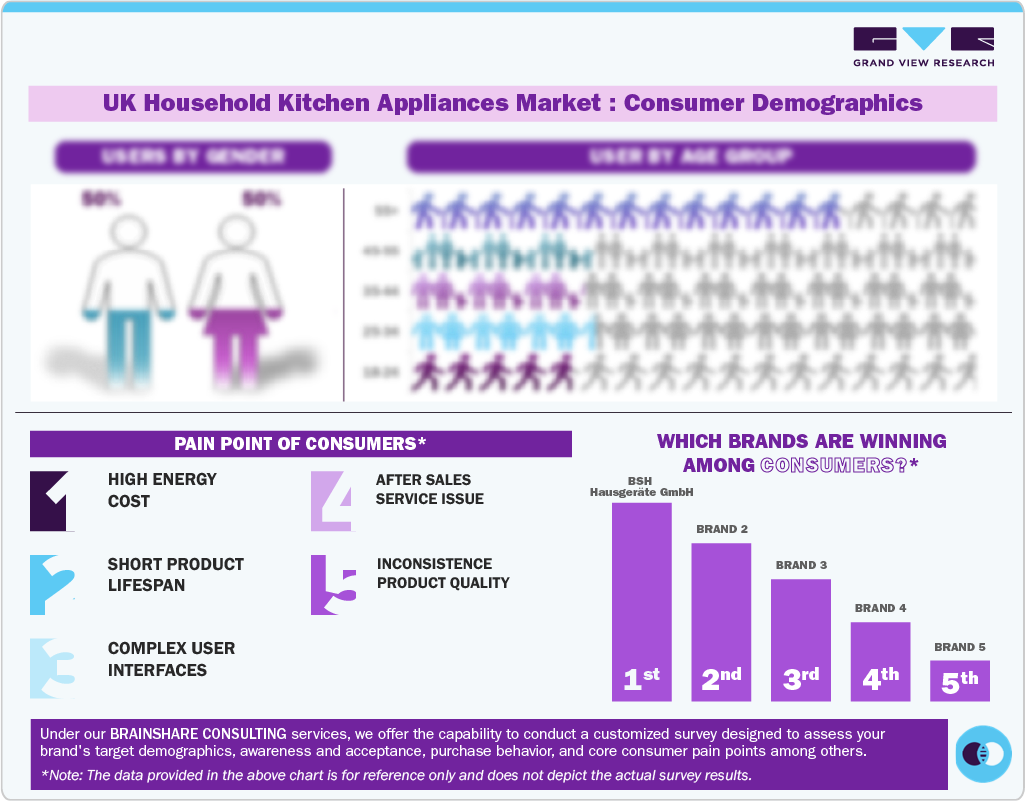
Geographically, urban centers such as London, Manchester, and Birmingham exhibit higher rates of connected appliance adoption. Better broadband access, higher income levels, and the need for space-saving kitchen technology in compact living environments drive this trend.
Environmental awareness spans all age groups in the UK, with middle-aged homeowners particularly demonstrating a growing commitment to selecting kitchen appliances that offer greater longevity, lower energy consumption, and recyclability or reparability. Electrical appliances, including kitchen devices, account for ~20% to 72% of household energy use.
Pricing Analysis
Pricing in the UK household kitchen appliances industry is largely influenced by brand positioning, product functionality, design complexity, and smart technology integration. Domestic and international brands compete at various prices, from entry-level freestanding units to premium built-in smart appliances. Advanced features such as AI-powered cooking, Wi-Fi and voice assistant compatibility, inverter technology, and high energy efficiency ratings (A or above) increase the cost significantly. UK consumers often prioritize long-term savings and performance over the initial purchase price, particularly within mid to high-income segments. Consequently, brands typically divide their product lines into value, mid-range, and luxury kitchen appliances, adjusting features and specifications accordingly.
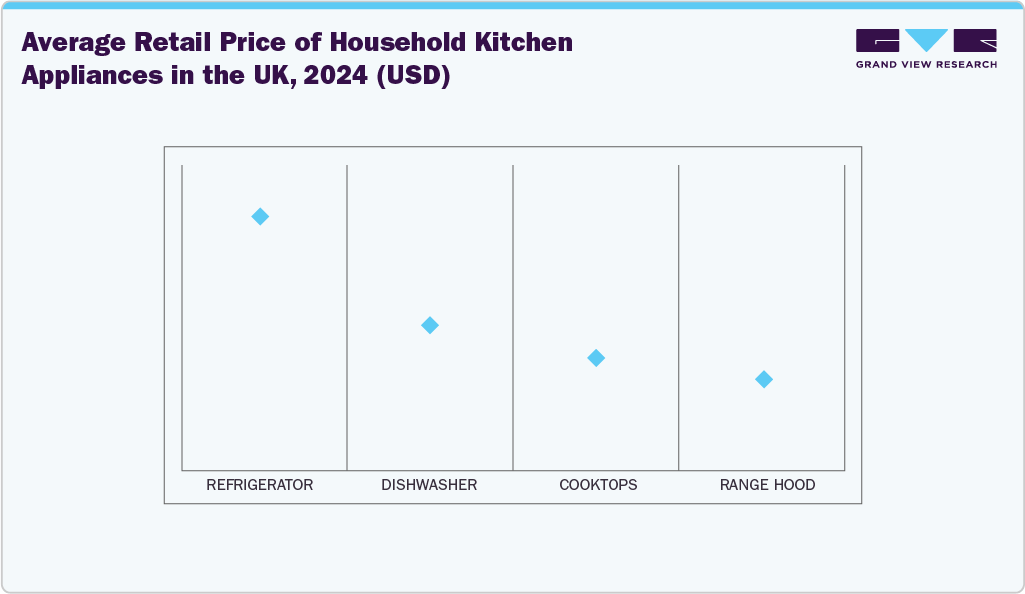
Freestanding models featuring mechanical controls and minimal digital functionality occupy the lower end of the price spectrum and are favored by renters and budget-conscious buyers. Built-in and smart-enabled appliances command higher prices due to their seamless aesthetic integration, digital interfaces, and app-based controls. In addition, factors such as repair support, energy efficiency, and brand reputation are key to consumers’ willingness to invest more in major kitchen appliances.
Product Insights
The cooking appliances segment accounted for a revenue share of 46.2% in 2024. Cooking appliances such as cooktops, ranges, ovens, and others form a key segment in the UK household kitchen appliances market. This category is witnessing strong demand as consumers increasingly seek time-saving, multifunctional products that simplify traditional cooking processes. The shift toward home-cooked meals, growing interest in smart kitchen solutions, and the rising adoption of compact, health-focused appliances such as induction cooktops, air fryers, and built-in ovens are shaping the market.
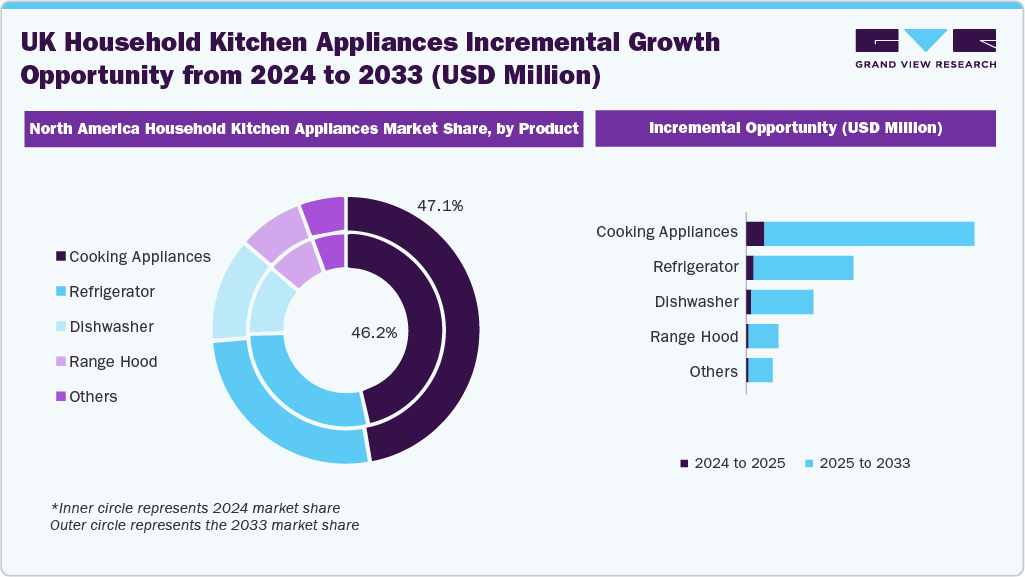
The dishwasher segment is projected to experience the fastest CAGR of 4.8% from 2025 to 2033, driven by shifting consumer lifestyles, greater focus on hygiene, and rising demand for convenience in domestic chores. Urbanization, smaller household sizes, and dual-income families have increased reliance on time-saving appliances such as dishwashers. In addition, a heightened awareness of water and energy efficiency, supported by newer eco-friendly models, has further accelerated segment adoption.
Technology Insights
Conventional household kitchen appliances market accounted for the largest revenue share of the UK market in 2024. Appliances such as standard ovens, stovetops, dishwashers, and refrigerators remain widely used across households, especially in non-smart or budget-conscious segments. Key drivers of their continued adoption include affordability, ease of use, and long-term reliability without needing connectivity or app-based controls. Consumers still prefer manual control features for their simplicity and independence from software updates or internet access.
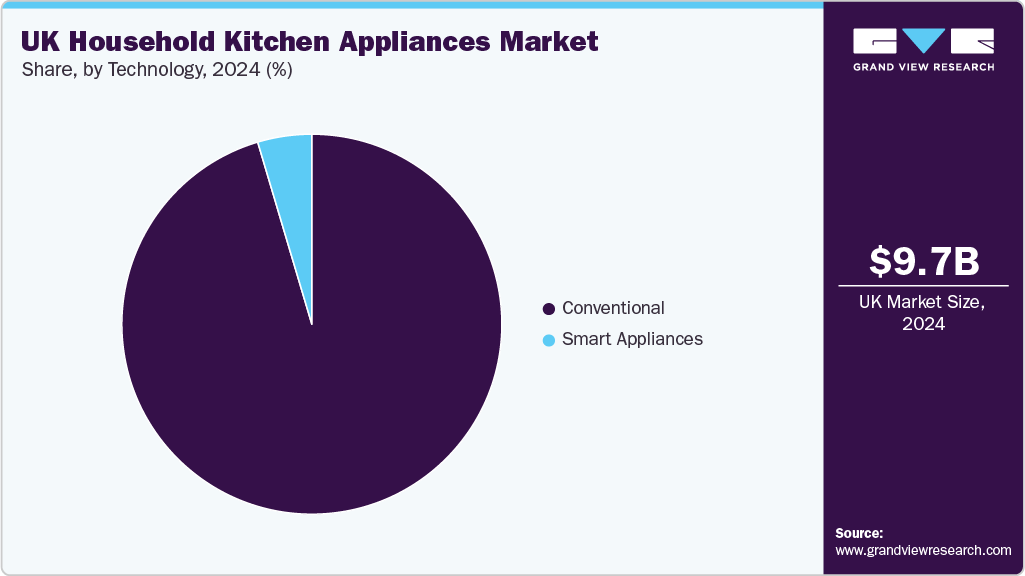
The smart kitchen appliances market is anticipated to experience the fastest CAGR from 2025 to 2033. The growth of smart kitchen appliances in the UK is driven by increasing demand for convenience, energy efficiency, and connected living. Consumers are embracing features such as remote control, voice assistance, and auto-programming, which simplify daily tasks and help reduce utility costs.
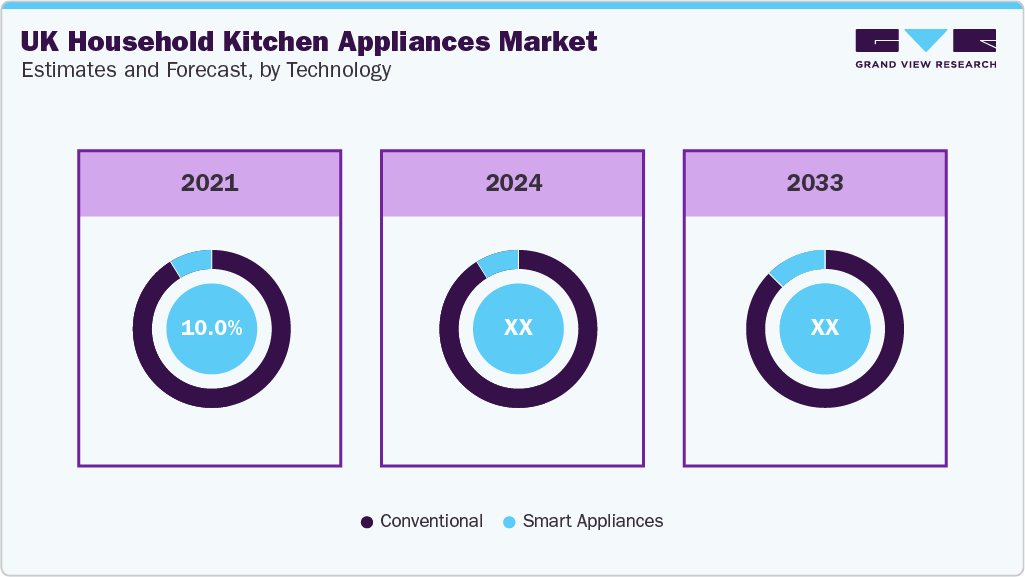
Rising health and hygiene awareness, especially post-pandemic, has further boosted interest in hands-free, app-enabled appliances.
Key UK Household Kitchen Appliances Company Insights
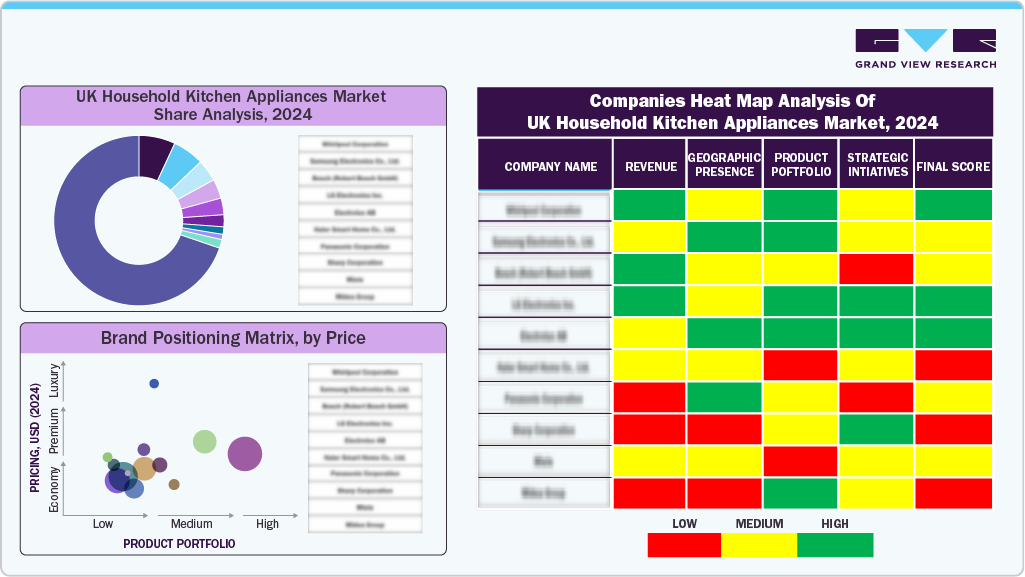
Some key players in the UK household kitchen appliances market are BSH Hausgeräte GmbH, Whirlpool Corporation, Samsung, and SMEG UK LTD.
-
BSH Hausgeräte GmbH is a leading European manufacturer of home appliances, known for premium brands and emphasizing smart technology and sustainability, offering a wide range of connected kitchen appliances integrated with Home Connect.
Key UK Household Kitchen Appliances Companies:
- BSH Hausgeräte GmbH
- Samsung.
- SMEG UK LTD
- LG Electronics.
- Whirlpool
Recent Developments
UK Household Kitchen Appliances Market Report Scope
|
Report Attribute
|
Details
|
|
Market size value in 2025
|
USD 10.06 billion
|
|
Revenue forecast in 2033
|
USD 13.67 billion
|
|
Growth rate
|
CAGR of 3.9% from 2025 to 2033
|
|
Actuals
|
2021 - 2024
|
|
Forecast period
|
2025 - 2033
|
|
Quantitative units
|
Revenue in USD million, and CAGR from 2025 to 2033
|
|
Report coverage
|
Revenue forecast, company ranking, competitive landscape, growth factors, trends
|
|
Segments covered
|
Product, technology
|
|
Key companies profiled
|
BSH Hausgeräte GmbH; Samsung.; SMEG UK LTD; LG Electronics.; Whirlpool
|
|
Customization scope
|
Free report customization (equivalent up to 8 analysts working days) with purchase. Addition or alteration to country, regional & segment scope.
|
|
Pricing and purchase options
|
Avail customized purchase options to meet your exact research needs. Explore purchase options
|
UK Household Kitchen Appliances Market Report Segmentation
This report forecasts revenue growth at the country level and provides an analysis of the latest industry trends in each of the sub-segments from 2021 to 2033. For this study, Grand View Research has segmented the UK household kitchen appliances market report based on product and technology:
-
Product Outlook (Revenue, USD Million, 2021 - 2033)
-
Refrigerator
-
Cooking Appliances
-
Cooktops & cooking range
-
Ovens
-
Others
-
Dishwasher
-
Range Hood
-
Others
-
Technology Outlook (Revenue, USD Million, 2021 - 2033)
-
Conventional
-
Smart Appliances

 Download Sample Report














