
- Home
- »
- Automotive & Transportation
- »
-
Smart Mobility Market Size & Share, Industry Report, 2033GVR Report cover
![Smart Mobility Market Size, Share & Trends Report]()
Smart Mobility Market (2026 - 2033) Size, Share & Trends Analysis By Offerings (Car Sharing, Ride Sharing), By Solution (Traffic, Parking), By Technology (AI & ML, IoT), By Region (North America, Europe, Asia Pacific, Latin America, Middle East & Africa), And Segment Forecasts
- Report ID: GVR-4-68040-645-2
- Number of Report Pages: 150
- Format: PDF
- Historical Range: 2021 - 2025
- Forecast Period: 2026 - 2033
- Industry: Technology
- Report Summary
- Table of Contents
- Interactive Charts
- Methodology
- Download FREE Sample
-
 Download Sample Report
Smart Mobility Market Summary
The global smart mobility market size was estimated at USD 59.32 billion in 2025 and is projected to reach USD 180.35 billion in 2033, growing at a CAGR of 15.3% from 2026 to 2033. Rapid urbanization across the globe has led to increased population density in cities, resulting in growing traffic congestion and longer commute times.
Key Market Trends & Insights
- North America dominated the smart mobility industry with the largest revenue share of 33.5% in 2025.
- The smart mobility in the U.S. is the largest in North America, primarily due to a combination of advanced infrastructure, high digital penetration, and supportive regulatory frameworks.
- By offering, the ride-sharing segment held the largest revenue share of 68.1% in 2025.
- By solution, the traffic management segment held the largest revenue share of 36.8% in 2025.
- By technology, the IoT segment held the largest revenue share of 34.7% in 2025.
Market Size & Forecast
- 2025 Market Size: USD 59.32 Billion
- 2033 Projected Market Size: USD 180.35 Billion
- CAGR (2026-2033): 15.3%
- North America: Largest market in 2025
- Asia Pacific: Fastest growing market
Municipal governments and transportation authorities are under pressure to enhance mobility efficiency and reduce traffic-related economic losses. Smart mobility solutions such as ridesharing, real-time traffic management, and connected transportation systems are emerging as vital tools for addressing urban transport challenges while enhancing the commuter experience.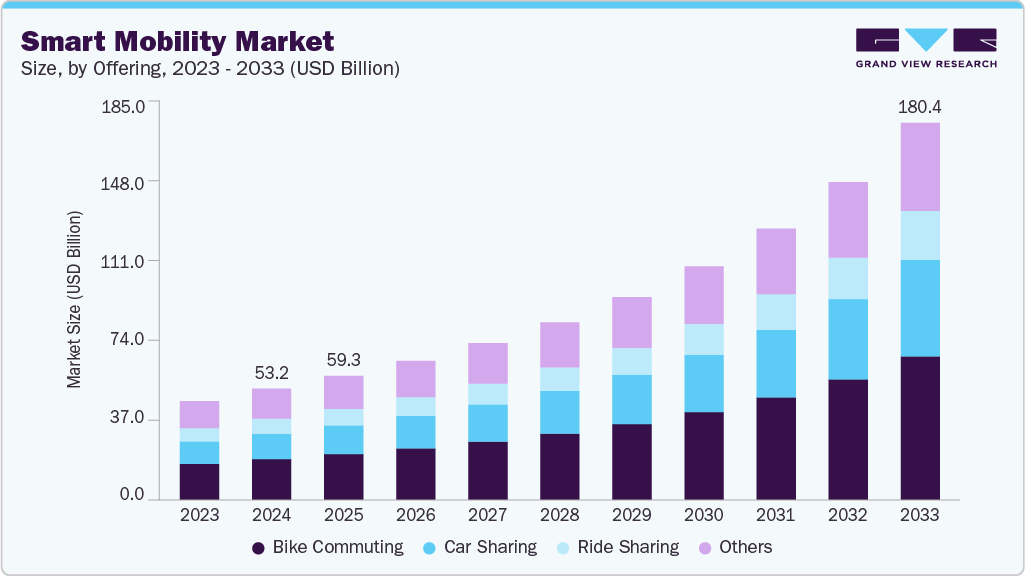
Governments worldwide are actively promoting smart mobility as part of broader sustainability and urban development goals. Policy frameworks, financial incentives, and investments in smart infrastructure are encouraging the deployment of electric vehicles (EVs), autonomous transport, and smart public transit systems. In addition, regulatory mandates on emissions and urban air quality are compelling transport operators to transition from conventional to intelligent, eco-friendly alternatives.
In addition, advancements in artificial intelligence, Internet of Things (IoT), and 5G connectivity are accelerating the evolution of smart mobility. These technologies enable real-time data exchange between vehicles, infrastructure, and users, allowing for predictive maintenance, intelligent route planning, and seamless multimodal travel. The integration of embedded systems, sensors, and GPS capabilities has also improved the accuracy and responsiveness of transport networks, driving higher adoption rates across public and private mobility services.
However, one of the significant hindrances to the smart mobility growth is the substantial capital investment required to deploy intelligent transport systems, advanced communication infrastructure, EV charging stations, and connected vehicle technology. Municipalities, especially in developing regions, often lack financial resources and technical capacity to implement large-scale smart mobility projects. In addition, the integration of emerging technologies like AI, IoT, and embedded systems further drives up upfront costs, making it challenging for smaller cities and startups to enter the market.
Offering Insights
In terms of the offering, the market is classified into bike commuting, car sharing, ride sharing, and others. The ride-sharing segment dominated the overall market, gaining a market share of 68.1% in 2025. Ride sharing continues to grow as demand for convenient, on-demand transportation increases, particularly in densely populated urban areas. The offering addresses first- and last-mile connectivity challenges and provides flexible mobility for users who prefer not to rely on personal vehicles or fixed public transport schedules. Growth of the segment is also supported by changing consumer behavior that favors access over ownership.
The bike commuting segment is expected to witness the fastest growth, growing at a CAGR of 16.3% over the forecast period. Rising emphasis on sustainable and low-emission urban mobility is driving the rapid growth of the bike commuting segment, as cities seek to address congestion, air pollution, and public health concerns. The expansion of dedicated cycling infrastructure, bike lanes, and last-mile connectivity solutions is encouraging commuters to shift from private vehicles to bicycles. In addition, the growing adoption of electric bikes has accelerated uptake by reducing physical effort and extending the range of feasible commuting distances, making bike commuting accessible to a wider population.
Solution Insights
In terms of solution, the market is classified into traffic management, parking management, mobility management, and others. The traffic management segment dominated the market in 2025 and accounted for a revenue share of 36.8%. This dominance is attributed to the growing need for efficient urban traffic flow, reduced congestion, and enhanced commuter safety in rapidly expanding cities. The integration of advanced technologies such as AI-powered traffic signal control, real-time data analytics, IoT-enabled sensors, and GPS-based monitoring systems has significantly improved the ability of municipalities to manage traffic patterns dynamically. Moreover, rising investments in smart city initiatives and infrastructure upgrades have accelerated the deployment of intelligent traffic management solutions.
The mobility management segment is anticipated to register the highest growth during the forecast period, growing at a CAGR of 16.1% throughout the forecast period. This rapid expansion is primarily driven by the increasing adoption of Mobility-as-a-Solution (MaaS) platforms, integrated multimodal transport systems, and the need for optimized urban transit solutions. As cities transition toward more sustainable and efficient transportation ecosystems, mobility management solutions are playing a vital role in orchestrating real-time coordination across various transport modes, including public transit, ride-sharing, car rentals, and micromobility. These systems enable users to plan, book, and pay for their journeys through unified digital platforms, enhancing convenience, cost-efficiency, and travel flexibility.
Technology Insights
In terms of technology, the market is classified into AI & ML, IoT, global positioning system (GPS), radio frequency identification (RFID), embedded systems, and others. Among them, the IoT segment dominated the market with a share of 34.7% in 2025. Rising demand for data-driven and connected transportation systems is driving the adoption of IoT in smart mobility, as cities seek to enhance the efficiency, safety, and sustainability of urban transportation. By integrating connected devices with real-time data analytics, IoT enables traffic optimization, congestion reduction, improved road safety, and better environmental outcomes. In addition, real-time visibility into traffic conditions, vehicle locations, and estimated arrival times enhances operational efficiency and user experience by enabling more effective journey planning and reducing uncertainty.

The AI & ML segment is anticipated to witness the fastest growth, growing at a CAGR of 16.0% over the forecast period. This rapid expansion is driven by the increasing integration of AI/ML technologies across a wide range of mobility applications, including autonomous driving, predictive maintenance, traffic forecasting, and demand-responsive transport systems. AI and ML enable smart mobility platforms to process and analyze vast volumes of real-time data, supporting intelligent decision-making, route optimization, and adaptive traffic signal control. These capabilities significantly improve transport efficiency, reduce congestion, and enhance safety for both passengers and pedestrians.
Regional Insights
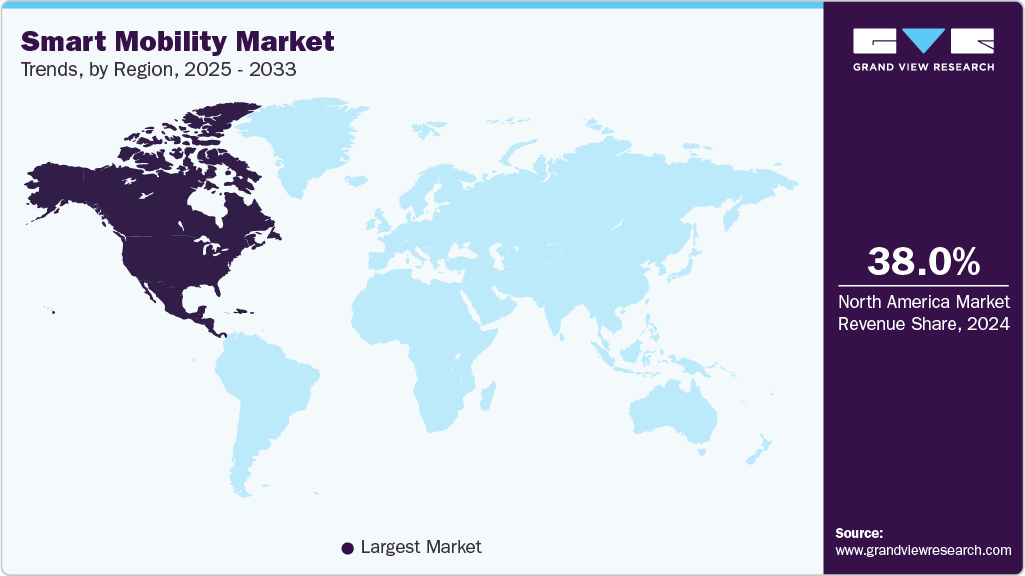
North America led the overall market in 2025, with a market share of 33.5%. This dominance can be attributed to the region’s advanced transportation infrastructure, high level of technology adoption, and the strong presence of established mobility solution providers. The region’s growing focus on sustainable, data-enabled urban mobility and rising consumer demand for efficient, connected transportation solutions continue to fuel growth. As a result, North America is expected to remain at the forefront of smart mobility innovation, setting standards for global adoption and expansion.
U.S. Smart Mobility Market Trends
The smart mobility market in the U.S. is fueled by a combination of well-established transportation infrastructure, a dynamic innovation ecosystem, and strong federal and state-level policy support. Major U.S. cities are actively investing in smart city initiatives that integrate advanced mobility solutions such as autonomous vehicles, AI-powered traffic systems, electric vehicle (EV) networks, and Mobility-as-a-Solution (MaaS) platforms.
Asia Pacific Smart Mobility Market Trends
The smart mobility market in the Asia Pacific is expected to register the highest CAGR of 16.5% during the forecast period. This growth is driven by the region’s rapid urbanization, expanding middle-class population, and aggressive investments in smart infrastructure and digital mobility solutions. Governments across key economies, including China, India, Japan, and Southeast Asian nations, are prioritizing smart transportation systems as part of broader smart city initiatives. Initiatives such as the development of electric vehicle ecosystems, integration of real-time traffic management systems, and rollout of AI- and IoT-enabled mobility services are accelerating adoption rates across the region.
China smart mobility market is leading the Asia Pacific region. Leadership in 5G deployment is a critical enabler of smart mobility. With the world’s largest 5G infrastructure, the country is advancing Vehicle-to-Everything (V2X) communication systems, enabling real-time data exchange between vehicles, infrastructure, and users. This capability is foundational to the success of autonomous vehicles, smart traffic management, and Mobility-as-a-Solution (MaaS) platforms. Public-private partnerships are also shaping China’s smart city and mobility framework. Municipal governments, in collaboration with technology companies like Huawei, are launching integrated MaaS platforms that unify public transport, shared mobility, and payment systems.
The smart mobility market in India is growing, as Mobility-as-a-Solution (MaaS) is gaining momentum in India, led by platforms that aggregate ride-hailing, public transit, and micro-mobility options, leveraging smartphone ubiquity and digital payments. Enhanced interoperability among transport modes is increasing convenience and pushing shared mobility models. In addition, central and state governments in India continue to drive electric and smart mobility through subsidy programs and manufacturing incentives. The FAME-II scheme and the Production-Linked Incentive (PLI) for EVs have reduced costs and spurred growth in the two- and three-wheeler EV segment.
Europe Smart Mobility Market Trends
The smart mobility market in Europe is being driven by a combination of stringent environmental regulations, technological advancements, and changing consumer behavior. One of the most significant drivers is the strong regulatory push from the European Union, including the EU Green Deal and Clean Mobility Package, which mandate significant reductions in carbon emissions. These initiatives are prompting widespread adoption of electric vehicles (EVs), smart transportation infrastructure, and connected mobility solutions across European cities.
The UK smart mobility market is gaining momentum, with e-scooters, bikes, and e-bikes expanding beyond trials into full-scale deployment across Manchester, Edinburgh, Brighton, and more. Local authorities are implementing safety regulations like night-time bans and geo-fencing to integrate this mode responsibly. MaaS platforms are also advancing, especially in urban centers, by integrating micro-mobility, ride-hailing, transit, and data-driven trip planning via a single app.
Key Smart Mobility Company Insights
Some of the leading smart mobility providers globally included in the study are Robert Bosch GmbH, Cisco Systems, Inc., Flash Parking, Kapsch TrafficCom AG, Siemens AG, among others. Companies operating in the smart mobility space are actively investing in R&D to enhance the efficiency, flexibility, and sustainability of their mobility solutions. Major areas of innovation include the deployment of advanced digital platforms for real-time traffic and fleet management, automation of service processes, and the use of predictive analytics for demand forecasting and route optimization. In addition, firms are adopting emerging technologies such as cloud-based mobility platforms, IoT, AI, and geospatial intelligence to deliver seamless and integrated transportation services.
-
Robert Bosch GmbH is an engineering and technology enterprise with operations spanning mobility technologies, industrial solutions, consumer technologies, and digital platforms. The company maintains a broad portfolio across automotive electronics, software, sensors, and connected systems. Its participation in the smart mobility ecosystem is reflected through advanced driver assistance technologies, connected vehicle platforms, intelligent sensors, and IoT-enabled mobility solutions that support traffic optimization, vehicle-to-infrastructure communication, and data-driven transport operations.
-
Cisco Systems, Inc. is a provider of networking infrastructure, cybersecurity solutions, cloud networking, and IoT platforms supporting large-scale digital ecosystems. The company’s capabilities in high-reliability connectivity, edge computing, and secure data transmission underpin digital transport infrastructure deployments. Its technology stack supports intelligent transportation systems, connected corridors, smart intersections, and mobility data platforms, enabling real-time traffic intelligence, resilient communications, and secure integration of connected mobility applications across urban transport networks.
Key Smart Mobility Companies:
The following key companies have been profiled for this study on the smart mobility market
- Robert Bosch GmbH
- Cisco Systems, Inc.
- Flash Parking
- Kapsch TrafficCom AG
- Siemens AG
- Cubic Transportation Systems, Inc.
- Iteris, Inc.
- TomTom International BV
- Swarco
- T2 Systems
Recent Developments
-
In January 2026, Kapsch TrafficCom AG launched EcoTrafiX, a next-generation urban mobility and traffic-management platform integrating adaptive signal control, multimodal traffic optimization, and real-time data analytics to reduce congestion, emissions, and travel time across smart cities.
-
In January 2026, TomTom International BV launched Area Analytics and enhanced Orbis Maps with lane-level precision, enabling advanced traffic insights, road-usage intelligence, and improved support for automated driving, fleet optimization, and urban mobility planning.
Smart Mobility Market Report Scope
Report Attribute
Details
Market size value in 2026
USD 66.50 billion
Revenue forecast in 2033
USD 180.35 billion
Growth rate
CAGR of 15.3% from 2026 to 2033
Historical data
2021 - 2025
Forecast period
2026 - 2033
Quantitative units
Revenue in USD million/billion and CAGR from 2026 to 2033
Report coverage
Revenue forecast, company ranking, competitive landscape, growth factors, and trends
Segments covered
Offering, solution, technology, region
Regional scope
North America; Europe; Asia Pacific; Latin America; MEA
Country scope
U.S.; Canada; Mexico; UK; Germany; France; China; India; Japan; Australia; South Korea; Brazil; UAE; KSA; South Africa
Key companies profiled
Robert Bosch GmbH; Cisco Systems, Inc.; Flash Parking; Kapsch TrafficCom AG; Siemens AG; Cubic Transportation Systems, Inc.; Iteris, Inc.; TomTom International BV; Swarco; T2 Systems
Customization scope
Free report customization (equivalent up to 8 analysts working days) with purchase. Addition or alteration to country, regional & segment scope.
Pricing and purchase options
Avail customized purchase options to meet your exact research needs. Explore purchase options
Global Smart Mobility Market Report Segmentation
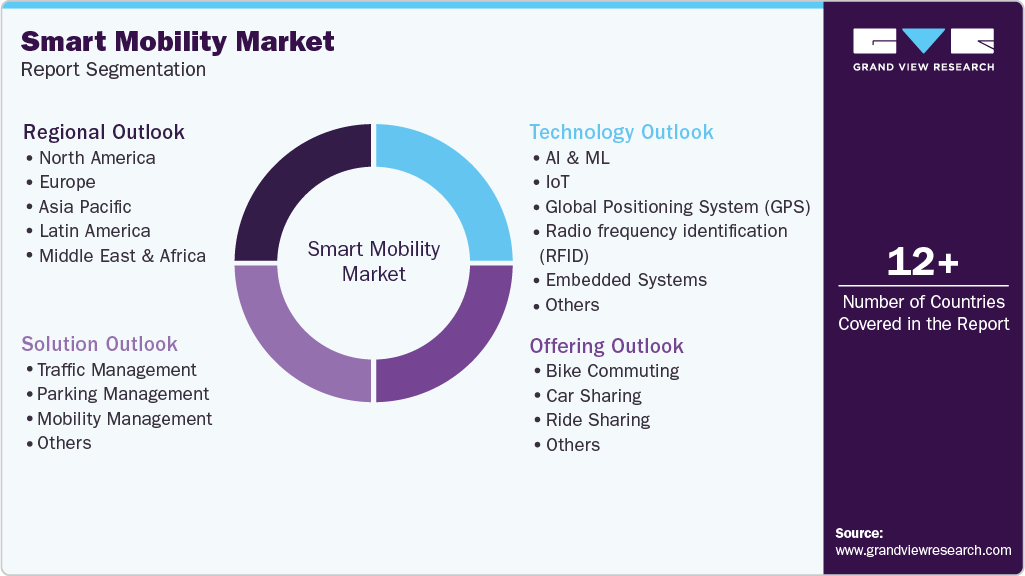
This report forecasts revenue growth at global, regional, and country levels and provides an analysis of the industry trends in each of the sub-segments from 2021 to 2033. For this study, Grand View Research has segmented the global smart mobility market report based on offering, solution, technology, and region:
-
Offering Outlook (Revenue, USD Million, 2021 - 2033)
-
Bike Commuting
-
Car Sharing
-
Ride Sharing
-
Others
-
-
Solution Outlook (Revenue, USD Million, 2021 - 2033)
-
Traffic Management
-
Parking Management
-
Mobility Management
-
Others
-
-
Technology Outlook (Revenue, USD Million, 2021 - 2033)
-
AI & ML
-
IoT
-
Global Positioning System (GPS)
-
Radio frequency identification (RFID)
-
Embedded Systems
-
Others
-
-
Regional Outlook (Revenue, USD Million, 2021 - 2033)
-
North America
-
U.S.
-
Canada
-
Mexico
-
-
Europe
-
Germany
-
UK
-
France
-
-
Asia Pacific
-
China
-
India
-
Japan
-
South Korea
-
Australia
-
-
Latin America
-
Brazil
-
-
Middle East & Africa
-
KSA
-
UAE
-
South Africa
-
-
Frequently Asked Questions About This Report
b. The key driving trends in the smart mobility market include the increasing integration of advanced connectivity and IoT technologies, enabling real-time traffic management, vehicle-to-everything (V2X) communication, and predictive maintenance. The rise of electric vehicles (EVs) and the expansion of EV charging infrastructure are also major contributors, driven by government incentives and sustainability goals.
b. The global smart mobility market size is expected to grow at a significant CAGR of 15.3% to reach USD 180.35 billion in 2033.
b. North America dominated the smart mobility market with share of 33.5% in 2025, driven by advanced transportation infrastructure, high level of technology adoption, and the strong presence of established mobility solution providers.
b. Some of the players in the smart mobility market are Robert Bosch GmbH; Cisco Systems, Inc.; Flash Parking; Kapsch TrafficCom AG; Siemens AG; Cubic Transportation Systems, Inc.; Iteris, Inc.; TomTom International BV; Swarco; T2 Systems.
b. The global smart mobility market size was estimated at USD 59.32 billion in 2025 and is expected to reach USD 66.50 billion in 2026.


Share this report with your colleague or friend.
Need a Tailored Report?
Customize this report to your needs — add regions, segments, or data points, with 20% free customization.


ISO 9001:2015 & 27001:2022 Certified
We are GDPR and CCPA compliant! Your transaction & personal information is safe and secure. For more details, please read our privacy policy.
Trusted market insights - try a free sample
See how our reports are structured and why industry leaders rely on Grand View Research. Get a free sample or ask us to tailor this report to your needs.












