- Home
- »
- Beauty & Personal Care
- »
-
Organic Baby Toiletries Market Size, Industry Report, 2030GVR Report cover
![Organic Baby Toiletries Market Size, Share & Trends Report]()
Organic Baby Toiletries Market (2025 - 2030) Size, Share & Trends Analysis Report By Product (Skin Care, Bathing Products), By Distribution Channel (Supermarkets & Hypermarkets, Specialty Stores), By Region, And Segment Forecasts
- Report ID: GVR-4-68040-527-3
- Number of Report Pages: 110
- Format: PDF
- Historical Range: 2018 - 2023
- Forecast Period: 2025 - 2030
- Industry: Consumer Goods
- Report Summary
- Table of Contents
- Interactive Charts
- Methodology
- Download FREE Sample
-
 Download Sample Report
Organic Baby Toiletries Market Summary
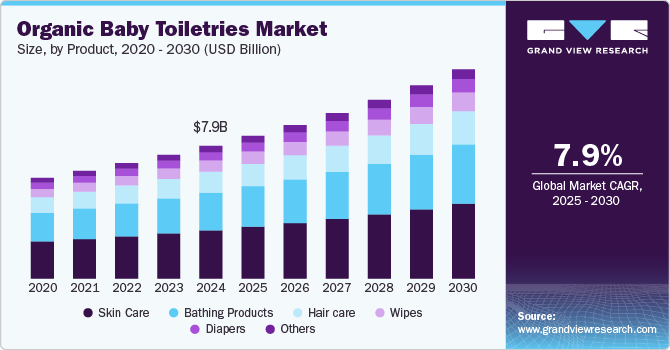
The global organic baby toiletries market size was estimated at USD 7,932.9 million in 2024 and is projected to reach USD 12,503.3 million by 2030, growing at a CAGR of 7.9% from 2025 to 2030. The organic baby toiletries industry is experiencing significant growth as parents increasingly recognize the advantages of using natural, chemical-free products for their little ones.
Key Market Trends & Insights
- In terms of region, North America was the largest revenue generating market in 2024.
- In terms of segment, skin care (lotions, oils, creams) accounted for a revenue of USD 7,932.9 million in 2024.
- Skin Care (lotions, oils, creams) is the most lucrative product segment registering the fastest growth during the forecast period.
Market Size & Forecast
- 2024 Market Size: USD 7,932.9 Million
- 2030 Projected Market Size: USD 12,503.3 Million
- CAGR (2025-2030): 7.9%
- North America: Largest market in 2024
Concerns about the potential hazards of synthetic chemicals have driven a strong preference for products free from parabens, artificial fragrances, and other harmful substances. This shift in consumer behavior has fueled rising demand in the baby toiletries industry as more parents seek safer, healthier alternatives.
Sustainability has also become a major factor propelling the organic baby toiletries industry. Parents now prioritize products that are not only safe for their babies but also environmentally friendly. As a result, brands are developing toiletries with natural ingredients and sustainable packaging. For instance, in October 2024, Pura, a prominent eco-friendly baby brand, partnered with Rumer Willis as its global creative partner and ambassador. Willis’s advocacy for non-toxic, certified allergy-safe products has bolstered Pura’s visibility in both the UK and U.S. markets.
Furthermore, rising disposable incomes, particularly in developing regions, have allowed parents to invest in premium-quality products within the baby toiletries industry. Urbanization and evolving lifestyles have contributed to the increasing demand for convenient and effective solutions in the baby care industry. The rapid growth of e-commerce platforms has also played a pivotal role, making it easier for parents to access a diverse range of organic baby toiletries while enabling smaller brands to reach a broader customer base and sustain industry growth.
Consumer Survey & Insights
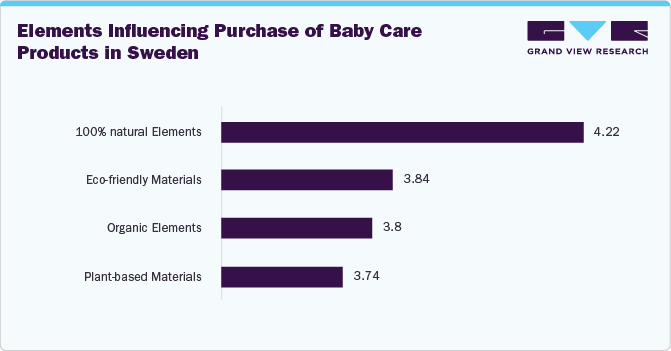
According to the study conducted by Jönköping University in 2022 on consumer buying behavior of baby care products in Sweden, the mean values for various elements influencing the purchase of baby care products are as follows: 100% natural elements (4.22), organic elements (3.80), plant-based materials (3.74), and eco-friendly materials (3.84). The mean value of 4.22 indicates that 100% natural elements moderately influence buyers. In contrast, organic, plant-based, and eco-friendly materials have little impact on consumers' buying behavior.
Survey results show that 8.8% of respondents stated that 100% natural elements do not at all influence their purchase decisions, while another 8.8% felt they had too little impact. About 20.6% indicated that these elements had little influence, 12.7% said they moderately influenced them, 11.8% found them highly influential, and 37.3% considered them very highly influential. This means more than a quarter of respondents are strongly swayed by 100% natural elements.
Moreover, Mylo, a leading pregnancy and parenting platform, conducted an online survey in 2023 to understand the preferences of parents when purchasing baby care products. The survey gathered responses from 625 parents across various geographic areas and demographics in India. The findings highlight key factors such as place and frequency of purchase, important criteria for selecting baby care products, a shift towards chemical-free products, and preferred brands.
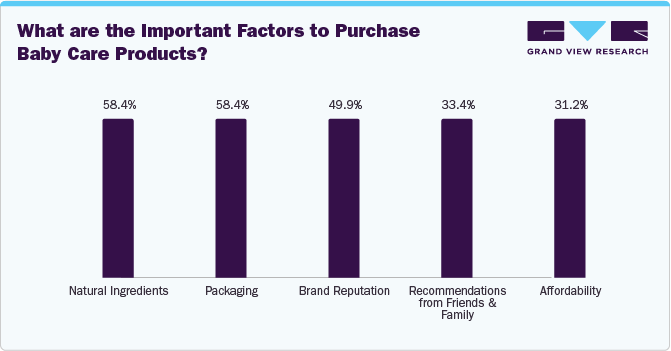
Natural ingredients were deemed the most important factor by 58.4% of parents when selecting baby care products. Brand reputation was crucial for 49.9%, while 33.4% relied on recommendations from friends and family. Affordability influenced 31.2% of parents, and 58.4% considered packaging a significant factor.
Product Insights
Organic baby skincare products accounted for a revenue share of over 36% in 2024, driven by growing consumer awareness about the benefits of using organic and natural baby skincare and the growing demand for safe and chemical-free baby care products. Moreover, companies are continuously developing new and improved organic baby products to meet the specific needs of infants and toddlers. For instance, Nala’s Baby, a natural baby skincare brand, was launched in Sainsbury’s on August 4, 2024. Renowned for its authentic and accessible products, the brand offers a range of dermatologist-approved, pediatrician-approved, cruelty-free, vegan, and fully recyclable skincare solutions for infants. Nala’s Baby is rapidly expanding across major UK retailers.
Demand for organic baby wipes is set to grow at a CAGR of 8.9% from 2025 to 2030. This growth is attributed to several factors, including the convenience and hygiene that wipes offer, as they make diaper changes and clean-ups easier for parents. In addition, the portability of wipes makes them essential for parents on the go. The availability of a variety of wipes, including organic and chemical-free options, appeals to health-conscious parents, while continuous product innovations, such as eco-friendly and biodegradable wipes, are attracting more consumers.
Distribution Channel Insights
Sales of organic baby toiletries through supermarkets & hypermarkets accounted for a revenue share of over 39% in 2024. Supermarkets and hypermarkets offer a convenient shopping experience for parents, allowing them to purchase a variety of baby care products in one place. In addition, these retail channels often provide attractive discounts and promotions, further driving sales of organic baby toiletries. The growing consumer preference for shopping at well-established and trusted retail stores also plays a role in the high revenue share of supermarkets and hypermarkets in this market segment.
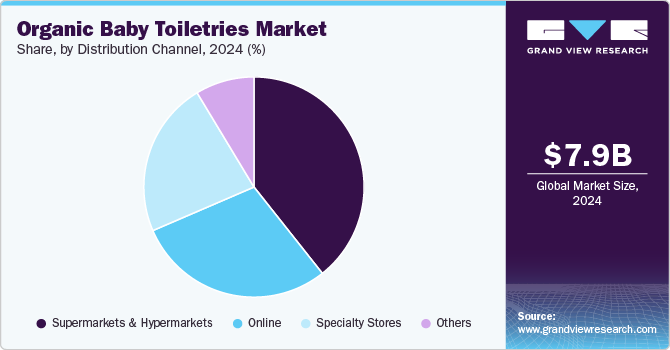
The online channel is set to grow at a CAGR of 8.6% from 2025 to 2030. The segment’s growth is attributed to the convenience and ease of online shopping, which allows parents to access a wide range of products from the comfort of their homes. In addition, the rise of e-commerce platforms and digital marketing strategies has made it easier for consumers to discover and purchase organic baby products. The availability of product reviews, ratings, and detailed descriptions online also helps consumers make informed purchasing decisions. Overall, the online channel is becoming an increasingly important sales avenue for organic baby toiletries.
Regional Insights
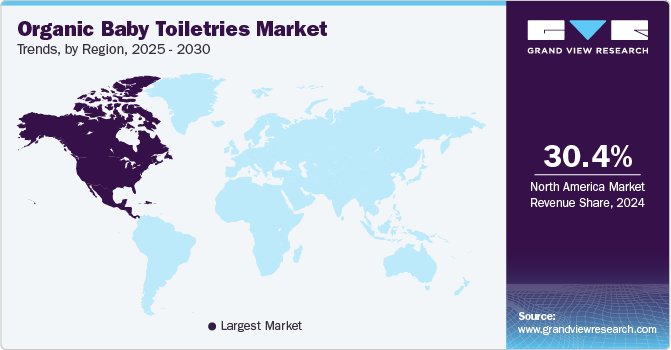
The organic baby toiletries industry in North America accounted for 30.4% of the global revenue share in 2024, attributed to the high consumer awareness about the benefits of organic products, increased disposable income, and a strong emphasis on health and wellness. In addition, the presence of well-established organic baby care brands and the growing trend of eco-friendly and sustainable products have contributed to the robust market demand in the region. The easy availability of these products through various retail channels, including supermarkets, hypermarkets, and online platforms, also plays a crucial role in driving market growth in North America.
In August 2023, Terra announced the launch of its premium plant-based diapers and wipes in the U.S. and Canada. Comprising 85% plant-based materials, Terra diapers provide 360-degree absorbency with over 12 hours of protection against wetness. Dermatologically tested, these products prevent diaper rash and feature skin-friendly fibers without harmful chemicals. The diapers utilize a backsheet made from 100% bamboo fiber and include sustainably sourced materials, ensuring eco-friendliness while delivering effective performance.
U.S. Organic Baby Toiletries Market Trends
The organic baby toiletries industry in the U.S. is expected to grow significantly from 2025 to 2030. The demand for eco-friendly and sustainable baby care products is on the rise, driving market growth. The presence of well-established organic baby care brands and the growing trend of online shopping also contribute to the robust market demand in the U.S.
Europe Organic Baby Toiletries Market Trends
The organic baby toiletries industry in Europe accounted for about 27% of the global organic baby toiletries industry in 2024. The presence of established organic baby care brands and the growing preference for chemical-free baby products have contributed to the market's robust performance in the region. Moreover, consumer awareness about the benefits of organic products, stringent regulations promoting the use of safe and natural ingredients, and a strong emphasis on sustainability and eco-friendly products have aided in the market growth.
In January 2024, the UAE founded baby care brand PureBorn, recognized for its hypoallergenic diapers made from up to 43% organic bamboo, and expanded its operations into Europe. Following a partnership with Swiss distributor Laboratoire Naturel, PureBorn launched a dedicated European website with country-specific portals, enabling seamless product access.
Asia Pacific Organic Baby Toiletries Market Trends
The organic baby toiletries industry in Asia Pacific is set to grow at a CAGR of 9.2% from 2025 to 2030. The region’s growth is attributed to the increasing consumer awareness about the benefits of organic and chemical-free products, rising disposable incomes, and the growing trend of health and wellness in the region. In addition, the expanding e-commerce sector in the Asia Pacific is making it easier for parents to access a wide range of organic baby products. The demand for eco-friendly and sustainable baby care products is contributing to the robust market growth in the region. For instance, Adorica Care, founded by Abhishek Pandey in 2023, offers a range of organic baby products designed to meet infants' needs and parents' preferences. With an emphasis on mildness and protection for delicate skin, Adorica Care provides hair oil, lotion, shampoo, and massage oil. Products are available on their official website and major e-commerce platforms.
Key Organic Baby Toiletries Company Insights
The organic baby toiletries industry is fragmented primarily due to the presence of several globally recognized players as well as regional players. Some prominent companies in this market are Earth Mama, California Baby, Nature’s Baby Organics, The Honest Company, Inc., Green People, and others.
-
Earth Mama Organics offers a range of organic baby toiletries, including Calendula Baby Oil, Organic Diaper Balm, Castile-Based Baby Wash, and Calendula Baby Lotion. These products are made with organic ingredients, free from artificial fragrances, preservatives, and harsh chemicals.
-
California Baby provides products such as Calendula Cream, Super Sensitive Shampoo & Bodywash, Broad Spectrum SPF 30+ Sunscreen, Natural Bug Blend Bug Repellent Spray, and Therapeutic Relief Eczema Shampoo & Bodywash. Their offerings are USDA-certified, free of synthetic fragrances, and manufactured in an FDA-registered, certified organic facility
Key Organic Baby Toiletries Companies:
The following are the leading companies in the organic baby toiletries market. These companies collectively hold the largest market share and dictate industry trends.
- Earth Mama
- California Baby
- Nature’s Baby Organics
- The Honest Company, Inc.
- Green People
- Burt's Bees Baby
- LittleTwig
- Erbaviva
- Babyganics
- Charlie Banana
Recent Developments
-
In November 2024, The Good Glamm Group completed the full acquisition of The Moms Co., having initially acquired a majority stake in 2021. This transaction marks the end of prior partial exits for the company's founders and investors. The financial terms of the final acquisition have not been disclosed.
-
In October 2023, Birch Babe, an organic beauty and skincare brand, launched the Birch Baby collection, which features three all-natural, vegan, and fragrance-free products. Each product is formulated with organic ingredients, ensuring safety for infants and efficacy for all family members. Furthermore, 1% of sales will support the David Suzuki Foundation, emphasizing the brand's commitment to sustainability and environmental conservation.
Organic Baby Toiletries Market Report Scope
Report Attribute
Details
Market size value in 2025
USD 8.53 billion
Revenue forecast in 2030
USD 12.50 billion
Growth rate (Revenue)
CAGR of 7.9% from 2025 to 2030
Actuals
2018 - 2023
Forecast period
2025 - 2030
Quantitative units
Revenue in USD million/billion, and CAGR from 2025 to 2030
Report coverage
Revenue forecast, company ranking, competitive landscape, growth factors, and trends
Segments covered
Product, distribution channel, region
Regional scope
North America, Europe, Asia Pacific, Latin America, and Middle East & Africa
Country scope
U.S, Canada, Mexico, Germany, UK, France, Italy, Spain, China, Japan, India, Australia & New Zealand, South Korea, Brazil, Argentina, South Africa, UAE
Key companies profiled
Earth Mama; California Baby; Nature’s Baby Organics; The Honest Company, Inc.; Green People; Burt's Bees Baby; LittleTwig; Erbaviva; Babyganics; Charlie Banana
Customization
Free report customization (equivalent up to 8 analysts working days) with purchase. Addition or alteration to country, regional & segment scope.
Pricing and purchase options
Avail customized purchase options to meet your exact research needs. Explore purchase options Global Organic Baby Toiletries Market Report Segmentation
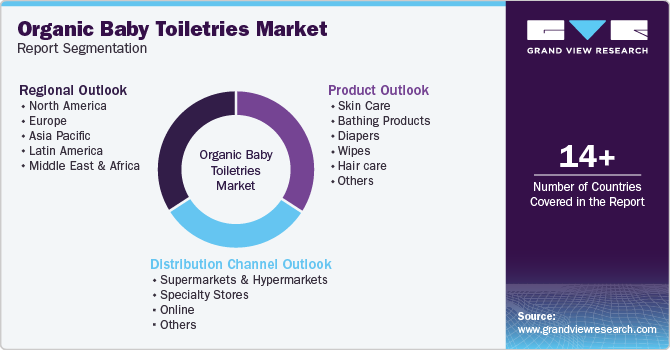
This report forecasts revenue growth at the global, regional, and country levels and provides an analysis of the latest industry trends and opportunities in each of the sub-segments from 2018 to 2030. For this study, Grand View Research has segmented the global organic baby toiletries market report based on product, distribution channel, and region:
-
Product Outlook (Revenue, USD Million, 2018 - 2030)
-
Skin Care
-
Bathing Products
-
Diapers
-
Wipes
-
Hair care
-
Others
-
-
Distribution Channel Outlook (Revenue, USD Million, 2018 - 2030)
-
Supermarkets & Hypermarkets
-
Specialty Stores
-
Online
-
Others
-
-
Regional Outlook (Revenue, USD Million, 2018 - 2030)
-
North America
-
U.S.
-
Canada
-
Mexico
-
-
Europe
-
UK
-
Germany
-
France
-
Italy
-
Spain
-
-
Asia Pacific
-
Japan
-
China
-
India
-
South Korea
-
Australia & New Zealand
-
-
Latin America
-
Brazil
-
Argentina
-
-
Middle East and Africa (MEA)
-
South Africa
-
UAE
-
-
Frequently Asked Questions About This Report
b. The global organic baby toiletries market was estimated at USD 7.93 billion in 2024 and is expected to reach USD 8.53 billion in 2025.
b. The global organic baby toiletries market is expected to grow at a compound annual growth rate of 7.9% from 2025 to 2030 to reach USD 12.50 billion by 2030.
b. North America dominated the organic baby toiletries market with a share of 30% in 2024. This is due to the high consumer awareness about the benefits of organic products, increased disposable income, and a strong emphasis on health and wellness.
b. Some of the key players operating in the organic baby toiletries market are Earth Mama; California Baby; Nature’s Baby Organics; The Honest Company, Inc.; Green People; Burt's Bees Baby; LittleTwig; Erbaviva; Babyganics; Charlie Banana
b. Factors driving the organic baby toiletries market are increasing parental awareness of natural products, concerns over chemical exposure, and a growing preference for eco-friendly options.

Share this report with your colleague or friend.
Need a Tailored Report?
Customize this report to your needs — add regions, segments, or data points, with 20% free customization.


ISO 9001:2015 & 27001:2022 Certified
We are GDPR and CCPA compliant! Your transaction & personal information is safe and secure. For more details, please read our privacy policy.
Trusted market insights - try a free sample
See how our reports are structured and why industry leaders rely on Grand View Research. Get a free sample or ask us to tailor this report to your needs.