
- Home
- »
- Electronic & Electrical
- »
-
North America Household Washer And Dryer Market Report, 2033GVR Report cover
![North America Household Washer And Dryer Market Size, Share & Trends Report]()
North America Household Washer And Dryer Market (2025 - 2033) Size, Share & Trends Analysis Report By Product, By Load Type, By Structure, By Type, By Capacity, By Price Range, By Technology, By Distribution Channel, By Region, And Segment Forecasts
- Report ID: GVR-4-68040-375-9
- Number of Report Pages: 110
- Format: PDF
- Historical Range: 2021 - 2024
- Forecast Period: 2025 - 2033
- Industry: Consumer Goods
- Report Summary
- Table of Contents
- Segmentation
- Methodology
- Download FREE Sample
-
 Download Sample Report
North America Household Washer And Dryer Market Summary
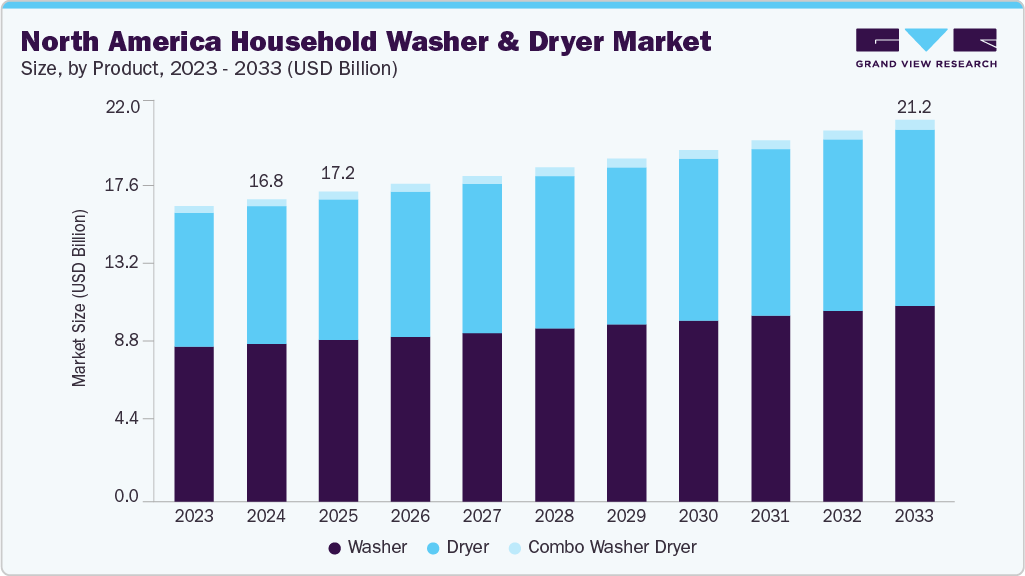
The North America household washer and dryer market size was estimated at USD 16.75 billion in 2024 and is projected to reach USD 21.18 billion in 2033, growing at a CAGR of 2.7% from 2025 to 2033. According to data from the U.S. Census Bureau, the proportion of households in the U.S. living in homes they own rose from 64.4% in 2018 to 65.8% in 2022. Meanwhile, in Canada, according to Canadian Statistics, the homeownership rate was 66.3% in 2022. This upward trend indicates a significant increase in homeownership rates across the region. With more individuals and families opting to invest in their own homes, there is a corresponding increase in the demand for household appliances like washers & dryers.
Moreover, the demand for all-in-one washer and dryer combos drives the market. An all-in-one washer-dryer combo is designed to wash and dry clothes within the same enclosed drum. Equipped with programmed controls, these devices can perform both functions in tandem or separately. These innovative appliances streamline laundry routines by eliminating the need to transfer damp clothes from the washer to the dryer.
There is an increase in spending on remodeling and renovations in homes across North America. According to the 2023 U.S. Houzz & Home Renovation Report, homeowners in the U.S. spent USD 3,000 on laundry rooms in 2022, up by around 50% from 2021. This included investment in replacing old washers & dryers with newer, more advanced, and efficient models.
Busy lifestyles and a growing emphasis on convenience encourage consumers to invest in appliances that save time and effort, such as washers and dryers with faster cycles and advanced features. In addition, innovations such as energy-efficient models, smart features, and automation contribute to market growth by enticing consumers to upgrade their appliances for improved performance and convenience.
All-in-one washer and dryer units are also renowned for their energy efficiency, consuming less power than traditional dryers. Moreover, these combination units offer a space-saving solution for the laundry area, particularly beneficial if consumers have limited space for two separate machines. Being ventless, they are not constrained by the need for an exhaust vent, allowing flexibility in placement along any wall with access to a water line, even within kitchens or bathrooms.
Consumer Insights for the North America Household Washer And Dryer Market:
Consumer trends and preferences in the market have evolved rapidly in recent years, driven by technological advancements, sustainability concerns, and changing lifestyle patterns. One prominent trend is the increasing demand for energy-efficient appliances. Consumers are becoming more environmentally conscious and are actively seeking products that can help them reduce their carbon footprint and lower utility bills. As a result, there is a growing preference for washers and dryers with high Energy Star ratings and features such as cold-water washing options and sensor-based drying cycles that optimize energy usage.
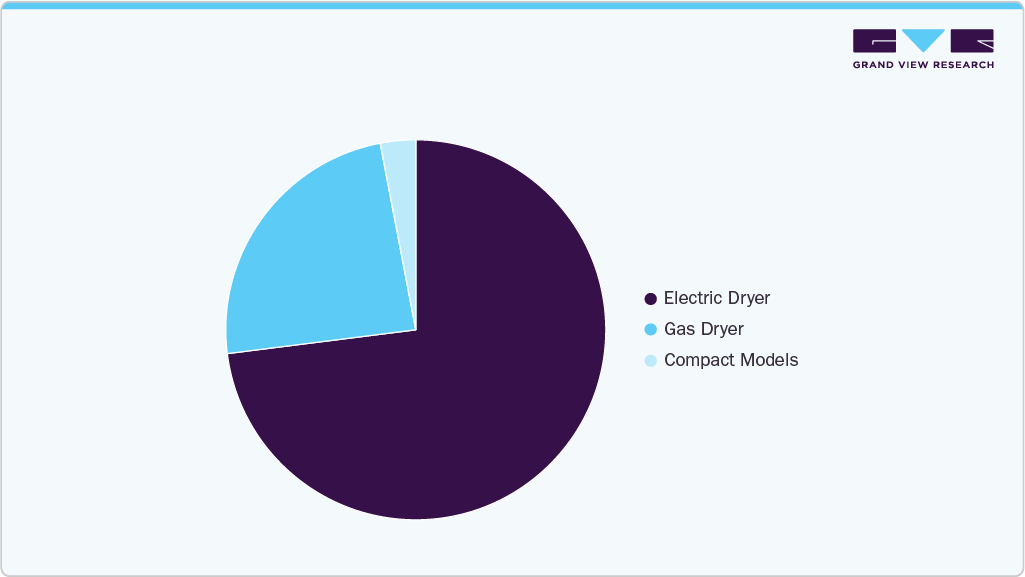
One key feature of Energy Star-certified dryers is using refrigerants with lower global warming potential (GWP). These dryers often use refrigerants like R-290, which have a much lower impact on global warming than traditional refrigerants like hydrofluorocarbons (HFCs).
Another significant trend is the rising integration of smart home technology. With the proliferation of smartphones and connected devices, consumers are increasingly looking for washers and dryers that can be controlled remotely via mobile apps or voice commands. Smart features such as Wi-Fi connectivity, remote monitoring, and notifications for cycle completion are becoming standard expectations among tech-savvy consumers who value convenience and efficiency in their household appliances.
In March 2024, GE Appliances debuted a new washing machine tailored to the preferences of Hispanic consumers in the U.S. Scheduled for release in April 2024 alongside a complementary dryer, the machine boasts customized features and a control panel available in Spanish. Targeting households where English is a second language, the appliance offers extra soaking, intense wash, and eco cold wash for energy efficiency and water level control, with a 4.5 cu. ft. capacity, the washing machine is priced at USD 799, aligning with the cost of the coordinating dryer featuring a Spanish display. GE Appliances aims for seamless integration into the lives of all Americans, prioritizing inclusivity and convenience.
Product Insights
Washer dominated the market, accounting for a revenue share of 52.2% in 2024. Due to increasingly hectic schedules, washing machines are one of every household's most prevalent home appliances. Moreover, the introduction of innovative technologies has changed the consumer perception of home appliances; these machines are no longer just utility products but a modern-day necessity. This shift in consumer perception has driven product innovation in the market. For instance, in July 2022, Samsung Electronics Co. Ltd. announced the expansion of its bespoke lineup with new AI-powered washers and dryers in the U.S. The Samsung Bespoke AI Laundry pair combines design-forward innovation with intelligent washing capabilities to fit consumers’ styles and simplify their cleaning routines.
Combo washer & dryer is anticipated to grow at a CAGR of 3.8% from 2025 to 2033. The compact nature of combo washer-dryers appeals to people living in smaller spaces, such as apartments, condos, or tiny homes, which are increasingly common in urban areas where space comes at a premium. With limited square footage, consumers seek appliances that can perform multiple functions without taking up excessive space, making combo washer-dryers an attractive choice. Combo washer-dryers offer the convenience of washing and drying functions in a single unit, eliminating the need to transfer clothes from one machine to another. This appeals to busy individuals and families who value time-saving solutions in their daily routines.
Load Type Insights
The top load washer & dryer segment accounted for a revenue share of 61.4% in 2024. Convenience plays a significant role in the popularity of these appliances. Top-load washers and dryers are known for their ease of use, with many consumers appreciating the simplicity of loading and unloading laundry from the top rather than bending down to load from the front. This feature appeals to a wide range of consumers, particularly people with mobility issues or those simply looking for a more user-friendly laundry solution. Secondly, the efficiency and effectiveness of top-load washer-dryer units contribute to their popularity.
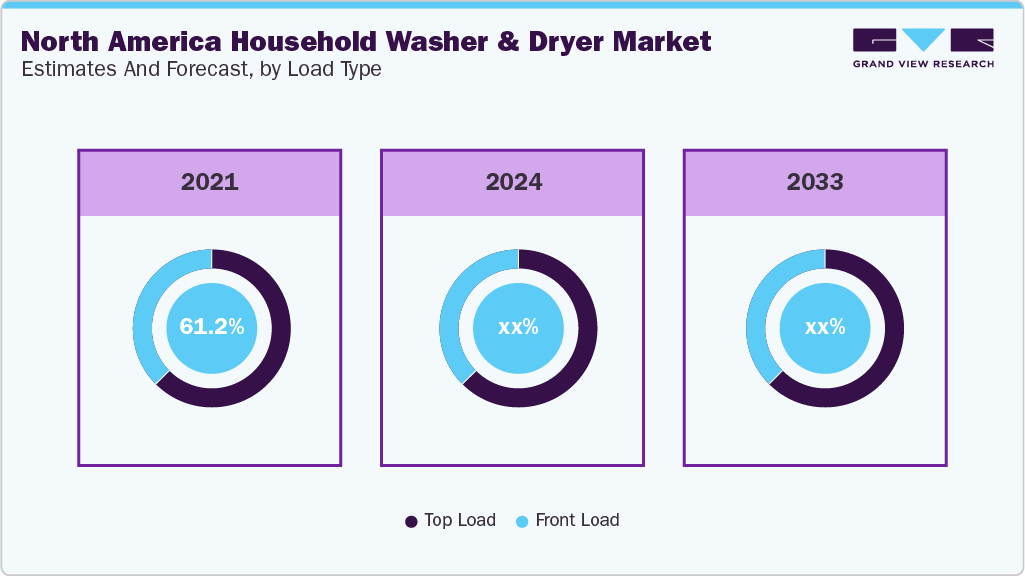
The front load washer & dryer segment is expected to grow at a CAGR of 3.2% from 2025 to 2033. North America has a growing demand for energy-efficient and sustainable household appliances. Front-load washers and dryers are known for their superior energy efficiency compared to top-load variants, as they typically use less water and electricity per cycle. With increasing concerns about environmental impact and rising energy costs, consumers are actively seeking appliances that can help reduce their carbon footprint and save on utility bills.
Structure Insights
The standalone washer & dryer segment accounted for a revenue share of 63.1% in 2024. Advancements in technology have led to the development of more energy-efficient and feature-rich standalone washers and dryers. Energy efficiency is a major consideration for consumers looking to minimize their environmental footprint and reduce utility costs. Modern standalone units often come equipped with advanced features such as smart connectivity, customizable wash cycles, and sensors that optimize water and energy usage, appealing to tech-savvy consumers seeking convenience and efficiency. Moreover, ample space is often available in larger homes and multi-story dwellings to accommodate separate laundry appliances, further fueling product demand.
The side-by-side washer and dryer segment is expected to grow at a CAGR of 2.2% from 2024 to 2033. This segment caters to consumers' evolving needs and preferences in North America. The growing awareness and emphasis on sustainability and eco-friendliness drive the adoption of energy-efficient appliances, including side-by-side washer and dryer units. Manufacturers increasingly focus on developing products that consume less energy and water, reducing environmental impact and lowering consumer utility bills.
Type Insight
The free-standing washer & dryers segment accounted for a revenue share of 66.5% in 2024. Freestanding washers and dryers can be placed anywhere with water, drainage, and electricity access. They do not require special installation like built-in units, making them suitable for various spaces, including apartments, rental homes, and even temporary setups. These appliances typically do not require professional installation or modifications to existing cabinetry or countertops, reducing both the time and costs associated with setup. Freestanding washers and dryers are generally portable, allowing for easy relocation. This is particularly useful for renters or homeowners who may move frequently.
The built-in washer & dryer segment is expected to grow at a CAGR of 3.2% from 2025 to 2033. Built-in units are designed to fit seamlessly into cabinets or closets, maximizing home floor space. This is particularly advantageous for smaller living spaces, such as apartments or condominiums. Integrating washers and dryers into cabinetry creates a streamlined and cohesive look in homes, enhancing their overall aesthetic appeal. They can blend in with the surrounding décor and architecture, creating a more organized space. Moreover, built-in units can be customized to match specific design preferences and requirements. Consumers can choose cabinetry, finishes, and configurations that complement their interior design scheme, creating a cohesive and personalized space.
Capacity Insights
The 8 kg to 12 kg segment accounted for a revenue share of 58.4% in 2024. Technological advancements have significantly driven the market growth for 8kg to 11kg capacity washer & dryer units. Manufacturers have incorporated innovative features, such as smart connectivity, energy-efficient designs, and advanced washing and drying capabilities. These technological advancements improve the appliances' efficiency and performance and enhance the user experience. Another driving factor is the increasing emphasis on energy efficiency and sustainability. Consumers are becoming more environmentally conscious and are seeking appliances that consume less energy and water. Many washer & dryer units with an 8kg to 11kg capacity now have energy-saving features, such as low water usage, shorter wash cycles, and higher energy efficiency ratings. This helps consumers reduce their utility bills and minimizes their environmental footprint.
Washer & dryer with a capacity of over 11 kg is expected to grow at a CAGR of 2.5% from 2025 to 2033. The increasing size of American households and the corresponding need for appliances that can efficiently handle larger loads of laundry are primary factors driving the market for washer-dryer units with a capacity of over 11kg. With families getting bigger or living in multigenerational households, the demand for washers and dryers to accommodate more clothes has surged. The driving force behind the popularity of washer & dryer units with a capacity of over 11kg is the growing emphasis on convenience and time-saving solutions. Larger machines allow users to complete more laundry in fewer cycles, reducing the time and effort required for household chores. This particularly appeals to busy families and individuals who value efficiency and convenience in managing their daily routines.
Price Range Insights
Washers & dryers ranging between USD 501 to USD 1,000 accounted for a revenue share of 36.8% in 2024. There is a growing emphasis on sustainability and eco-friendliness within the appliance industry. Many consumers are willing to invest more in exchange for energy-efficient and environmentally responsible appliances. Washers and dryers in the USD 500 to USD 1000 price range often come equipped with energy-saving technologies like sensor drying, which can help reduce energy consumption and lower utility bills over time. This eco-consciousness resonates with a significant portion of the consumer base, further driving demand within this price segment.
Washers & dryers ranging between USD 1,001 to USD 1,500 are expected to grow at a CAGR of 2.9% from 2025 to 2033. Consumers are increasingly seeking appliances that offer advanced features and technologies to simplify household chores and improve efficiency. Washers and dryers within this price range often have innovative functionalities such as energy-efficient settings, multiple wash/dry cycles, and smart connectivity options. These features appeal to modern consumers who prioritize appliance convenience and performance. Moreover, there is a growing emphasis on sustainability and environmental consciousness among consumers, leading to a preference for energy-efficient appliances. Washers and dryers in the USD 1,001 to USD 1,500 range often boast higher energy efficiency ratings, helping households reduce their utility bills and minimize their carbon footprint. This aligns with the eco-conscious mindset of many consumers today, driving the demand for greener home appliances.
Technology Insights
Conventional machines accounted for a revenue share of 71.4% in 2023. The market for conventional washers and dryers in North America is primarily driven by consumer demand for convenience, ease of use, and efficiency. Conventional models, although not as technologically advanced as their smart or connected counterparts, are still highly efficient in washing and drying clothes, meeting the basic needs of consumers. Brand loyalty and reputation play a major role in this segment. Established appliance manufacturers with a long history of producing reliable washers and dryers often enjoy a loyal customer base. Consumers trust these brands for their durability and performance, leading them to opt for conventional models from trusted manufacturers.
Smart machines are expected to grow at a CAGR of 3.9% from 2025 to 2033. The increasing adoption of smart home technologies is a growing trend across households in North America. Consumers seek more convenience and efficiency in their daily lives, so they turn to smart appliances offering remote monitoring and control capabilities. Smart washers and dryers fit this trend perfectly, allowing users to schedule laundry cycles, monitor energy usage, and receive smartphone alerts, enhancing convenience and efficiency. The proliferation of the Internet of Things (IoT) is a major factor driving the demand for smart appliances, including washers and dryers. These interconnected devices enable seamless communication between appliances, smartphones, and other smart home devices, creating a more integrated and streamlined user experience.
Distribution Channel Insights
The sales of washer & dryer through offline channel accounted for a revenue share of 80.7% in 2024. Consumers in North America pay attention to the product lifecycle and the price/value while purchasing a washer or dryer, and find retail shops the most convenient place to check products before making a purchase. Offline retail stores across the region house a wide range of washers and dryers from numerous leading brands to suit consumers' preferences and needs. In December 2021, Whirlpool Corporation announced the launch of top-load washing machines with 2-in-1 removable agitators in major retailers in the U.S. and across the globe. The company targets consumers and provides them with various options for upgraded products in the top-load washer category.
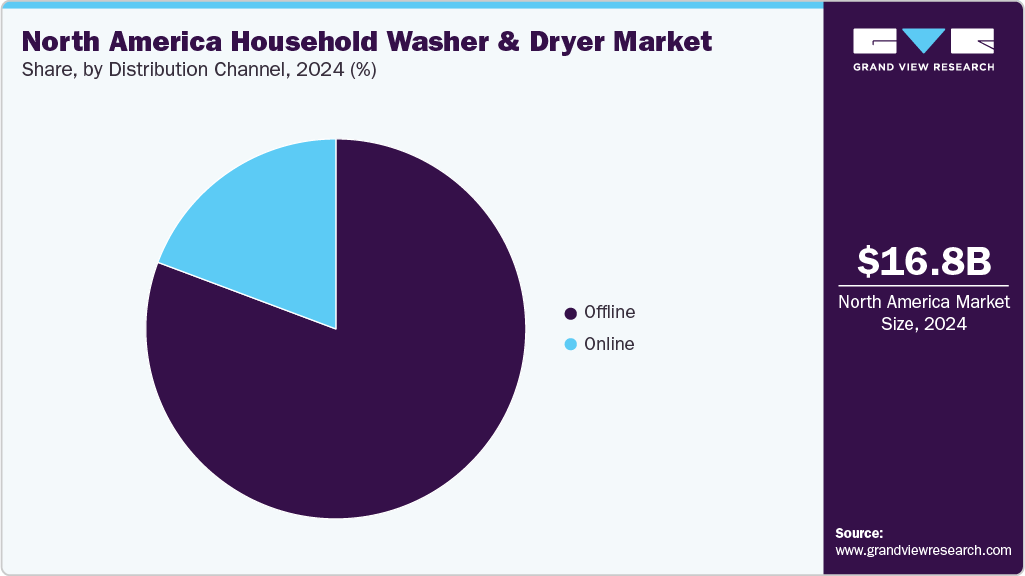
The sales of washer & dryer through online channels is expected to grow at a CAGR of 4.7% from 2025 to 2033. The online distribution channel is primarily driven by the convenience and accessibility that online shopping offers consumers. With the proliferation of e-commerce platforms and the increasing comfort of online transactions, consumers are turning to the Internet to research and purchase household appliances like washers and dryers. Many leading companies are entering the e-commerce marketplace to increase their customer base, streamline revenues, and decrease operational costs. For example, Whirlpool Corporation, Panasonic Corporation, and General Electric have a significant online and offline presence in the region. They are the leading manufacturers of washing machines and other electronic products.
Regional Insights
The household washer and dryer market in the U.S. held a market share of 91.7% in North America in 2024. The growing number of households in the U.S. significantly contributes to the rising demand for residential washing machines in the country. According to estimates released by the U.S. Census Bureau and the Department of Housing and Urban Development, the sales of new single‐family houses in August 2022 were at a seasonally adjusted annual rate of 685,000, 28.8% above the revised rate of 532,000 in July 2022.
Another important driver is the growing emphasis on sustainability and energy efficiency. With increasing awareness of environmental concerns and rising energy costs, consumers increasingly seek appliances that offer reduced water and energy consumption. As a result, there is a growing demand for Energy Star-rated washers and dryers that help consumers save money on utility bills and minimize their environmental footprint.
Canada Household Washer And Dryer Market Trends
The household washer and dryer market in Canada is expected to grow at a CAGR of 4.1% from 2025 to 2033. With more people spending time at home and prioritizing cleanliness and hygiene, there has been a surge in demand for household washers and dryers. Consumers are investing in appliances that can help them maintain a clean and sanitized living environment, driving sales within the market. Consumer preferences for aesthetics and design also influence purchasing decisions in Canada's washer and dryer market. Manufacturers are responding to this demand by offering a wide range of styles, colors, and finishes to complement various kitchen and laundry room aesthetics, catering to consumers' desire for appliances that perform well and enhance their homes' overall look and feel.
Key North America Household Washer And Dryer Company Insights
Key household washer and dryer companies primarily focus on innovation, energy efficiency, and smart technology integration. They invest in product development, strategic partnerships, and sustainable manufacturing practices to cater to evolving consumer preferences, expand their market presence, and enhance competitiveness across countries.
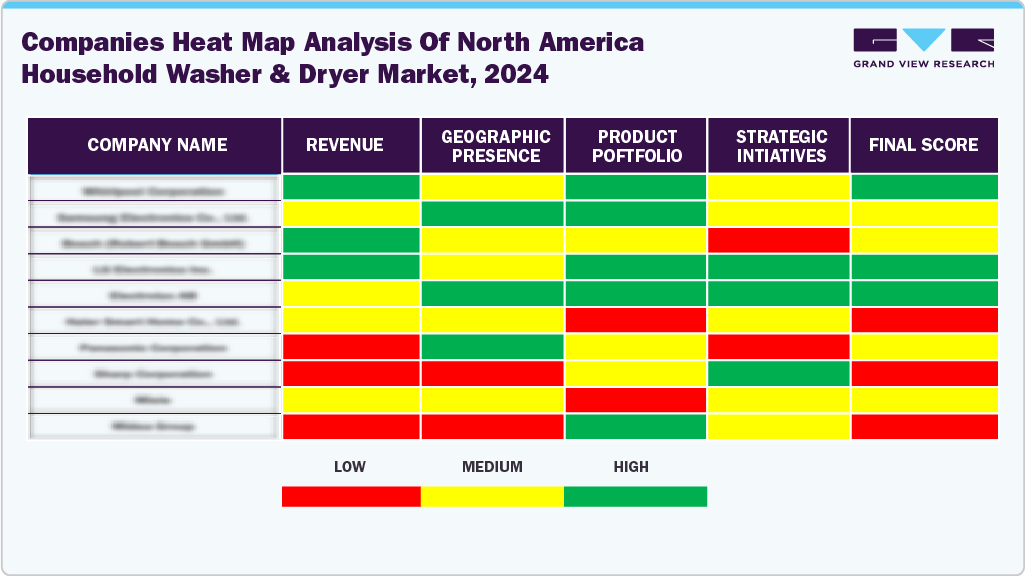
Key North America Household Washer And Dryer Companies:
- Electrolux AB
- Alliance Laundry System LLC
- GE Appliances (a Haier Company)
- Avanti Products
- Fisher & Paykel Appliances Ltd
- Kenmore (Transform Holdco LLC)
- LG Electronics Inc.
- Danby
- Miele
- Crosley
- Robert Bosch GmbH
Recent Developments
-
In April 2024, GE Appliances announced a new range of five top-load washing machines available under the GE and Hotpoint brands. This innovative lineup introduces the new Cold Plus cycle, which enhances the effectiveness of cold water washing to promote environmental sustainability and financial savings for consumers. By optimizing cold water washing, these machines enable users to lessen their carbon footprint and reduce utility expenses, all without compromising wash performance.
-
In January 2024, LG Electronics introduced the latest addition to its laundry lineup, the 5.0 cu. Ft. Mega Capacity Smart WashCombo All-in-One Washer/Dryer (WM6998HBA). This innovative appliance features Inverter HeatPump Technology and a Direct Drive Motor, completing a wash and dry cycle in under two hours without transferring clothes. Its space-saving ventless design offers energy efficiency, using up to 60 percent less energy than vented models.
-
In August 2023, Samsung Electronics Co., Ltd. announced its latest innovation, the BESPOKE AI Washer & Dryer Combo featuring Digital Inverter Heat Pump technology, at IFA 2023, a renowned consumer electronics trade show in Berlin. This model streamlines the laundry process by eliminating the need to transfer clothes between the washer and dryer, completing laundry loads in a single step.
North America Household Washer And Dryer Market Report Scope
Report Attribute
Details
Market size value in 2025
USD 17.16 billion
Revenue forecast in 2033
USD 21.18 billion
Growth rate
CAGR of 2.7% from 2025 to 2033
Actuals
2021 - 2024
Forecast period
2025 - 2033
Quantitative units
Volume in thousand units, revenue in USD million/billion, and CAGR from 2025 to 2033
Report coverage
Volume & revenue forecast, company ranking, competitive landscape, growth factors, and trends
Segments covered
Product, load type, structure, type, capacity, price range, technology, distribution channel, region
Country scope
U.S.; Canada
Key companies profiled
Electrolux AB; Alliance Laundry System LLC; GE Appliances (a Haier Company); Avanti Products; Fisher & Paykel Appliances Ltd; Kenmore (Transform Holdco LLC); LG Electronics Inc.; Danby; Miele; Crosley; Robert Bosch GmbH
Customization scope
Free report customization (equivalent up to 8 analysts’ working days) with purchase. Addition or alteration to country, regional & segment scope. Pricing and purchase options
Avail customized purchase options to meet your exact research needs. Explore purchase options North America Household Washer And Dryer Market Report Segmentation
This report forecasts volume & revenue growth at regional & country levels and provides an analysis of the latest trends and opportunities in each of the sub-segment from 2021 to 2033. For this study, Grand View Research has segmented the North America household washer and dryer market based on product, load type, structure, technology, type, capacity, price range, distribution channel, and region:
-
Product Outlook (Volume, Thousand Units; Revenue, USD Billion, 2021 - 2033)
-
Washer
-
Dryer
-
Combo Washer & Dryer
-
-
Load Type Outlook (Volume, Thousand Units; Revenue, USD Billion, 2021 - 2033)
-
Front Load
-
Top Load
-
-
Structure Outlook (Volume, Thousand Units; Revenue, USD Billion, 2021 - 2033)
-
Stacked
-
Side by Side
-
Standalone
-
-
Type Outlook (Volume, Thousand Units; Revenue, USD Billion, 2021 - 2033)
-
Freestanding
-
Built-In
-
-
Capacity Outlook (Volume, Thousand Units; Revenue, USD Billion, 2021 - 2033)
-
Up to 8 kg
-
8 kg to 11 kg
-
Above 11 kg
-
-
Price Range Outlook (Volume, Thousand Units; Revenue, USD Billion, 2021 - 2033)
-
Up to USD 500
-
USD 501 to USD 1,000
-
USD 1,001 to USD 1,500
-
USD 1,501 to USD 2,000
-
USD 2,001 to USD 3,000
-
Above USD 3,000
-
-
Technology Outlook (Volume, Thousand Units; Revenue, USD Billion, 2021 - 2033)
-
Smart Machines
-
Conventional
-
-
Distribution Channel Outlook (Volume, Thousand Units; Revenue, USD Billion, 2021 - 2033)
-
Offline
-
Online
-
-
Country Outlook (Volume, Thousand Units; Revenue, USD Billion, 2021 - 2033)
-
North America
-
U.S.
-
Canada
-
-
Frequently Asked Questions About This Report
b. The North America household washer and dryer market size was estimated at USD 16.75 billion in 2024 and is expected to reach USD 17.16 billion in 2025.
b. The North America household washer and dryer market is expected to grow at a compounded growth rate of 2.7% from 2025 to 2033 to reach USD 21.18 billion by 2030.
b. Washers dominated the North America household washer & dryer market with a share of 52.2% in 2024. With growing concerns over environmental impact, consumers are increasingly seeking washers that offer higher energy efficiency ratings and utilize less water.
b. Some key players operating in North America household washer & dryer market include Electrolux AB; Alliance Laundry System LLC; GE Appliances (a Haier Company); Avanti Products; Fisher & Paykel Appliances Ltd; Kenmore (Transform Holdco LLC); LG Electronics Inc.; Danby; Miele; Crosley; Robert Bosch GmbH; Samsung Electronics America, Inc.; ASKO; Midea; and Whirlpool Corporation.
b. Innovations such as energy-efficient models, smart features, and automation contribute to market growth by enticing consumers to upgrade their appliances for improved performance and convenience.


Share this report with your colleague or friend.
Need a Tailored Report?
Customize this report to your needs — add regions, segments, or data points, with 20% free customization.


ISO 9001:2015 & 27001:2022 Certified
We are GDPR and CCPA compliant! Your transaction & personal information is safe and secure. For more details, please read our privacy policy.
Trusted market insights - try a free sample
See how our reports are structured and why industry leaders rely on Grand View Research. Get a free sample or ask us to tailor this report to your needs.












