Italy Pest Control Products Market Trends
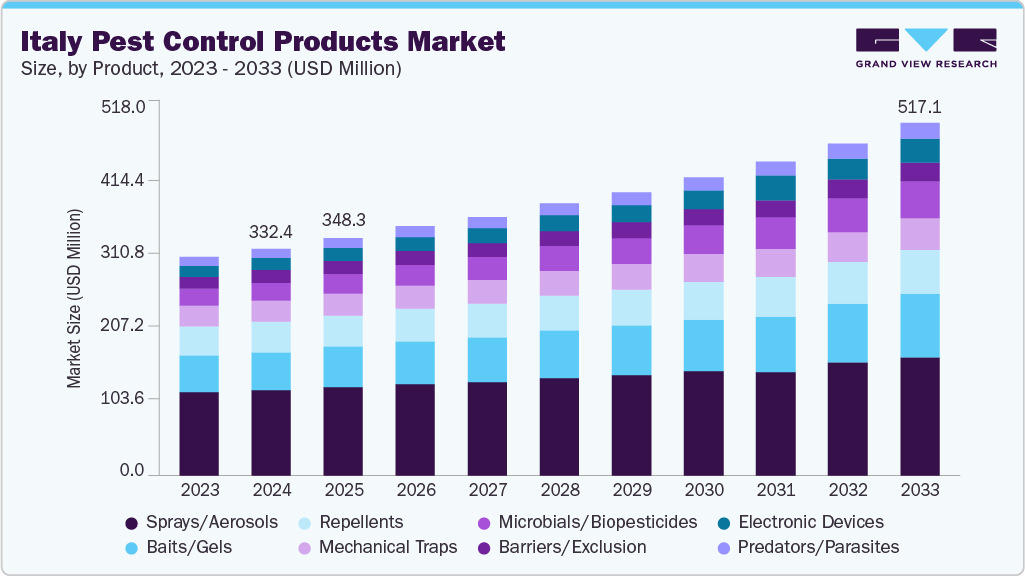
The Italy pest control products market size was estimated at USD 332.4 million in 2024 and is projected to reach USD 517.1 million by 2033, growing at a CAGR of 5.1% from 2025 to 2033. Climate variability and warming temperatures are driving measurable shifts in pest ecology across Italy, and companies are responding by expanding product portfolios and operational capacity. Warmer winters and altered precipitation patterns have extended the active seasons for mosquitoes, ticks, and several agricultural pests in northern and central regions, increasing demand for both public-health vector control solutions and season-long agricultural treatments. Firms that supply insecticides, larvicides, and integrated vector-management kits have therefore seen higher order volumes from municipal authorities and large agribusinesses.
Regulatory constraints at the EU and national levels impose a material restraint on the market by restricting permitted active substances, shaping permissible product claims, and increasing compliance costs for manufacturers and distributors. EU chemical-safety frameworks (REACH, CLP) and pesticide authorization processes require exhaustive dossiers, residue studies, and post-market surveillance, raising barriers to entry for smaller innovators and elevating the time and cost to bring new chemistries to Italy's market.
Political dynamics have added further uncertainty: recent debates and policy shifts at the European level (including proposals and revisions around sustainable use of pesticides) produce provisional pauses or renegotiations that affect procurement cycles, farmer adoption plans, and municipal vector-control budgets. In practice, manufacturers face a dual challenge of meeting stricter environmental and human-health requirements while navigating evolving policy proposals and stakeholder protests that can prompt regulatory recalibration in the Italy pest control products industry.
Italy’s concentrated high-value cropping systems, viticulture, horticulture, and specialty fruits and vegetables, sustain persistent demand for crop protection inputs, thereby driving the Italy pest control products industry. Producers of premium exports and protected-cultivation players require reliable insecticides, fungicides, and rodenticides to protect yield quality and meet strict phytosanitary standards; this creates a steady commercial channel for manufacturers and distributors. As growers prioritize product efficacy and residue management (for export compliance), the agricultural intensity of Italy’s value chains continues to act as a structural demand driver for the pest control products industry.
Consumer Insights
Italian consumers increasingly prioritize the health implications of pest control products, especially in households with children and pets. Biocides and insecticides demonstrating low toxicity, residue-free performance, and compliance with EU safety standards see stronger adoption. The surge of biological and botanical-based formulations (such as pheromone traps and microbial insecticides) reflects this preference. For example, the 2025 launch of Sumifly (Sumitomo Chemical Italia), a bioinsecticide targeting whiteflies and thrips, was marketed on its low toxicity and safety for beneficial insects, directly appealing to consumer safety concerns.
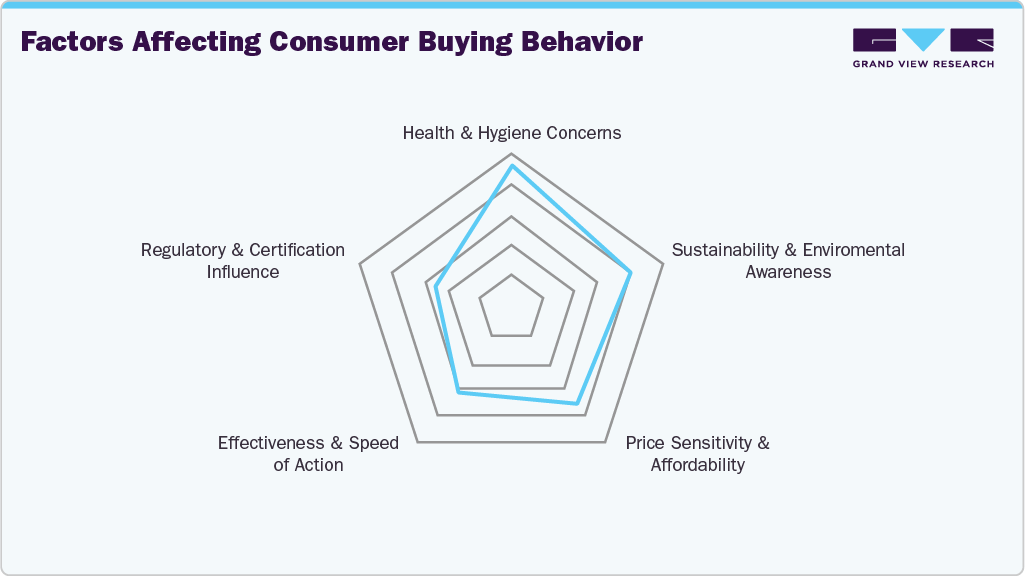
Italy’s strong participation in EU environmental policies (such as the European Green Deal and Farm to Fork strategy) significantly shapes consumer expectations. Buyers, both households and professional users, lean toward biopesticides, pheromone traps, and natural fumigants that align with sustainability objectives. A 2025 field trial in Sicily under the LIFE NextFUMIGREEN project demonstrated consumer and farmer demand for natural fumigation alternatives, underscoring that sustainability has become a purchasing driver.
While eco-friendly solutions are gaining traction, affordability still heavily influences consumer decisions. Price-sensitive consumers (especially in rural and suburban Italy) balance cost with effectiveness, often choosing generic chemical products over branded biologicals if budget constraints exist. At the same time, professionals and cooperatives look for multi-purpose products or bulk packaging that reduces per-application cost. Reports on Italy’s crop protection chemicals market emphasize steady demand for cost-effective conventional insecticides alongside premium biopesticides, reflecting this dual behavior.
Product Insights
Pest control sprays/aerosols accounted for a revenue share of 37.38% in 2024, driven by their ability to deliver immediate, versatile knockdown for a wide array of end users (households, foodservice, and facility managers) and therefore capture a large portion of routine, on-demand purchases. Their convenience (ready-to-use cans and portable applicators), broad retail availability (supermarkets, DIY chains, and ecommerce), and the regulatory familiarity of long-established formulations make them the default choice when speed and ease of application matter.
The microbials/biopesticides product category is expected to grow at a CAGR of 8.1% from 2025 to 2033, driven by regulatory and buyer-driven displacement of conventional chemistries: tighter EU residue limits, retailer sustainability requirements, and growing demand from export-oriented growers compel rapid adoption of low-residue, biologically based protections. This regulatory/market pressure creates a favorable commercialization pathway for microbial agents, pheromones, and botanical actives that meet resistance-management and residue-compliance needs. So manufacturers accelerate launches and field trials.
Pest Type Insights
The flying insects category by pest type accounted for a revenue share of 35.61% of the Italy pest control products industry in 2024 due to heightened public-health demand and visible nuisance effects: recent increases in vector activity (mosquitoes that transmit West Nile, dengue and chikungunya) pushed municipal control programs, hospitality operators, and households to purchase repellents, fogging services and space-spray products at scale.
The crawling insects category is expected to grow at a CAGR of 5.6% from 2025 to 2033 in the Italy pest control products industry. Urbanization and intensified food-industry hygiene requirements drive the projected rapid growth for crawling-insect control: densely occupied residential blocks, expanding logistics/food-processing facilities, and stricter retail/restaurant audit standards create persistent demand for baits, gels, and monitoring systems for cockroaches and other crawling pests.
Control Mechanism Insights
Chemical pest control accounted for a revenue share of 67.67% in 2024, driven by incumbent chemistries still providing cost-effective, broad-spectrum performance across multiple pests and large application footprints (agriculture, warehouses, and urban vector programs). Established registration dossiers, economies of scale in manufacture, and familiarity among applicators shorten buying cycles and reduce perceived technical risk, so procurement committees and retailers continue to allocate the bulk of volume spent on chemical formulations despite growing interest in alternatives.
Biological pest control is expected to grow at a CAGR of 7.5% from 2025 to 2033, driven by the convergence of supply-chain customer demand and policy incentives: large retailers, food processors, and export growers now contractually require reduced synthetic residues and prefer proof-of-sustainability, creating a premium pull for biocontrol. This commercial pull lowers entry barriers for biological innovations (microbial formulations, parasitoids, pheromones). It accelerates buyer trials and multi-year adoption, yielding a higher growth rate for biological control relative to legacy chemicals.
End Use Insights
B2B end users accounted for a revenue share of 78.12% of the Italy pest control products industry in 2024 due to institutional purchasers (food processors, hotel chains, municipalities, and agribusinesses) buying at scale, requiring certified products for compliance, and purchasing recurring service contracts that bundle products with monitoring and technical services. These high-value, recurrent contracts concentrate revenue on the B2B channel; corporate procurement also favors suppliers with registration support and traceability records, reinforcing incumbent supplier relationships and larger order sizes versus one-off retail consumer purchases.
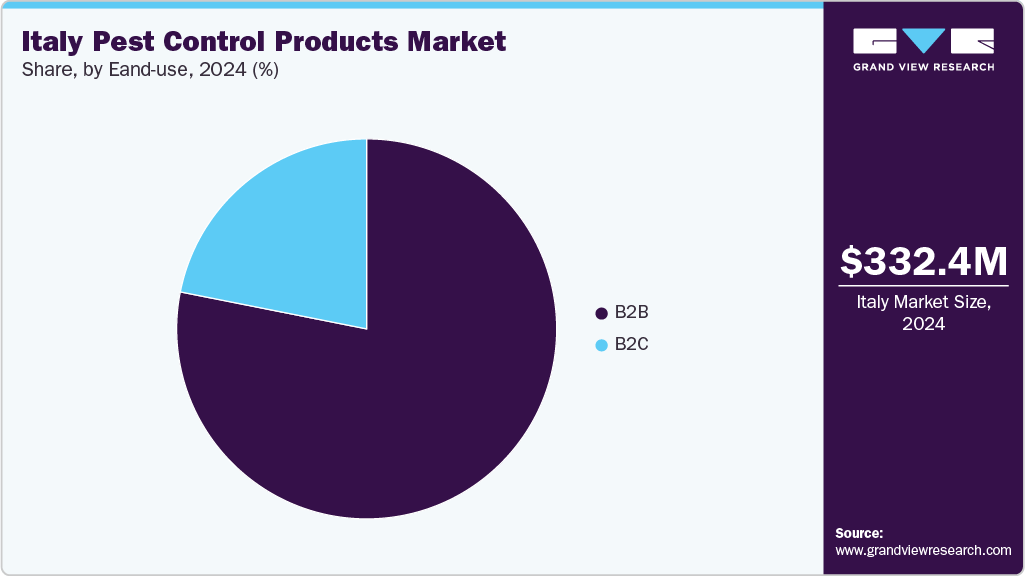
The B2C end user category is expected to grow at a CAGR of 7.3% from 2025 to 2033, propelled by behavioral shifts toward do-it-yourself solutions, expanded ecommerce penetration, and rising health/safety awareness that drives more frequent household purchases of repellents, sprays, and plug-in devices. The combination of easier online access to product information and direct-to-consumer offerings (subscription refills, eco-labelled botanicals) reduces switching friction and raises per-household spend, so, even from a smaller base, the residential channel is poised to post the fastest percentage growth as DIY adoption, product innovation, and digital retailing accelerate.
Key Italy Pest Control Products Company Insights
The Italian market sits at the intersection of two adjacent industries, crop protection (agrochemicals/biopesticides) and professional/consumer biocides (rodenticides, insecticides, disinfectants)-and is served by a mix of global agrochemical majors and specialised Italian manufacturers/distributors. Global leaders (Bayer, BASF, Corteva, Syngenta, and others) dominate technologically intensive crop-protection segments, while Italian specialists (Isagro, Sipcam Oxon, Colkim, Xeda, and peers) capture niche, formulation, post-harvest, and professional pest-management product demand.
Suppliers and local distributors have increased field trials and demonstration plots to prove efficacy under Italian agroecological conditions; several multinational and domestic firms now co-develop microbial agents, pheromone traps, and botanical extracts tailored to vineyards and greenhouse vegetables. Retail and cooperative channels actively promote integrated pest management (IPM) packages that place biopesticides as first-line tools, reserving synthetic chemistries as a last resort. This repositioning accelerates product uptake and creates recurring revenue through subscription-style supply agreements. Investors and product developers cite Italy’s export orientation and consumer sensitivity to residues as commercial rationales for prioritizing biopesticide launches.
Key Italy Pest Control Products Companies:
- BASF SE
- Syngenta Group
- Bayer AG
- Corteva Agriscience
- ISAGRO S.p.A.
- Zapi Industrie Chimiche S.p.A.
- Sariaf Gowan S.p.A.
- Chemia S.p.A.
- Colkim S.r.l.
- Ferbi S.r.l.
Recent Developments
-
In March 2025, Sumitomo Chemical Italia unveiled Sumifly, a bioinsecticide based on spores of Paecilomyces fumosoroseus (strain FE 9901). Registered in the EU, it targets whiteflies and thrips (especially eggs and larvae), with secondary activity against aphids, caterpillars, and some mites.
-
In February 2024, FMC Corporation enhanced its Italy-focused biopesticide lineup, emphasizing control of aphids and other pests impacting key Italian crops like olives and citrus. This expansion aligns with growing demand for environmentally friendly and organic pest control solutions.
Italy Pest Control Products Market Report Scope
|
Report Attribute
|
Details
|
|
Market size in 2025
|
USD 348.3 million
|
|
Revenue forecast in 2033
|
USD 517.1 million
|
|
Growth rate (revenue)
|
CAGR of 5.1% from 2025 to 2033
|
|
Actuals
|
2021 - 2024
|
|
Forecast period
|
2025 - 2033
|
|
Quantitative units
|
Revenue in USD million/billion, and CAGR from 2025 to 2033
|
|
Report coverage
|
Revenue forecast, company ranking, competitive landscape, growth factors, and trends
|
|
Segments covered
|
Product, pest type, control mechanism, end use
|
|
Country scope
|
Italy
|
|
Key companies profiled
|
BASF SE; Syngenta Group; Bayer AG; Corteva Agriscience; ISAGRO S.p.A.; Zapi Industrie Chimiche S.p.A.; Sariaf Gowan S.p.A.; Chemia S.p.A.; Colkim S.r.l.; Ferbi S.r.l.
|
|
Customization
|
Free report customization (equivalent up to 8 analysts working days) with purchase. Addition or alteration to country, regional & segment scope
|
|
Pricing and purchase options
|
Avail customized purchase options to meet your exact research needs. Explore purchase options
|
Italy Pest Control Products Market Report Segmentation
This report forecasts revenue growth at the country’s level and provides an analysis of the latest industry trends and opportunities in each of the sub-segments from 2021 to 2033. For this study, Grand View Research has segmented the Italy pest control products market report based on product, pest type, control mechanism, and end use:
-
Product Outlook (Revenue, USD Million, 2021 - 2033)
-
Sprays/Aerosols
-
Baits/Gels
-
Repellents
-
Predators/Parasites
-
Microbials/Biopesticides
-
Barriers/Exclusion
-
Mechanical Traps
-
Electronic Devices
-
Pest Type Outlook (Revenue, USD Million, 2021 - 2033)
-
Flying Insects
-
Crawling Insects
-
Rodents
-
Others (Birds, etc.)
-
Control Mechanism Outlook (Revenue, USD Million, 2021 - 2033)
-
Chemical
-
Physical/Mechanical
-
Biological
-
End Use Outlook (Revenue, USD Million, 2021 - 2033)
-
B2C
-
Supermarkets and Hypermarkets
-
Pharmacies & Drugstores
-
Home Improvement & Hardware Stores
-
E-commerce/Online
-
Others (Grocery Stores, Department Stores, etc.)
-
B2B
-
Direct Sales
-
Distributors & Wholesalers
-
Agricultural Supply Stores & Co-operatives
-
Commercial & Institutional E-procurement Platforms
-
Others (Government Procurement Programs, etc.)
Frequently Asked Questions About This Report
b. The Italy pest control products market was estimated at USD 332.4 million in 2024 and is expected to reach USD 348.3 million in 2025.
b. The Italy pest control products market is expected to grow at a compound annual growth rate of 5.1% from 2025 to 2033 to reach USD 517.1 million by 2033.
b. The chemical pest control hold the largest market share in the Italy pest control products market due incumbent chemistries still provide cost-effective, broad-spectrum performance across multiple pests and large application footprints (agriculture, warehouses, and urban vector programs).
b. Key players in the Italy pest control products market are BASF SE, Syngenta Group, Bayer AG, Corteva Agriscience, ISAGRO S.p.A., Zapi Industrie Chimiche S.p.A., Sariaf Gowan S.p.A., Chemia S.p.A., Colkim S.r.l., Ferbi S.r.l., among others.
b. Key factors that are driving the Italy pest control products market growth include rising climate variability and warming temperatures, and shift toward biologicals and low-toxicity solutions.

 Download Sample Report














