- Home
- »
- Market Trend Reports
- »
-
Europe Vitamin D Supplements Market - Retailer Landscape Analysis
![Europe Vitamin D Supplements Market - Retailer Landscape Report]()
Europe Vitamin D Supplements Market - Retailer Landscape Analysis
- Published: Nov, 2025
- Report ID: GVR-MT-100521
- Format: PDF/Excel databook
- No. of Pages/Datapoints: 20
- Report Coverage: 2024 - 2030
Report Overview
The Europe vitamin D supplements market continues to demonstrate consistent growth, supported by aging population, increased health awareness, and a growing consumer shift towards wellness. This rise in demand reflects the broader trend of consumers proactively seeking to improve their health through dietary supplements. Notably, the market has become more diversified, with pharmacies and drugstores maintaining their position as key players due to their association with professional guidance and credibility. These outlets still hold a significant share, especially through pharmacist-led recommendations and the increasing presence of private-label products. However, supermarkets, hypermarkets, and online platforms are emerging as increasingly important channels, reshaping the market dynamics by offering greater convenience and accessibility.
Europe's mature regulatory environment plays a pivotal role in ensuring product safety and consumer trust. Under the European Food Safety Authority (EFSA), stringent guidelines for product claims provide a robust foundation for the market. Retailers are aligning their assortments with rising consumer preferences for clean-label, vegan, and clinically supported products. As consumer interest shifts towards personalized wellness, transparency, and sustainability have become crucial elements in product offerings. Brands that emphasize eco-friendly packaging and ethical sourcing are tapping into an increasingly conscientious consumer base.
Within Europe's largest markets Germany, the U.K., France, Italy, and Spain pharmacies and drugstores dominate the value share of the vitamin D supplements market. The importance of pharmacist-led recommendations in these regions cannot be overstated, with consumers relying on trusted advice when making health-related purchases. On the other hand, online and direct-to-consumer (D2C) channels are seeing the fastest growth, driven by the rise of subscription models, health-tracking apps, and influencer-led marketing. This shift points to a broader trend where consumers seek both convenience and personalized health solutions, making e-commerce a growing segment of the market.
Supermarkets and hypermarkets, while more traditional in their approach, are evolving their strategies to capture more of the wellness-conscious shopper segment. They are increasingly promoting wellness aisles, offering bundled promotions, and rolling out seasonal offerings targeted at family shoppers and impulse buyers. With the increase in consumer interest in health and wellness, retailers are adapting their strategies to cater to the changing landscape, where convenience, trust, and personalized experiences are key to capturing and maintaining consumer loyalty. The future of the vitamin D supplements market in Europe will likely be shaped by these evolving retail strategies and the growing demand for high-quality, transparent, and sustainable products.
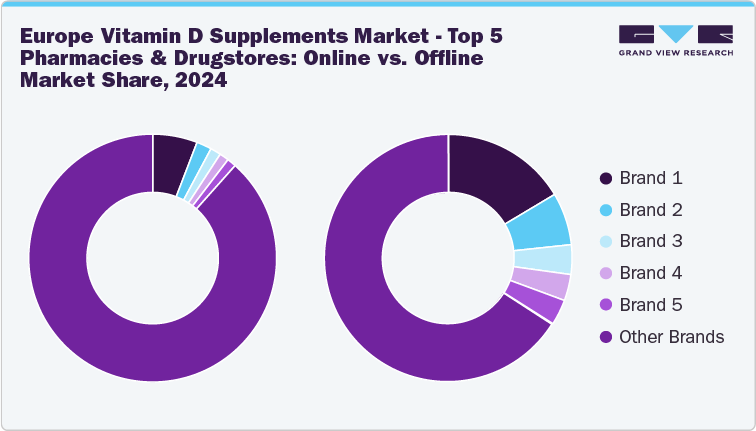
Europe vitamin D supplements market: Retail Sales by Top 5 Brands in Pharmacies & Drug Stores, 2024
Rank
Pharmacy & Drug Store Brand
Vitamin D Supplements Offline Revenue (USD Million)
Vitamin D Supplements Online Revenue (USD Million)
#1
Brand 1
-
-
#2
Brand 2
-
-
#3
Brand 3
-
-
#4
Brand 4
-
-
#5
Brand 5
-
-
Strategies and Recent Development
Pharmacies and drugstores have increasingly turned to digital platforms to sell vitamin D supplements, especially with the growing shift towards online shopping. They are focusing on offering subscription services for vitamins, ensuring regular replenishment for consumers. This model helps retailers establish customer loyalty and creates a continuous revenue stream. Consumers, especially health-conscious ones, are attracted to subscription models because of the convenience and the ability to personalize their wellness regimes. Many brands now allow customers to tailor their supplement needs based on health goals or personalized health data. This is especially relevant for D2C brands, which are leveraging health-tracking apps to promote vitamin D products, integrate with health routines, and create a more holistic wellness experience.
As consumer demand for clean, ethical, and natural products increases, retailers are responding by expanding their clean-label and vegan vitamin D options. Vitamin D supplements are increasingly being marketed as plant-based (especially Vitamin D3 sourced from lichen rather than animals), with an emphasis on being free from additives, gluten, and artificial preservatives. Many consumers, particularly in the younger age group, are more likely to trust brands that prioritize sustainability and ethical sourcing. Retailers are aligning their product offerings to these values by stocking more plant-based vitamin D products and focusing on clear labeling that highlights organic, non-GMO, and eco-friendly certifications.
Retailers are capitalizing on the seasonality of vitamin D consumption, particularly in countries with less sunlight during the winter months. Campaigns are tailored around health-conscious seasons, where vitamin D demand peaks, such as in autumn and winter when consumers are more likely to be concerned about deficiency due to reduced sun exposure. Retailers are creating special promotions or bundles that encourage consumers to stock up during these periods. Additionally, products are marketed with a focus on health applications, such as supporting bone health, immune support, and general wellness common consumer concerns that drive vitamin D supplement purchases.
Europe vitamin D supplements market: Market Share of Key Supermarkets & Hypermarkets, 2024
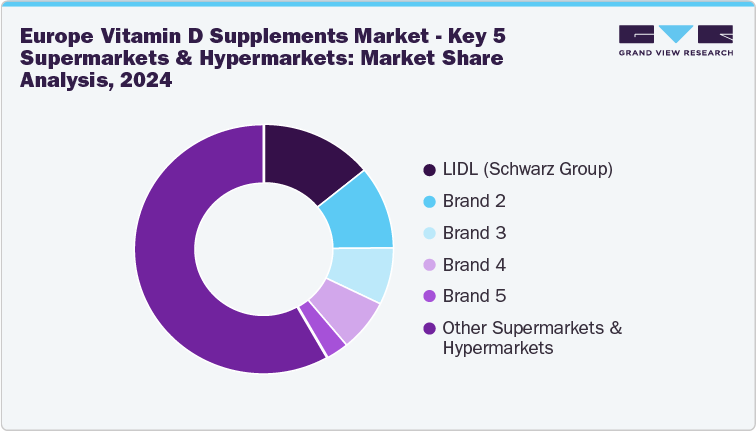
Lidl (Schwarz Group), one of Europe’s largest supermarket chains with over 12,000 stores across 31 countries, has also established a dominant presence in the Vitamin D supplements market. Leveraging its extensive retail network, value-driven pricing strategy, and aggressive private-label approach, Lidl has effectively positioned itself as a key player in the vitamin D category within the broader dietary supplements market. The retailer offers a range of vitamin D products ranging from traditional pills and soft gels to vegan options under its own private labels such as Vemondo (plant-based) and IronMaxx (sports nutrition). These products are priced competitively, making them accessible to a wide range of consumers who prioritize affordability without compromising on quality.
Lidl’s strength lies in its robust logistics network, enabling quick stock turnover and consistent supply of vitamin D supplements across its stores. The company's aggressive expansion strategy and growing e-commerce infrastructure, including features such as online ordering and click-and-collect services, further bolster its position in the vitamin D segment. Lidl’s focus on private-label supplements not only drives customer loyalty but also allows for pricing flexibility, making its products highly competitive in the mass-market segment. As consumers increasingly seek affordable, high-quality vitamin D supplements, Lidl's strategic approach ensures it remains a leading player, delivering strong access and pricing advantages unmatched by many of its competitors.
Europe vitamin D supplements market: Market Share of Key Pharmacies, 2024
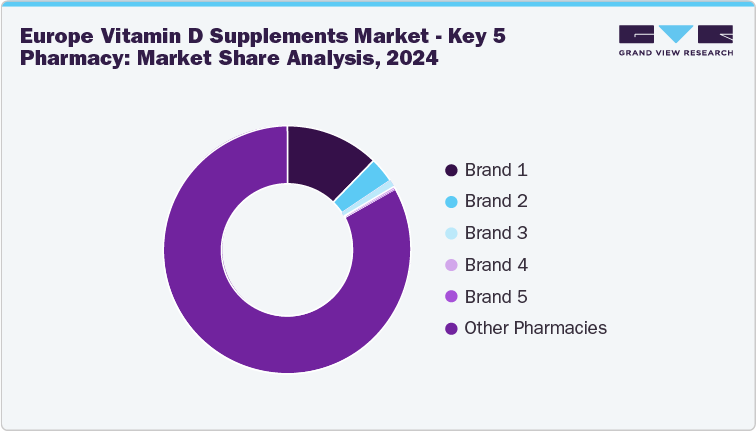
The top five pharmacy chains in Europe BENU Pharmacy, Brand 2, Brand 3, Brand 4, and Brand 5, lead the continent’s vitamin D supplements retail segment by combining trusted healthcare expertise with strong omnichannel capabilities. Pharmacies in Europe are increasingly positioning vitamin D supplements as not only general wellness products but also as targeted solutions based on seasonal and physiological factors. For example, in Ireland, pharmacies are advising consumers especially older adults, individuals with darker skin, and those with limited sun exposure to take vitamin D supplements due to the documented "vitamin D winter" period, when UVB exposure is insufficient for natural synthesis of the vitamin. This trend highlights the evolving role of pharmacies in addressing seasonal health challenges and promoting proactive wellness.
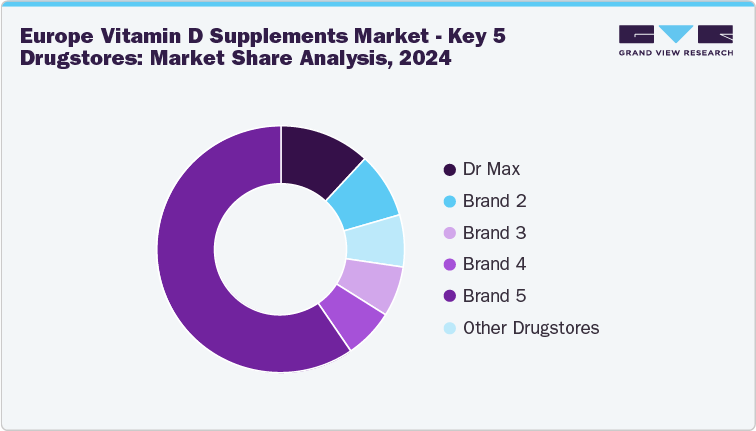
Europe vitamin D supplements market: Market Share of Key Drugstores, 2024
Müller is a large drug‑store chain with 900+ outlets across multiple European countries. Their product mix includes health‑foods and dietary supplements, of which Vitamin D is a commonly stocked item. Drug‑store chains play a key role in the vitamin D supplements market as they combine broad retail reach with health‑oriented product assortments. They often bridge the gap between pharmacies with clinical credibility and general retail with convenience. These chains offer a mix of over‑the‑counter supplements, wellness products, and self‑care items. Vitamin D is commonly featured in formulations for bone health, immunity support, and general wellness.
Europe vitamin D supplements market: Market Share of Key Online Retailers, 2024
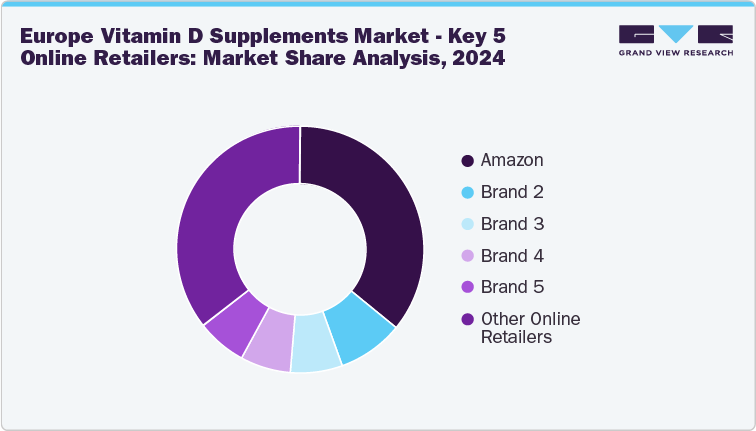
Amazon has become a dominant force in the European vitamin D supplements market, offering a wide range of products including tablets, softgels, liquid drops, and vegetarian/vegan options, catering to diverse consumer preferences. The platform's value proposition is built around convenience, with products like year-long supply packs and higher dosage options such as 4,000 IU softgels, which appeal to consumers looking for both cost-efficiency and higher potency. Health claims related to immune support and bone health are prominently featured, aligning with the consumer demand for supplements that support general well-being. Amazon’s “Subscribe & Save” feature encourages repeat purchases, fostering long-term customer loyalty. The importance of clean-label claims, such as “vegan,” “gluten-free,” and “made in the UK,” is also evident, as they help differentiate products in a competitive space. High-volume consumer reviews and ratings play a significant role in building trust and influencing purchasing decisions, while brands selling on Amazon must prioritize compliance with accurate dosage and safety standards to ensure credibility and avoid safety concerns.
Europe vitamin D supplements market: Market Share of Key Brands in D2C, 2024
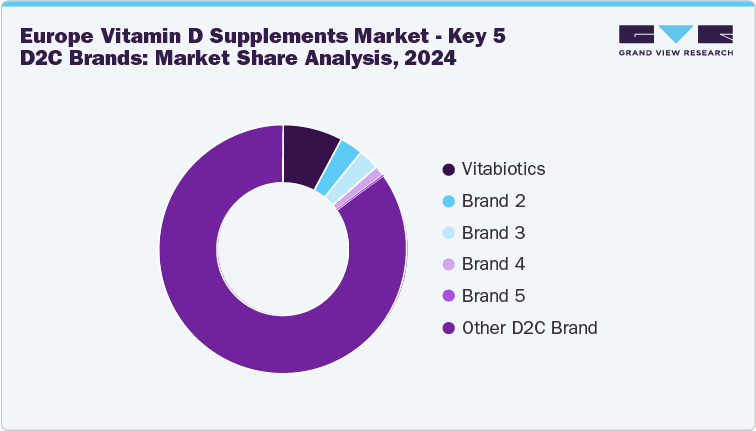
Vitabiotics stands out as a major D2C player in Europe’s dietary supplements space because it combines true e-commerce scale, vertical control of product, and pan-European localisation. Direct-to-consumer (D2C) brands in the European vitamin D supplements market offer a diverse range of products, including softgels, tablets, and liquid drops, with varying dosages like 1000 IU or 2000 IU to cater to different consumer needs. These brands, such as Vitabiotics and Viridian Nutrition, leverage their e-commerce platforms to sell directly to customers, allowing for closer relationships and better customer insights. D2C brands often differentiate themselves by emphasizing clean-label ingredients, vegan-friendly options, and full-year supply packs. They also capitalize on subscription services to encourage repeat purchases, often offering discounts or auto-ship options.
![gvr icn]()
GET A FREE SAMPLE
![gvr icn]()
This FREE sample includes market data points, ranging from trend analyses to market estimates & forecasts. See for yourself.
![gvr icn]()
NEED A CUSTOM REPORT?
We can customize every report - free of charge - including purchasing stand-alone sections or country-level reports, as well as offer affordable discounts for start-ups & universities.
Contact us now to get our best pricing.
![esomar icon]()
ESOMAR certified & member
![ISO]()
ISO Certified
We are GDPR and CCPA compliant! Your transaction & personal information is safe and secure. For more details, please read our privacy policy.


We are committed towards customer satisfaction, and quality service.
Client Testimonials

"The quality of research they have done for us has been excellent..."
ISO Certified
