
- Home
- »
- Homecare & Decor
- »
-
Europe Connected Fitness Services Market Size Report, 2033GVR Report cover
![Europe Connected Fitness Services Market Size, Share & Trends Report]()
Europe Connected Fitness Services Market (2025 - 2033) Size, Share & Trends Analysis Report By Services (Live Streaming Fitness Classes, On-Demand Fitness Content, AI-Based Virtual Trainers), By Application, By Delivery Mode, By Device, And Segment Forecasts
- Report ID: GVR-4-68040-721-3
- Number of Report Pages: 80
- Format: PDF
- Historical Range: 2021 - 2024
- Forecast Period: 2025 - 2033
- Industry: Consumer Goods
- Report Summary
- Table of Contents
- Segmentation
- Methodology
- Download FREE Sample
-
 Download Sample Report
Market Size & Trends
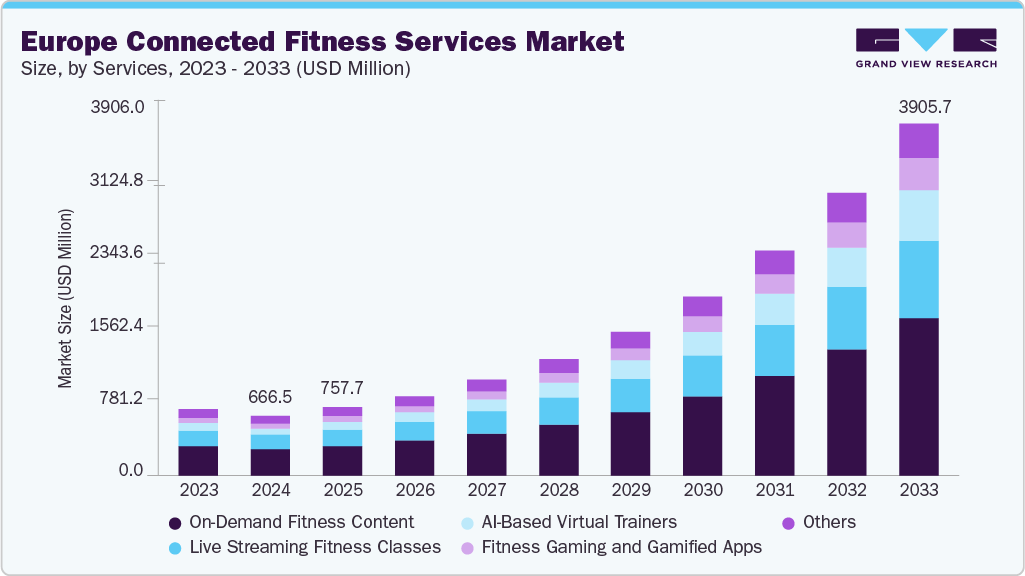
The Europe connected fitness services market size was valued at USD 666.52 million in 2024 and is expected to reach USD 3,905.69 million by 2033, growing at a CAGR of 22.8% from 2025 to 2033. The industry is expanding steadily, driven by evolving lifestyle habits, a growing emphasis on proactive health management, and rising demand for intelligent workout solutions that integrate seamlessly with fitness equipment. Consumers are adopting platforms that sync with treadmills, stationary bikes, rowing machines, and strength-training systems. Services such as Peloton App, iFIT, and Technogym Live offer immersive experiences through interactive displays, real-time performance metrics, and adaptive workout recommendations, enhancing the utility of connected equipment. For instance, Technogym’s MyWellness platform allows users in both residential and gym settings to track workouts across devices and machines while receiving customized programs from personal trainers or physical therapists. These services appeal to European users seeking not just convenience, but smart, integrated experiences that replicate the intensity and structure of in-person training with the flexibility of digital access.
Many platforms offer a blend of strength training, mobility routines, guided meditation, and breathwork. For instance, Les Mills+ has expanded its digital offerings beyond high-intensity workouts to include mindful movement and post-workout recovery classes. This holistic approach appeals to European consumers who prioritize long-term health and stress management over short-term aesthetic goals. In countries such as the Netherlands and Sweden, where public health policy emphasizes well-being over reactive treatment, digital fitness apps are increasingly used to support a more balanced, preventive lifestyle.
Furthermore, companies like SAP and Siemens have implemented employee well-being platforms that include digital fitness subscriptions, making services such as Urban Sports Club or ClassPass accessible as part of workplace benefits. This not only helps employers reduce absenteeism but also promotes engagement and mental resilience among employees. In some regions, public health bodies have partnered with digital platforms to drive preventive care. For instance, in France, certain mutual health insurance providers now reimburse a portion of digital fitness subscriptions that include medically approved movement therapy or rehabilitation programs.
The linguistic and cultural diversity of Europe plays a key role in shaping platform strategies. Successful service providers are investing in localized content across multiple languages and workout styles to match regional preferences.
Innovation and digital community-building continue to be key to competitive advantage. Platforms such as Fiit have introduced leaderboard-driven classes and team-based challenges, creating a virtual group fitness experience that mimics the social atmosphere of physical gyms. Meanwhile, Basic-Fit, with its expanding digital content strategy, allows members to switch between in-gym and app-based workouts, an example of hybrid model execution aligned with European consumer preference for flexibility.
With the rise of 5G infrastructure and increased mobile internet coverage across rural regions in countries like Poland, Portugal, and Ireland, access to high-quality streaming and real-time interaction is no longer limited to urban users. This opens new growth corridors for providers willing to adapt content and pricing strategies to less saturated, cost-sensitive markets. As digital literacy and health awareness continue to rise, the European connected fitness services landscape is positioned for long-term evolution, guided not just by technology but by cultural alignment, community focus, and wellness integration.
Consumer Insights
Consumer trends in the region indicate a clear move away from one-size-fits-all fitness. People are looking for variety, autonomy, and meaningful engagement. From younger, tech-native consumers in the UK who engage in virtual spin and boxing classes, to older demographics in France interested in low-impact mobility routines, personalization is no longer a perk; it’s expected. Meanwhile, the rise of wellness-minded travel and corporate wellness initiatives has expanded the customer base beyond the individual to include hospitality and workplace partnerships. Digital fitness is no longer just about exercise; it’s part of a broader self-care routine.
To keep pace, leading providers are rolling out new services that bridge content, hardware, and physical access. UK-based Fiit Ltd. has introduced a connected experience with select equipment brands, syncing workout data across machines and mobile apps. EGYM GmbH continues to partner with gyms to build cloud-based workout ecosystems that let users track progress whether at a club or remotely. There’s also growing traction in "content layering," where fitness apps bundle in mental wellness, recovery, and nutrition modules to increase value and reduce churn. These developments reflect a market that is becoming more competitive, localized, and experience-driven across Europe.
With busy work routines, unpredictable schedules, and a growing preference for home-based wellness, consumers are opting for platforms that let them work out when and where it suits them. This shift is particularly evident in urban markets such as Berlin, Paris, and Amsterdam, where commuting time and lifestyle pressures have prompted users to turn to mobile-friendly and app-based fitness solutions. Providers like Fiit Ltd. and WithU have capitalized on this need by offering bite-sized workouts, trainer-led sessions, and integration with smart TVs and phones, giving consumers a consistent experience across all settings, whether at home or while traveling.
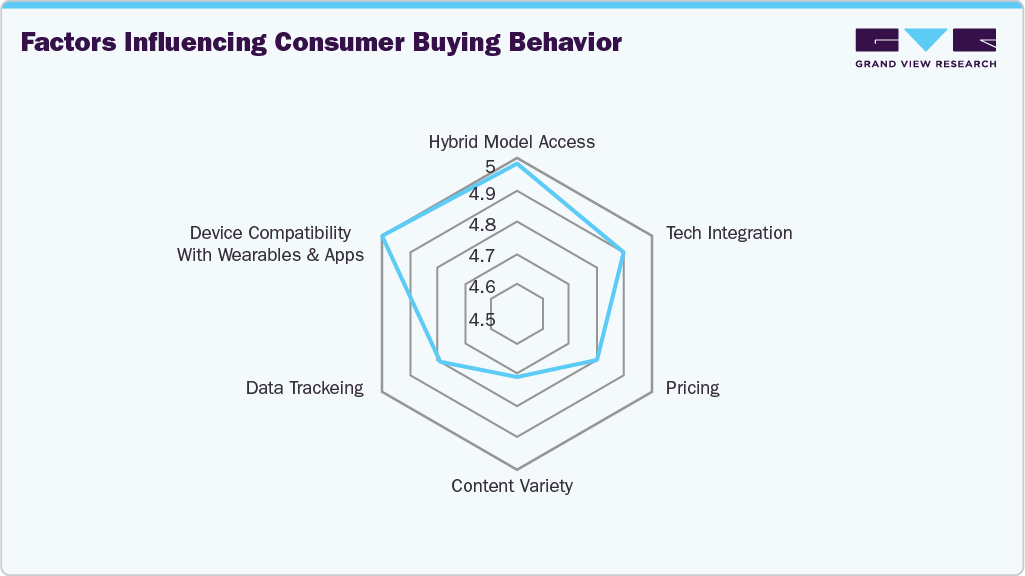
Furthermore, consumers are not only looking for expert-led fitness but also demand content that resonates with their routines, language, and lifestyle. This includes local trainers, music preferences, and programs tailored to cultural norms, like wellness-focused programs in Scandinavia or strength-centric regimens in Germany. Services that can localize their offerings without losing quality are outperforming global generic platforms. For instance, Urban Sports Club in Germany has built loyalty by curating partnerships with local studios and offering users access to both virtual and in-person classes through a single subscription.
Services Insights
On-demand fitness content accounted for the largest revenue share of 43.87% in 2024, driven by increasing consumer demand for flexibility, personalization, and convenience. Users across the region are gravitating toward platforms that allow them to access high-quality workouts anytime, without being tied to fixed schedules or live class timings. This format caters to a wide range of fitness levels and goals, offering options from strength training and cardio to yoga and recovery sessions. Platforms such as Les Mills+, iFIT, and Freeletics have capitalized on this trend by providing diverse, instructor-led content that users can stream through smart devices or integrated fitness equipment. The ability to pause, repeat, or customize sessions enhances the user experience, making on-demand content a preferred choice for individuals balancing fitness with busy personal and professional lives.
AI-based virtual trainers are projected to grow at a CAGR of 26.1% over the forecast period of 2025-2033. These virtual trainers use artificial intelligence to analyze user performance, adapt exercise intensity, and provide real-time feedback, creating a more engaging and efficient training environment. European consumers are showing strong interest in intelligent fitness guidance that mimics the role of a personal coach without the associated costs or scheduling constraints. Platforms such as Freeletics and VAHA are already integrating AI to deliver tailored workout plans, track progress, and adjust routines based on user feedback and biometrics. As digital literacy grows and smart device adoption rises, AI-based trainers are becoming a preferred solution for individuals seeking customized fitness support that evolves with their goals and lifestyle.
Application Insights
Business-to-Consumer (B2C) held the largest revenue share of 85.61% in 2024. The shift in lifestyle priorities, centered around convenience, autonomy, and wellness, has driven widespread adoption of subscription-based services that provide access to expert-led workouts, guided programs, and performance tracking without reliance on physical gym attendance. The appeal of direct-to-consumer access, coupled with features like AI-driven personalization, gamified engagement, and adaptive training plans, has strengthened retention and user engagement. The B2C model continues to drive growth in the region by enabling brands to monetize directly, build strong digital communities, and respond swiftly to shifting fitness preferences through continuous content innovation.
The demand for connected fitness services in the business-to-business (B2B) industry is expected to grow at a CAGR of 27.9% from 2025 to 2033. Fitness studios, hotel groups, corporate wellness programs, and residential developments are adopting connected platforms that deliver virtual classes, personalized training plans, and performance insights to enhance user experience and engagement. These services enable organizations to differentiate their offerings by providing value-added, on-demand fitness solutions that can be accessed both on-premises and remotely. In Europe’s competitive hospitality and real estate markets, connected fitness is becoming a key amenity for attracting and retaining customers or tenants. Simultaneously, employers are investing in digital wellness initiatives to support healthier, more productive workforces.
Device Insights
Connected fitness equipment represented 44.07% of revenue in the Europe connected fitness services industry in 2024. The demand is driven by consumers seeking structured, data-driven workouts at home through advanced machines such as smart bikes, rowers, treadmills, and multifunctional strength systems. These products integrate seamlessly with mobile apps and streaming platforms, offering personalized coaching, progress tracking, and community engagement features. European households have shown a growing preference for hybrid fitness models, where equipment-based training complements gym or studio memberships. Leading brands have strengthened their presence by combining premium hardware with subscription-based content, ensuring consistent usage and long-term customer loyalty.
The demand for connected fitness wearable devices is expected to grow at a CAGR of 26.2% from 2025 to 2033. Wearables such as smartwatches, fitness bands, and heart rate monitors enable users to track key metrics like calories burned, sleep quality, heart rate, and activity levels, allowing for more informed and customized workout experiences. Their seamless integration with fitness apps and digital platforms enhances user engagement by offering data-driven feedback and progress tracking. As consumers become more health-conscious and tech-savvy, the appeal of wearables as tools for accountability, motivation, and continuous improvement continues to grow.
Delivery Mode Insights
Subscription-based services accounted for the largest revenue share of 81.23% in 2024. Consumers are increasingly drawn to monthly or annual plans that offer curated workout programs, expert-led sessions, and health-focused add-ons such as mindfulness, recovery, and nutrition support. This model allows users to explore a wide variety of training styles and intensity levels without committing to long-term contracts or high upfront costs. The recurring structure not only supports user retention but also enables platforms to update content regularly, introduce new features, and continuously refine the user experience, all of which contribute to the strong adoption of subscription-based fitness services across the region.
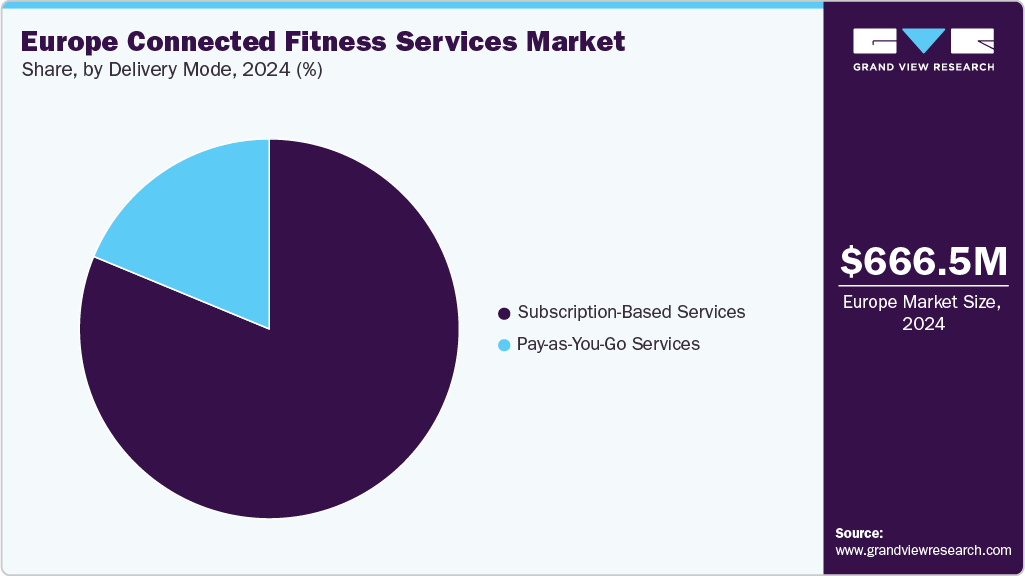
Pay-as-you-go services in the Europe connected fitness service industry are expected to grow at a CAGR of 19.0% from 2025 to 2033. Many consumers across the region, particularly casual users and those with irregular schedules, prefer the ability to access individual sessions or short-term packages without being tied to recurring subscriptions. This model appeals to travelers, seasonal users, and individuals exploring different workout formats before committing to a routine. Platforms such as Urban Sports Club and ClassPass have popularized this approach by offering credits or passes that can be redeemed for digital classes, live streams, or hybrid workouts. As consumers seek more control over their spending and fitness choices, the pay-as-you-go model offers a convenient and cost-effective way to engage with professional content while maintaining full flexibility, making it an increasingly attractive option in a diverse and dynamic market landscape.
Key Europe Connected Fitness Services Companies Insights
Key players operating in the Europe connected fitness services market are undertaking various initiatives to strengthen their presence and increase the reach of their products and services. Strategies such as expansion activities and partnerships are key in propelling the market growth.
Key Europe Connected Fitness Services Companies:
- Peloton Interactive, Inc.
- EGYM GmbH
- Freeletics GmbH
- Les Mills International Ltd.
- WithU Training Ltd.
- Zwift, Inc.
- iFIT Health & Fitness, Inc.
- VAHA Technologies GmbH
- FitXR Ltd.
- Fiit Ltd.
Recent Developments
-
In June 2025, iFIT expanded its AI Coach feature to 19 new countries, including places like Canada, the UK, Australia, and several European nations, marking its first availability outside the U.S. The AI Coach uses machine learning and personal data to craft tailored fitness and wellness plans that align with each user’s goals and daily schedule. It offers guidance across areas such as strength training, cardio, recovery, and mindfulness, and provides real-time feedback and motivation. Users can access the AI Coach through the iFIT app or on compatible NordicTrack and ProForm equipment, with support for multiple languages to suit local markets.
-
In October 2024, Les Mills and adidas hosted a large-scale fitness event in Berlin called “Les Mills Live,” drawing over 3,000 participants for a unique blend of intense workouts and entertainment. Held at the Kraftwerk venue, the gathering featured dynamic group exercise classes paired with nightclub-style lighting, virtual reality elements, and live music performances. The event also marked the launch of Les Mills Pilates, a new program that mixes controlled movements with science-backed techniques to improve core strength. Adidas highlighted its Dropset 3 training shoes and Optime activewear during the sessions, reflecting the brand’s shared focus on innovation in fitness experiences and athletic gear.
Europe Connected Fitness Services Market Report Scope
Report Attribute
Details
Market size value in 2025
USD 757.72 million
Revenue forecast in 2033
USD 3,905.69 million
Growth rate
CAGR of 22.8% from 2025 to 2033
Actuals
2021 - 2024
Forecast period
2025 - 2033
Quantitative units
Revenue in USD million/billion and CAGR from 2025 to 2033
Report coverage
Revenue forecast, company ranking, competitive landscape, growth factors, and trends
Segments covered
Services, application, delivery mode, device
Country scope
Europe
Key companies profiled
Peloton Interactive, Inc.; EGYM GmbH; Freeletics GmbH; Les Mills International Ltd.; WithU Training Ltd.; Zwift, Inc.; iFIT Health & Fitness, Inc.; VAHA Technologies GmbH; FitXR Ltd.; Fiit Ltd.
Customization scope
Free report customization (equivalent up to 8 analysts working days) with purchase. Addition or alteration to country, regional & segment scope.
Pricing and purchase options
Avail customized purchase options to meet your exact research needs. Explore purchase options
Europe Connected Fitness Services Market Report Segmentation
This report forecasts revenue growth at the regional level and provides an analysis of the latest trends and opportunities in each of the sub-segments from 2021 to 2033. For this study, Grand View Research has segmented the Europe connected fitness services market report on the basis of services, application, delivery mode, and devices.
-
Services Outlook (Revenue, USD Million, 2021 - 2033)
-
Live Streaming Fitness Classes
-
On-Demand Fitness Content
-
AI-Based Virtual Trainers
-
Fitness Gaming and Gamified Apps
-
Others
-
-
Application Outlook (Revenue, USD Million, 2021 - 2033)
-
Business-to-Consumer (B2C)
-
Business-to-Business (B2B)
-
-
Delivery Mode Outlook (Revenue, USD Million, 2021 - 2033)
-
Subscription-Based Services
-
Pay-as-You-Go Services
-
-
Device Outlook (Revenue, USD Million, 2021 - 2033)
-
Smartphone
-
Tablet
-
Wearable Devices
-
Connected Fitness Equipment
-
Frequently Asked Questions About This Report
b. The Europe connected fitness services market was estimated at USD 666.52 million in 2024 and is expected to reach USD 757.72 million in 2025.
b. The Europe connected fitness services market is expected to grow at a compound annual growth rate of 22.8% from 2025 to 2033 to reach USD 3,905.69 million by 2033.
b. On-demand fitness content accounted for a revenue share of 43.87% in the year 2024 in the Europe connected fitness services industry, driven by consumer demand for flexible, anytime-accessible workouts. The format’s personalized programs, diverse class libraries, and compatibility with both mobile devices and connected equipment made it the dominant choice across the region.
b. Some of the key players in the Europe connected fitness services market include Peloton Interactive, Inc.; EGYM GmbH; Freeletics GmbH; Les Mills International Ltd.; WithU Training Ltd.; Zwift, Inc.; iFIT Health & Fitness, Inc.; VAHA Technologies GmbH; FitXR Ltd., Fiit Ltd.
b. The Europe connected fitness services market is driven by rising smartphone penetration, growing adoption of smart equipment, and consumer preference for flexible, home-based fitness options. Additionally, integration with wearables, availability of localized digital platforms, and increasing health awareness continue to fuel demand across the region.


Share this report with your colleague or friend.
Need a Tailored Report?
Customize this report to your needs — add regions, segments, or data points, with 20% free customization.


ISO 9001:2015 & 27001:2022 Certified
We are GDPR and CCPA compliant! Your transaction & personal information is safe and secure. For more details, please read our privacy policy.
Trusted market insights - try a free sample
See how our reports are structured and why industry leaders rely on Grand View Research. Get a free sample or ask us to tailor this report to your needs.












