
- Home
- »
- Homecare & Decor
- »
-
Europe Connected Fitness Equipment Market Report, 2033GVR Report cover
![Europe Connected Fitness Equipment Market Size, Share & Trends Report]()
Europe Connected Fitness Equipment Market (2025 - 2033) Size, Share & Trends Analysis Report By Product (Cardiovascular Training Equipment, Strength Training Equipment), By Application (Business-to-Consumer , Business-to-Business ), By Country, And Segment Forecasts
- Report ID: GVR-4-68040-724-7
- Number of Report Pages: 80
- Format: PDF
- Historical Range: 2021 - 2024
- Forecast Period: 2025 - 2033
- Industry: Consumer Goods
- Report Summary
- Table of Contents
- Segmentation
- Methodology
- Download FREE Sample
-
 Download Sample Report
Market Size & Trends
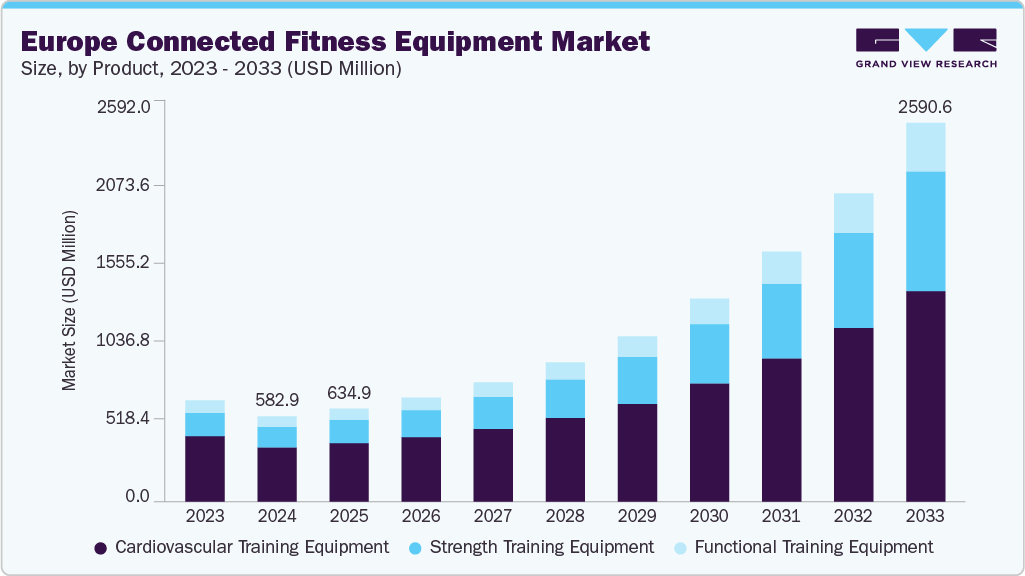
The Europe connected fitness equipment market size was estimated at USD 582.92 million in 2024 and is projected to reach USD 2590.6 million by 2033, growing at a CAGR of 19.2% from 2025 to 2033. Fitness preferences across Europe are transforming, with consumers, especially younger demographics, increasingly seeking exercise experiences that combine physical activity with real-time digital interaction. Rather than using isolated or repetitive gym equipment, individuals are shifting toward smart machines and systems that offer interactive content, adaptive programming, and performance analytics. These preferences are reflected in the growing demand for connected treadmills, intelligent strength systems, rowing machines with virtual landscapes, and mirrors that deliver guided fitness sessions from personal trainers.
The appeal for connected fitness equipment is especially strong in urban locales such as Berlin, Stockholm, and Barcelona, where compact living spaces demand versatile, app‑integrated fitness solutions. Several major brands are innovating rapidly to meet this demand. For example, Italy’s Technogym introduced its Checkup AI station in 2024, a device that assesses balance, mobility, cognition, and strength to generate a personalized "Wellness Age" and ongoing Precision Training plan via its interconnected Technogym ecosystem. The company’s overall platform now ties together equipment, software, wearables, and content into a unified user experience based on real-time data.
Norway-based NOHrD continues to design space-efficient, aesthetically refined rowing and strength machines that integrate with mobile apps for training guidance and workout metrics, all inspired by the region’s focus on longevity and design-led wellness. Meanwhile, Spain’s Pavigym offers a resistance trainer capable of adjusting load automatically based on biometric signals like grip force and movement cadence, which is ideal for adaptive strength training in small units.
Connected equipment is increasingly expected to support holistic health goals. In France and the Nordic countries, platforms now offer sleep tracking, recovery prompts, guided warm-ups, and breathing exercises, positioning devices as wellness hubs rather than simple cardio tools. Many manufacturers bundle hardware with app-based subscriptions that include mental wellness support and adaptive programming.
Fitness studios in cities such as Amsterdam and Paris are also pursuing hybrid models, blending in-person classes with at-home workouts via compatible connected bikes and treadmills. 1Rebel in London, for instance, launched its "Ride at Home" service, which synchronizes smartphone-connected bikes with live studio sessions and branded playlists, offering the same group dynamic remotely.
Government-backed digital infrastructure efforts are helping expand access beyond major urban centres. The EU’s Digital Decade initiative, launched in 2021, aims to deliver reliable high-speed internet to all households by 2030, unlocking full functionality of cloud-based streaming, app connectivity, and real-time performance feedback in rural and suburban regions.
Emerging products launched in 2024 reflect a focus on accessibility and multifunctionality. For instance, Fazer Move (Finland) partnered with wellness networks to distribute smart treadmills tailored for older adults and beginners, featuring visual pacing cues and stability support. These innovations demonstrate a move toward inclusive fitness design for diverse age groups and abilities.
Wearables integration is a standard component of European connected fitness. Brands such as Polar and Garmin allow users’ biometric data, like heart rate variability, recovery metrics, and training load, to feed directly into compatible equipment or apps, enabling real‑time feedback and session customization. This seamless flow empowers users to adapt workouts based on their personal recovery status and overall fatigue.
Consumer Insights
According to the UK Health and Fitness Market Report published in April 2025, there are significant generational differences in gym or leisure facility membership across Europe, which directly influence the adoption and growth of connected fitness equipment. Younger adults, particularly those aged 16-24 and 25-34, show the highest levels of current membership at 47% and 48% respectively. This demographic's strong engagement with fitness facilities indicates a growing demand for smart, connected solutions that enhance their workout experience both in and outside the gym, including home-based digital fitness tools, wearable integrations, and interactive platforms.
The middle-aged groups, particularly individuals aged 35-54, show a mixed trend. For the 35-44 age group, 27% are current members, while a significant 42% report being former members. Similarly, among those aged 55-64, only 13% are active members, despite 39% having been members in the past. This pattern suggests that while interest in fitness exists within these age groups, barriers such as time constraints, health issues, or lifestyle shifts may be limiting long-term participation. However, their previous exposure to gym culture creates potential for re-engagement through convenient connected fitness options that offer flexibility and personalized features.
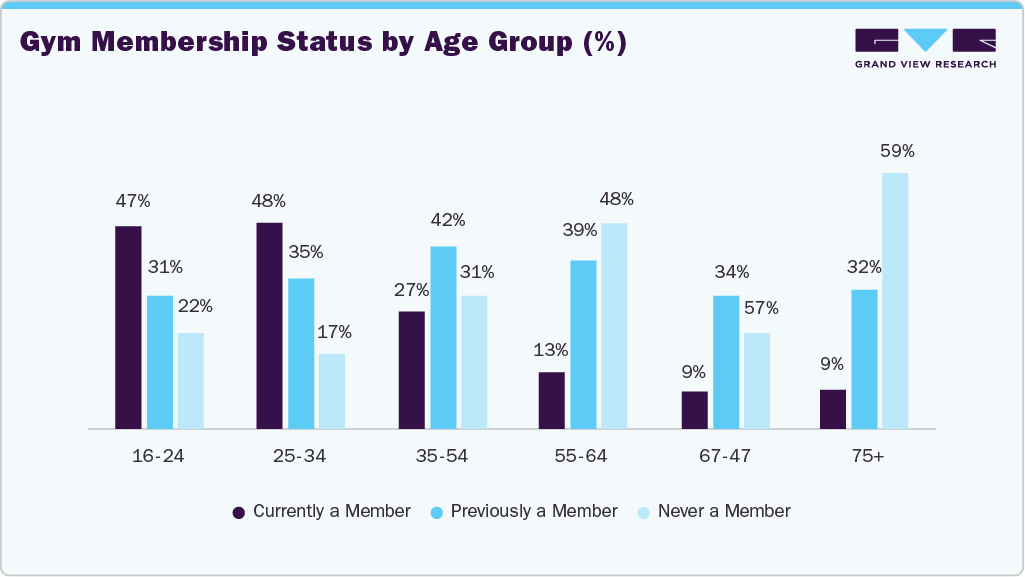
In contrast, the older population ages 65-74 and 75+ shows low current membership rates at just 9%, with a majority reporting they have never been members 57% and 59% respectively. This reflects a longstanding gap in fitness facility usage among seniors, which may present both a challenge and an opportunity for the connected fitness equipment market. Tailored solutions, such as low-impact digital fitness programs, health monitoring features, and senior-friendly interfaces, could help tap into this underserved segment, especially as this demographic becomes more digitally literate and health-conscious with age.
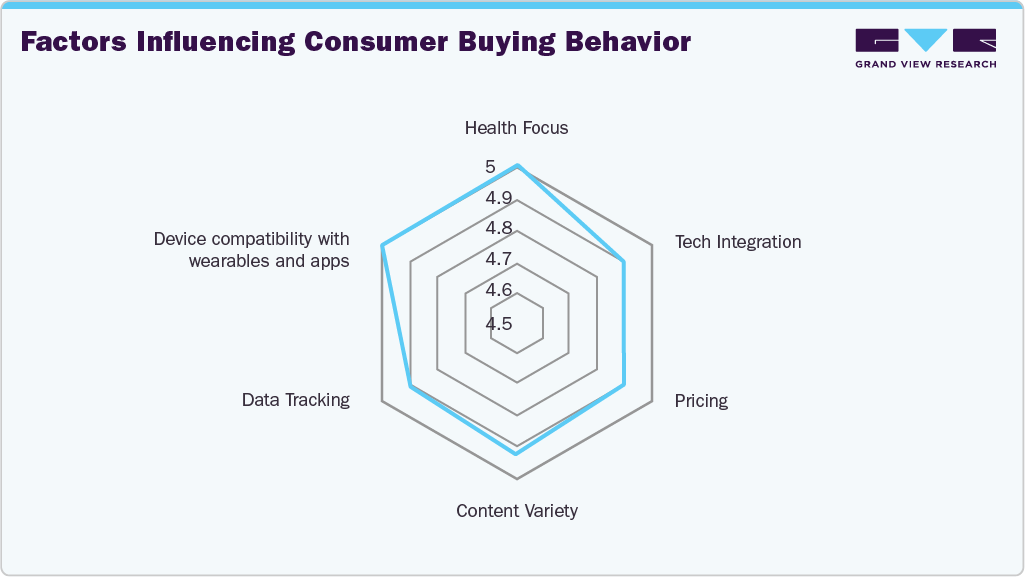
Health focus has emerged as a primary driver of consumer purchasing decisions. With rising awareness around physical and mental well-being, consumers are increasingly investing in fitness technologies that support preventive health, rehabilitation, and overall lifestyle improvement. Equipment that provides personalized health insights, heart rate monitoring, and guided workouts tailored to fitness goals is particularly appealing. This focus aligns with broader public health campaigns and individual preferences for long-term wellness solutions, making health-oriented features a crucial influence on buying behavior.
Another significant factor is tech integration, which refers to the ability of fitness equipment to seamlessly connect with mobile apps, wearables, virtual coaching platforms, and smart home ecosystems. European consumers are drawn to devices that deliver a connected, interactive experience, such as real-time performance feedback, remote trainer access, and progress synchronization across multiple devices. This level of integration not only enhances user engagement but also supports goal tracking, motivation, and accountability, making tech-enabled equipment a preferred choice among digitally savvy users.
Product Insights
Cardiovascular training equipment accounted for a revenue share of 63.75% in the year 2024 in the Europe connected fitness equipment industry. The growing emphasis on heart health, weight management, and endurance improvement has positioned cardio machines such as treadmills, stationary bikes, and ellipticals as essential components of modern fitness routines. Additionally, the integration of advanced connectivity features like real-time performance tracking, virtual coaching, and compatibility with fitness apps has significantly enhanced user engagement and satisfaction. The shift toward home-based fitness, accelerated by evolving lifestyles and digital convenience, further bolstered demand for connected cardio equipment, solidifying its dominant position in the market.
Strength training equipment is projected to grow at a CAGR of 22.6% over the forecast period of 2025-2033, driven by rising consumer interest in muscle toning, functional training, and long-term physical health. The increasing popularity of strength-based workout programs, such as resistance training, HIIT, and bodyweight routines, among a broader demographic, including older adults and women, has expanded the user base. Moreover, the integration of smart features like AI-driven feedback, digital load adjustment, and app-based performance tracking is transforming traditional strength equipment into interactive, personalized training solutions.
Application Insights
Business-to-Consumer (B2C) held a revenue share of 76.23% in 2024. Factors such as increasing health awareness, the convenience of exercising at home, and the growing availability of affordable, tech-enabled fitness equipment have significantly boosted individual ownership. Consumers are increasingly investing in smart treadmills, bikes, and strength systems that offer app integration, live classes, and on-demand workout content, replicating the gym experience in personal spaces. In addition, aggressive online retail strategies and direct-to-consumer sales models adopted by leading brands have further accelerated B2C market penetration across the region.
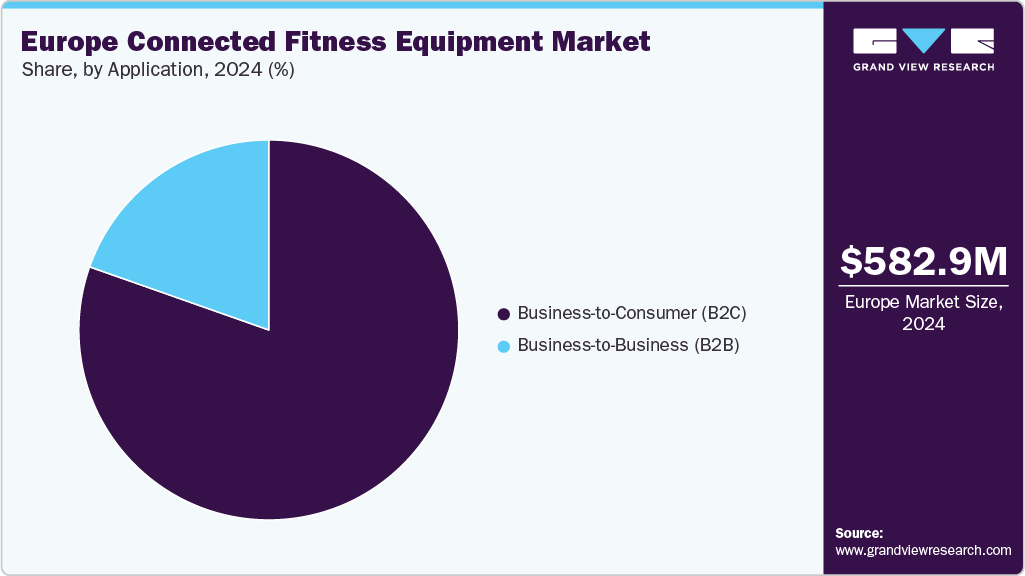
The demand for connected fitness equipment in the business-to-business (B2B) industry is expected to grow at a CAGR of 21.8% from 2025 to 2033, driven by increasing investment in digital fitness infrastructure by gyms, hotels, corporate wellness programs, and rehabilitation centers. Businesses are prioritizing smart equipment to enhance member experience, improve engagement, and offer data-driven training solutions. The integration of cloud connectivity, remote monitoring, and performance analytics enables operators to optimize equipment usage and personalize client offerings. Moreover, the growing focus on employee wellness and value-added services in hospitality and healthcare sectors is accelerating the adoption of advanced, connected fitness solutions in commercial environments.
Country Insights
UK Connected Fitness Equipment Market Trends
The UK connected fitness equipment industry accounted for a revenue share of 20.1% in 2024. The country’s high penetration of internet-connected devices, combined with a growing preference for flexible, at-home workout options, has driven demand for interactive and app-integrated fitness equipment. In addition, the presence of health-conscious urban populations, widespread use of subscription-based wellness platforms, and investments in personalized fitness technologies have accelerated market growth. The UK’s mature e-commerce ecosystem and early acceptance of digital fitness trends have further reinforced its position as a leading contributor to the regional market.
Germany Connected Fitness Equipment Market Trends
Germany connected fitness equipment industry is projected to grow at a CAGR of 22.3% over the forecast period of 2025-2033, driven by increasing health awareness, a strong emphasis on preventive care, and rising investment in digital wellness solutions. The country’s technologically advanced manufacturing landscape and supportive government initiatives for promoting active lifestyles are contributing to the rapid integration of smart fitness systems in both residential and commercial settings. German consumers are showing a growing preference for equipment that offers personalized training, real-time performance tracking, and seamless integration with mobile apps and wearables. Moreover, fitness studios, corporate wellness programs, and healthcare providers are adopting connected solutions to enhance user engagement and improve outcomes, further accelerating market expansion.
Key Europe Connected Fitness Equipment Company Insights
The Europe connected fitness equipment industry is characterized by a dynamic interplay between well-established brands and emerging innovators, fostering a highly competitive and rapidly evolving landscape. Leading companies are prioritizing the development of intelligent, user-centric workout solutions that align with modern wellness habits and digital lifestyles. Collaborations with tech firms, health institutions, and content providers are becoming increasingly common, aimed at enriching the user journey through smart connectivity and tailored fitness programs.
The market is propelled by advancements such as real-time biometric tracking, immersive virtual training environments, and adaptive resistance systems that respond to user performance. Integrated platforms combining hardware, subscription-based digital content, social interaction, and mobile integration are now the norm, appealing to consumers seeking both flexibility and engagement. In addition, there is a growing emphasis on sustainability and inclusivity, with brands investing in eco-friendly production methods, universal design features, and accessible pricing strategies. This alignment of innovation, personalization, and ethical considerations positions the European connected fitness sector to meet evolving consumer demands and support holistic health outcomes in a digital-first era.
Key Europe Connected Fitness Equipment Companies:
- Peloton Interactive, Inc.
- Technogym S.p.A.
- Johnson Health Tech Co., Ltd.
- iFIT Health & Fitness, Inc.
- Life Fitness
- Precor Incorporated
- EGYM GmbH
- Echelon Fitness Multimedia LLC
- Bowflex
- NOHrD by WaterRower GmbH
Recent Developments
-
In January 2024, EGYM and Life Fitness announced a collaboration to create a new Smart Cardio system, set to launch in the first half of 2024. The project will combine EGYM’s advanced software with Life Fitness cardio equipment featuring the Discover SE4 console. It will allow users to receive personalized workout guidance, track performance data, and enjoy exercise sessions tailored to their specific fitness goals. For gyms and fitness facilities, this integration promises to deliver a more engaging and tech-driven experience, highlighting both companies’ focus on innovation and customized training solutions.
-
In November 2022, Peloton extended its collaboration with Amazon by offering its fitness products, including the Peloton Bike, the Guide strength-training device, and various accessories, on Amazon’s platform in the UK, with plans to launch in Germany soon. Customers can choose between self-installation and free professional assembly services in certain areas. This expansion follows Peloton’s initial partnership with Amazon in the US and is intended to make its fitness equipment and services more easily accessible to customers in new international markets.
Europe Connected Fitness Equipment Market Report Scope
Report Attribute
Details
Market size value in 2025
USD 634.94 million
Revenue forecast in 2033
USD 2,590.6 million
Growth Rate
CAGR of 19.2% from 2025 to 2033
Actuals
2021 - 2024
Forecast period
2025 - 2033
Quantitative units
Revenue in USD million/billion and CAGR from 2025 to 2033
Report coverage
Revenue forecast, company ranking, competitive landscape, growth factors, and trends
Segments covered
Product, application, country
Regional scope
Europe
Country Scope
UK; Germany; France; Italy; Spain
Key companies profiled
Peloton Interactive Inc.; Technogym S.p.A.; Johnson Health Tech Co., Ltd.; iFIT Health & Fitness, Inc.; Life Fitness; Precor Incorporated; EGYM GmbH; Echelon Fitness Multimedia LLC; Bowflex; NOHrD by WaterRower GmbH
Customization scope
Free report customization (equivalent up to 8 analysts working days) with purchase. Addition or alteration to country, regional & segment scope.
Pricing and purchase options
Avail customized purchase options to meet your exact research needs. Explore purchase options
Europe Connected Fitness Equipment Market Report Segmentation
This report forecasts revenue growth at country levels and provides an analysis on the latest trends and opportunities in each of the sub-segments from 2021 to 2033. For this study, Grand View Research has segmented the Europe connected fitness equipment market report based on product, application, and country.
-
Product Outlook (Revenue, USD Million, 2021 - 2033)
-
Cardiovascular Training Equipment
-
Smart Treadmills
-
Smart Bikes
-
Connected Rowers
-
Others
-
-
Strength Training Equipment
-
Functional Training Equipment
-
-
Application Outlook (Revenue, USD Million, 2021 - 2033)
-
Business-to-Consumer (B2C)
-
Business-to-Business (B2B)
-
-
Country Outlook (Revenue, USD Million, 2021 - 2033)
-
UK
-
Germany
-
France
-
Italy
-
Spain
-
Frequently Asked Questions About This Report
b. The Europe connected fitness equipment market was estimated at USD 582.92 million in 2024 and is expected to reach USD 634.94 million in 2025.
b. The Europe connected fitness equipment market is expected to grow at a compound annual growth rate of 19.2% from 2025 to 2033 to reach USD 2590.6 million by 2033.
b. Cardiovascular training equipment held 63.75% of revenue in Europe’s connected fitness equipment industry in 2024, reflecting strong consumer demand for treadmills, bikes, and rowers that support endurance and calorie-burning workouts. The integration of live classes, performance tracking, and gamified challenges has further reinforced its dominance in the connected fitness landscape.
b. Some of the key players in the Europe connected fitness equipment market include Peloton Interactive Inc.; Technogym S.p.A.; Johnson Health Tech Co., Ltd.; iFIT Health & Fitness, Inc.; Life Fitness; Precor Incorporated; EGYM GmbH; Echelon Fitness Multimedia LLC; Bowflex; NOHrD by WaterRower GmbH
b. The Europe connected fitness equipment market is driven by rising consumer demand for home-based smart workout solutions, supported by growing health awareness and digital adoption. Enhanced connectivity, subscription-based content, and the appeal of immersive training experiences further accelerate market growth.


Share this report with your colleague or friend.
Need a Tailored Report?
Customize this report to your needs — add regions, segments, or data points, with 20% free customization.


ISO 9001:2015 & 27001:2022 Certified
We are GDPR and CCPA compliant! Your transaction & personal information is safe and secure. For more details, please read our privacy policy.
Trusted market insights - try a free sample
See how our reports are structured and why industry leaders rely on Grand View Research. Get a free sample or ask us to tailor this report to your needs.












