
- Home
- »
- Advanced Interior Materials
- »
-
Ductless HVAC Systems Market Size, Industry Report, 2033GVR Report cover
![Ductless HVAC Systems Market Size, Share & Trends Report]()
Ductless HVAC Systems Market (2026 - 2033) Size, Share & Trends Analysis Report By Installation (New Construction, Retrofit/Replacement), By Equipment Type (Air Conditioners, Heat Pump, Dehumidifiers), By End-use, By Region, And Segment Forecasts
- Report ID: GVR-4-68040-872-6
- Number of Report Pages: 150
- Format: PDF
- Historical Range: 2021 - 2024
- Forecast Period: 2026 - 2033
- Industry: Advanced Materials
- Report Summary
- Table of Contents
- Segmentation
- Methodology
- Download FREE Sample
-
 Download Sample Report
Ductless HVAC Systems Market Summary
The global ductless HVAC systems market size was estimated at USD 87.9 billion in 2025 and is projected to reach USD 157.9 billion by 2033, growing at a CAGR of 7.6% from 2026 to 2033. The growing demand for energy-efficient heating and cooling solutions is a key factor driving the ductless HVAC systems industry.
Key Market Trends & Insights
- Asia Pacific dominated the global ductless HVAC systems market with the largest revenue share of 47.0% in 2025.
- The China ductless HVAC systems market accounted for the largest market revenue share in the Asia Pacific in 2025.
- By installation, the new construction segment is projected to grow at the fastest CAGR of 8.0% during the forecast period.
- By equipment type, the heat pump segment is expected to register at the fastest CAGR of 8.5% during the forecast period.
- By end use, the residential segment led the market with the largest revenue share of 53.4% in 2025.
Market Size & Forecast
- 2025 Market Size: USD 87.9 Billion
- 2033 Projected Market Size: USD 157.9 Billion
- CAGR (2026-2033): 7.6%
- Asia Pacific: Largest market in 2025
Ductless systems, particularly mini-split air conditioners and heat pumps, eliminate the energy losses commonly associated with traditional ductwork, which can account for a significant portion of energy consumption in conventional HVAC systems.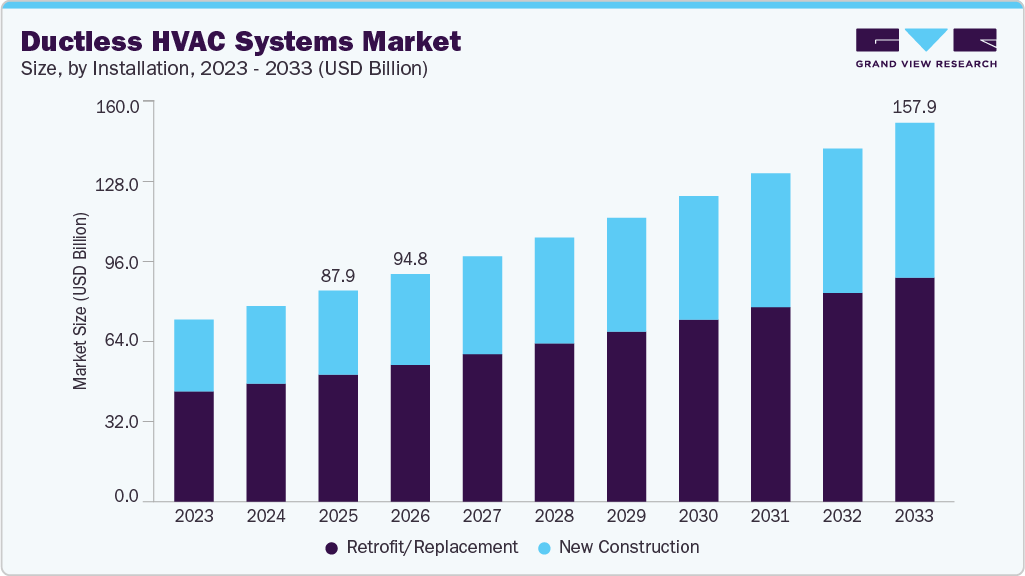
Major driver is the increasing demand for flexible and easy-to-install climate control systems in existing buildings. Many residential and commercial structures, especially older buildings, lack the space or infrastructure required for traditional ducted HVAC systems. Ductless systems offer a practical solution because they require minimal structural modification and allow zoned heating and cooling for individual rooms or areas.
Market Concentration & Characteristics
The ductless HVAC systems industry exhibits a consolidated competitive structure, with a few global manufacturers holding a significant share of the market. Large multinational companies such as Daikin Industries, Mitsubishi Electric, LG Electronics, and Carrier Global dominate the industry due to their strong product portfolios, advanced inverter and heat pump technologies, and extensive global distribution networks.
The ductless HVAC systems industry demonstrates a strong level of technological innovation, with manufacturers focusing on energy-efficient designs, advanced heat pump technologies, and environmentally friendly refrigerants. Companies are introducing smart connectivity, improved compressor technologies, and systems optimized for better energy performance and sustainability. For example, in August 2024 carrier launched an updated ductless product line incorporating new technology platforms and integrating the low-GWP refrigerant R-454B to enhance system efficiency and reduce environmental impact.
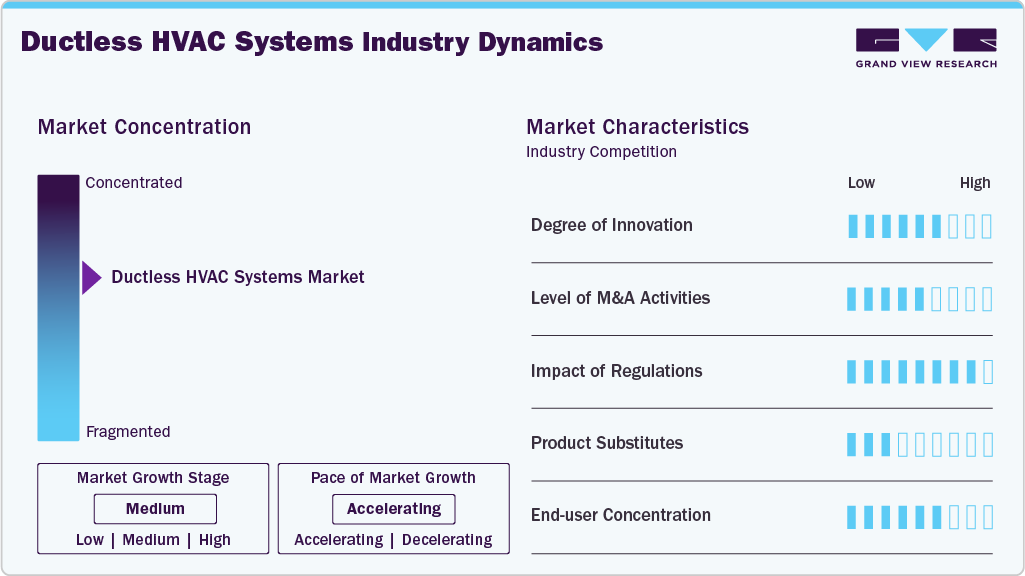
The ductless HVAC systems industry has experienced merger, acquisition, and partnership activity as manufacturers seek to expand distribution networks and strengthen technological capabilities in the growing ductless HVAC segment. For instance, in May 2024 when Samsung Electronics and Lennox established a joint venture named Samsung Lennox HVAC North America to develop and distribute ductless mini-split, heat pump, and VRF systems in the U.S. and Canada. Under the agreement, Samsung holds a 50.1% stake while Lennox owns 49.9%, enabling both companies to combine Samsung’s HVAC technology with Lennox’s strong distribution network.
Regulations related to building energy efficiency and refrigerant emissions significantly influence the ductless HVAC systems industry. Governments across major regions are introducing stricter energy performance standards and encouraging the transition toward low-global-warming-potential (GWP) refrigerants. These regulatory measures are driving the adoption of energy-efficient heating and cooling systems such as ductless heat pumps while pushing manufacturers to redesign products with advanced refrigerants and improved efficiency levels to comply with evolving environmental standards.
Drivers, Opportunities & Restraints
One of the major drivers of the ductless HVAC systems industry is the rising demand for energy-efficient and cost-effective heating and cooling solutions in residential and commercial buildings. Ductless systems minimize energy losses associated with traditional ductwork and provide zoned temperature control, allowing users to cool or heat specific rooms as required. In addition, the increasing construction of energy-efficient buildings and growing renovation activities in older structures are supporting the adoption of ductless HVAC systems.
Growing emphasis on sustainable buildings and electrification of heating systems is creating significant opportunities for the ductless HVAC systems industry. Governments and environmental agencies are promoting the use of high-efficiency heat pumps and low-emission HVAC technologies to reduce carbon footprints. Ductless heat pump systems are gaining traction in both new construction projects and retrofit applications, particularly in regions focusing on green building standards and decarbonization initiatives.
Despite strong growth potential, the ductless HVAC systems industry faces certain challenges, including the relatively higher upfront installation cost compared with conventional HVAC systems. Although ductless systems offer long-term energy savings, the initial equipment and installation expenses can discourage adoption among cost-sensitive consumers.
Installation Insights
The retrofit/replacement segment led the market with the largest revenue share of 60.2% in 2025, primarily due to the increasing need to upgrade or replace aging HVAC infrastructure in existing buildings. Many residential and commercial properties, especially older structures, lack ductwork or have inefficient ducted systems, making ductless solutions an attractive alternative. These systems require minimal structural modifications and can be installed quickly, which has made them a preferred choice for renovation and building upgrade projects.
The new construction segment is expected to witness at the fastest CAGR during the forecast period, as modern building designs increasingly prioritize energy efficiency and flexible climate control solutions. Developers are integrating ductless HVAC systems into newly constructed residential complexes, offices, and small commercial spaces due to their compact design, lower energy consumption, and ability to provide zoned heating and cooling. The rising development of energy-efficient buildings and green construction projects is further supporting the growth of this segment.
Equipment Type Insights
The air conditioners segment led the market with the largest revenue share of 41.8% in 2025, mainly due to the strong demand for efficient cooling solutions in residential and commercial buildings. Ductless air conditioning systems were widely adopted as they provided effective cooling, easy installation, and improved energy efficiency compared to conventional ducted systems. Their ability to deliver targeted cooling for individual rooms or zones made them particularly suitable for apartments, offices, and small commercial spaces.
The heat pump segment is anticipated to witness at the fastest CAGR of 8.5% during the forecast period, driven by the increasing focus on energy-efficient and low-emission heating and cooling technologies. Ductless heat pumps offer both heating and cooling through a single system, making them a flexible solution for year-round climate control. In addition, government initiatives supporting the electrification of heating systems and the rising adoption of environmentally friendly HVAC technologies are expected to further boost the demand for ductless heat pumps.
End-use Insights
The residential segment led the market with the largest revenue share of 53.4% in 2025 and is anticipated to grow at the fastest CAGR during the forecast period, due to the increasing adoption of compact and easy-to-install heating and cooling systems in homes. Ductless units allow homeowners to control temperatures in individual rooms, making them suitable for apartments and renovation projects. In January 2023, LG Electronics USA introduced a new HVAC product line for residential builders at the KBIS and NAHB International Builders’ Show in Las Vegas, featuring heat pumps, indoor air quality solutions, and inverter-based systems.
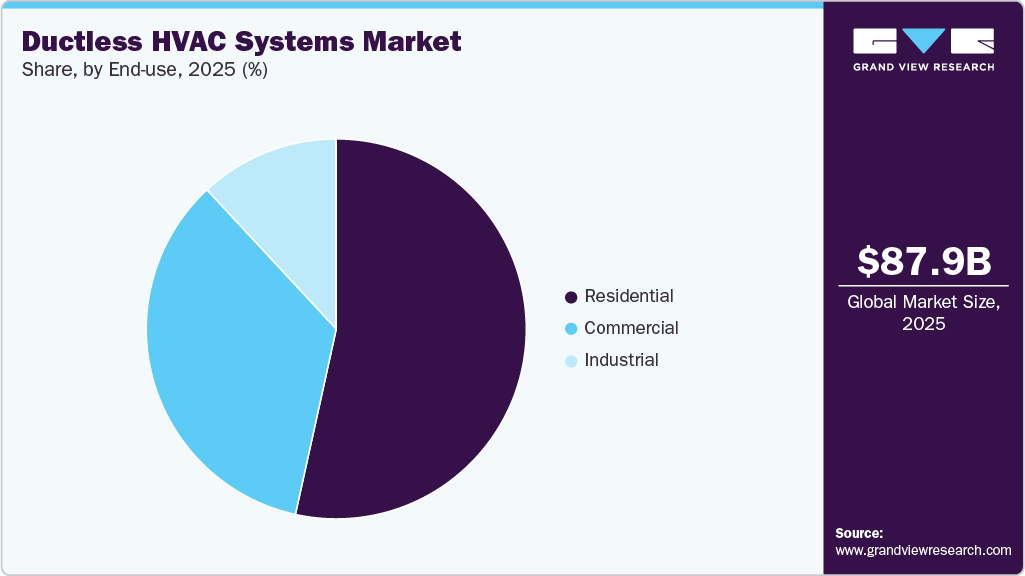
The commercial segment is expected to grow at a significant CAGR during the forecast period, driven by the rising demand for flexible climate control solutions in offices, retail stores, hotels, and educational facilities. Businesses are adopting ductless systems because they allow zoned temperature management and simpler installation compared with ducted HVAC systems.
Regional Insights
The ductless HVAC systems market in North America is witnessing steady growth due to increasing renovation and retrofit activities across residential and commercial buildings. The adoption of ductless systems is rising in older buildings that lack ductwork, particularly in the U.S. and Canada. In addition, growing consumer preference for compact HVAC solutions and the modernization of building infrastructure are supporting market development in the region.
U.S. Ductless HVAC Systems Market Trends
The ductless HVAC systems market in the U.S. accounted for the largest market revenue share in North America in 2025, supported by strong residential construction activity and continuous investments in housing infrastructure. According to data from the Federal Reserve Bank of St. Louis (FRED), total residential construction spending in the United States increased from about USD 904.6 billion in 2023 to around USD 939.7 billion in 2024, indicating sustained growth in housing development and renovation projects. The expansion of residential buildings, along with increasing modernization of existing homes, has supported the adoption of ductless HVAC systems across the country.
The Canada ductless HVAC systems market is experiencing steady growth, driven by increasing demand for flexible heating and cooling solutions in residential and small commercial buildings. The country’s cold climate has encouraged the adoption of ductless heat pump systems that provide efficient year-round temperature control. In addition, government initiatives promoting building upgrades and the replacement of older heating systems are contributing to the gradual expansion of the ductless HVAC systems industry across Canada.
Asia Pacific Ductless HVAC Systems Market Trends
Asia Pacific dominated the global ductless HVAC systems market with the largest revenue share of 47.0% in 2025, and is expected to remain at the fastest CAGR during the forecast period. This growth is supported by rapid urbanization, expanding residential construction, and rising demand for modern cooling and heating systems in countries such as China, Japan, South Korea, and India. The strong presence of major HVAC manufacturers and increasing investments in residential and commercial infrastructure are further contributing to the regional market expansion.
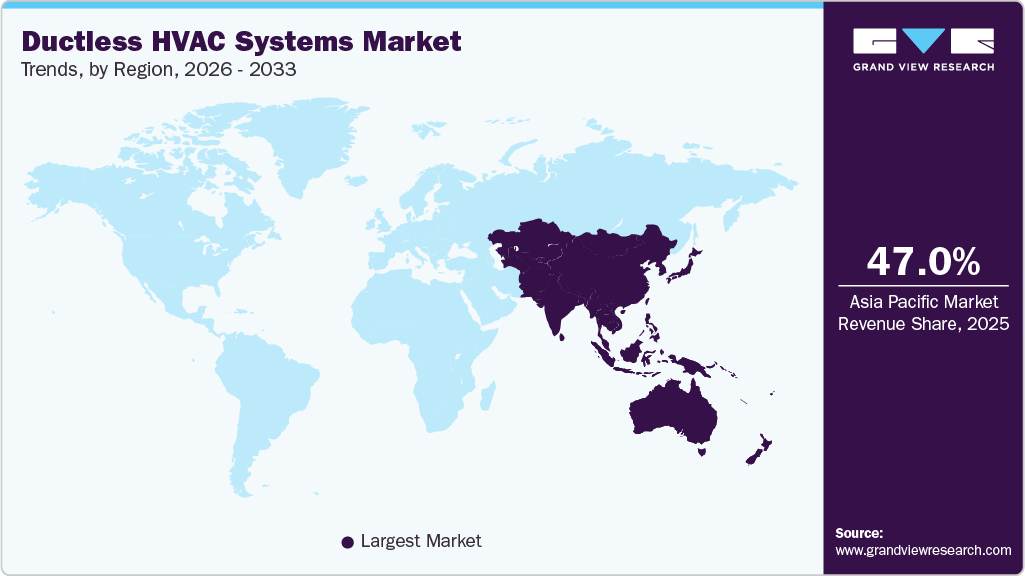
The ductless HVAC systems market in China accounted for the largest market revenue share in the Asia Pacific in 2025, supported by rapid urbanization and the development of large infrastructure and commercial projects. Major projects such as Beijing Daxing International Airport incorporate advanced heating and cooling technologies, including geothermal heat pump systems, to manage indoor climate across large terminal areas. In addition, the expansion of smart cities, commercial complexes, and transportation infrastructure continues to increase the demand for modern HVAC solutions across the country.
The India ductless HVAC systems market is expected to grow at the fastest CAGR during the forecast period, supported by increasing cooling demand and rapid urban development. According to India’s Cooling Action Plan, the demand for space cooling in buildings is projected to grow 11 times between 2018 and 2038. Furthermore, the International Energy Agency (IEA) estimates that by 2050 India could become the world’s largest consumer of space cooling, with cooling accounting for 28% of electricity demand and 44% of peak power load. This significant rise in cooling requirements is driving the adoption of advanced HVAC systems, including ductless technologies, across residential and commercial buildings.
Europe Ductless HVAC Systems Market Trends
The ductless HVAC systems market in Europe is experiencing notable growth, supported by the region’s focus on sustainable building technologies and the replacement of conventional heating systems. Countries such as Germany, France, and the UK are increasingly adopting ductless heat pumps and mini-split systems in residential and commercial spaces. Ongoing building renovation programs and stricter environmental policies are further influencing the adoption of advanced HVAC technologies.
The Germany ductless HVAC systems market represents a key market in Europe, supported by the country’s ongoing transition toward modern and low-emission building technologies. The replacement of traditional heating systems and the rising adoption of heat pumps in residential and commercial buildings are contributing to market expansion.
The ductless HVAC systems market in France is witnessing steady growth due to increasing efforts to modernize residential and commercial buildings. Government programs encouraging the adoption of heat pumps and improved indoor climate technologies are supporting market development. Furthermore, growing renovation activities and rising demand for flexible heating and cooling systems are driving the adoption of ductless HVAC systems across the country.
Latin America Ductless HVAC Systems Market Trends
The ductless HVAC systems market in Latin America is gradually expanding, driven by rising urban population and growing demand for modern cooling solutions in residential and commercial buildings. Countries including Brazil and Argentina are witnessing increased adoption of ductless HVAC systems due to expanding housing projects and improvements in commercial infrastructure. The growing middle-class population and rising indoor comfort requirements are also contributing to market growth in the region.
The Brazil ductless HVAC systems market held a significant share in Latin America in 2025, supported by expanding urban infrastructure and rising demand for indoor cooling in residential and commercial buildings. The country’s warm climate across many regions increases the need for reliable cooling solutions in homes, retail spaces, and offices. In addition, growing housing developments, commercial construction, and improvements in building facilities are encouraging the adoption of compact HVAC technologies such as ductless systems across major Brazilian cities.
Middle East & Africa Ductless HVAC Systems Market Trends
The ductless HVAC systems market in the Middle East & Africa is showing steady growth, mainly due to the increasing construction of residential complexes, hotels, and commercial facilities. Hot climatic conditions across several countries in the Middle East have increased the demand for effective cooling solutions. In addition, ongoing infrastructure development and urban expansion in countries such as the UAE, Saudi Arabia, and South Africa are supporting the adoption of ductless HVAC systems.
The Saudi Arabia ductless HVAC systems market is anticipated to grow at a significant CAGR during the forecast period, driven by extreme climatic conditions and large-scale infrastructure development. The country is witnessing rapid construction of residential complexes, hotels, and commercial facilities under initiatives such as Saudi Vision 2030.
Key Ductless HVAC Systems Company Insights
Some of the key players operating in the market include Daikin Industries Ltd., Mitsubishi Electric Corporation, and LG Electronics Corporation.
-
Daikin Industries Ltd. is a Japan-based multinational company headquartered in Osaka and is widely recognized as one of the world’s leading manufacturers of heating, ventilation, air conditioning, and refrigeration (HVACR) systems. The company develops and manufactures a broad range of residential, commercial, and industrial climate control solutions, along with refrigerants, filtration products, and chemical technologies. Daikin operates a large global network of subsidiaries and manufacturing facilities, serving customers in more than 170 countries. The company focuses on advanced air-conditioning technologies, including heat pumps, inverter systems, and integrated HVAC solutions designed to improve indoor comfort and environmental performance.
-
Mitsubishi Electric Corporation is a Japan-based multinational company headquartered in Tokyo. The company is a leading global manufacturer of electrical and electronic equipment used across residential, commercial, and industrial sectors. Its product portfolio includes air conditioning systems, factory automation equipment, elevators and escalators, transportation systems, energy solutions, semiconductors, and communication technologies. Through a broad international network of subsidiaries, research centers, and manufacturing facilities, Mitsubishi Electric delivers advanced technologies and integrated solutions designed to support infrastructure development, industrial productivity, and improved living environments worldwide.
Key Ductless HVAC Systems Companies:
The following key companies have been profiled for this study on the ductless HVAC systems market.
- Daikin Industries Ltd.
- Mitsubishi Electric Corporation
- Fujitsu General Limited
- LG Electronics
- Samsung Electronics
- Panasonic Corporation
- Carrier
- Trane Technologies plc
- Lennox International Inc.
- Rheem Manufacturing Company
- Gree Electric Appliances Inc.
- Bosch Thermotechnology
- Haier Smart Home Co., Ltd.
- Midea Group
- Johnson Controls International plc
Recent Developments
-
In February 2026, LG Electronics introduced the Essential Series air conditioners designed specifically for Indian households. The new models are built to handle India’s varied climate and power conditions while offering reliable cooling performance. The systems feature Smart Inverter compressors, variable tonnage technology, and multiple convertible cooling modes.
-
In September 2025, Bosch Home Comfort Group launched the Hitachi airHome series of single and multi-room ductless mini-split heat pumps aimed at lowering household heating and cooling costs. The systems feature smart connectivity for remote control and advanced self-cleaning technology to maintain performance. They are designed to operate efficiently even in very low temperatures. The units also use R-32 refrigerant and include air purification features to enhance indoor comfort.
-
In May 2025, Samsung Electronics agreed to acquire FläktGroup for about $1.74 billion to strengthen its position in the global HVAC sector. The deal expands Samsung’s capabilities in commercial ventilation and air-handling systems used in large buildings and data centers. It also supports the company’s strategy to grow its HVAC business and develop advanced climate control technologies.
Ductless HVAC Systems Market Report Scope
Report Attribute
Details
Market size value in 2026
USD 94.8 billion
Revenue forecast in 2033
USD 157.9 billion
Growth rate
CAGR of 7.6% from 2026 to 2033
Base year for estimation
2025
Historical data
2021 - 2024
Forecast period
2026 - 2033
Quantitative units
Revenue in USD million/billion, and CAGR from 2026 to 2033
Report coverage
Revenue forecast, company market position analysis, competitive landscape, growth factors, and trends
Segments covered
Installation, equipment type, end-use, region
Regional scope
North America; Europe; Asia Pacific; Latin America; Middle East & Africa
Country scope
U.S.; Canada; Mexico; Spain; France; Germany; Italy; UK; China; India; Japan; Australia; South Korea; Brazil; Argentina; Saudi Arabia; UAE; South Africa
Key companies profiled
Daikin Industries Ltd.; Mitsubishi Electric Corporation; Fujitsu General Limited; LG Electronics; Samsung Electronics; Panasonic Corporation; Carrier; Trane Technologies plc; Lennox International Inc.; Rheem Manufacturing Company; Gree Electric Appliances Inc.; Bosch Thermotechnology; Haier Smart Home Co., Ltd.; Midea Group; Johnson Controls International plc.
Customization scope
Free report customization (equivalent up to 8 analysts working days) with purchase. Addition or alteration to country, regional & segment scope.
Pricing and purchase options
Avail customized purchase options to meet your exact research needs. Explore purchase options
Global Ductless HVAC Systems Market Report Segmentation
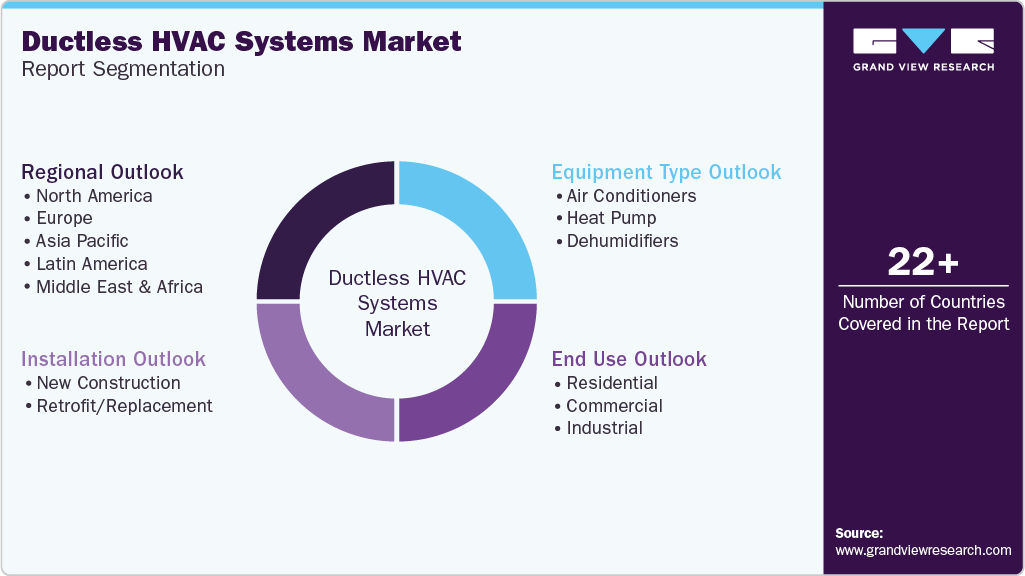
This report forecasts revenue growth at global, regional & country levels, and provides an analysis on the latest trends and opportunities in each of the sub-segments from 2021 to 2033. For this study, Grand View Research has segmented the global ductless HVAC systems market report based on the installation, equipment type, end-use, and region:
-
Installation Outlook (Revenue, USD Billion, 2021 - 2033)
-
New Construction
-
Retrofit/Replacement
-
-
Equipment Type Outlook (Revenue, USD Billion, 2021 - 2033)
-
Air Conditioners
-
Heat Pump
-
Dehumidifiers
-
-
End-use Outlook (Revenue, USD Billion, 2021 - 2033)
-
Residential
-
Commercial
-
Industrial
-
-
Regional Outlook (Revenue, USD Billion, 2021 - 2033)
-
North America
-
U.S.
-
Canada
-
Mexico
-
-
Europe
-
Spain
-
Germany
-
Italy
-
France
-
UK
-
-
Asia Pacific
-
China
-
India
-
Japan
-
Australia
-
South Korea
-
-
Latin America
-
Brazil
-
Argentina
-
-
Middle East & Africa
-
Saudi Arabia
-
UAE
-
South Africa
-
-
Frequently Asked Questions About This Report
b. The global ductless HVAC systems market size was estimated at USD 87.9 billion in 2025 and is expected to reach USD 94.8 billion in 2026
b. The global ductless HVAC systems market is expected to grow at a compound annual growth rate of 7.6% from 2026 to 2033 to reach USD 157.9 billion by 2033.
b. Asia Pacific dominated the ductless HVAC systems market with revenue share of 47.0% and is expected to remain the fastest-growing region during the forecast period. This growth is supported by rapid urbanization, expanding residential construction, and rising demand for modern cooling and heating systems in countries such as China, Japan, South Korea, and India.
b. Some of the key players operating in the ductless HVAC systems market include Daikin Industries Ltd.; Mitsubishi Electric Corporation; Fujitsu General Limited; LG Electronics; Samsung Electronics; Panasonic Corporation; Carrier; Trane Technologies plc; Lennox International Inc.; Rheem Manufacturing Company; Gree Electric Appliances Inc.; Bosch Thermotechnology; Haier Smart Home Co., Ltd.; Midea Group; Johnson Controls International plc.
b. The ductless HVAC systems market is driven by increasing demand for flexible heating and cooling solutions in residential and commercial buildings. Rising renovation activities in older structures without existing ductwork are encouraging the adoption of ductless systems


Share this report with your colleague or friend.
Need a Tailored Report?
Customize this report to your needs — add regions, segments, or data points, with 20% free customization.


ISO 9001:2015 & 27001:2022 Certified
We are GDPR and CCPA compliant! Your transaction & personal information is safe and secure. For more details, please read our privacy policy.
Trusted market insights - try a free sample
See how our reports are structured and why industry leaders rely on Grand View Research. Get a free sample or ask us to tailor this report to your needs.












