
- Home
- »
- Electronic Devices
- »
-
Digital Textile Printer Market Size, Industry Report, 2033GVR Report cover
![Digital Textile Printer Market Size, Share & Trends Report]()
Digital Textile Printer Market (2025 - 2033) Size, Share & Trends Analysis Report By Printing Process, By Operation Mode (Multi-pass, Single-pass), By Technology, By Application, By Region, And Segment Forecasts
- Report ID: GVR-4-68040-674-4
- Number of Report Pages: 130
- Format: PDF
- Historical Range: 2021 - 2023
- Forecast Period: 2025 - 2033
- Industry: Semiconductors & Electronics
- Report Summary
- Table of Contents
- Segmentation
- Methodology
- Download FREE Sample
-
 Download Sample Report
Digital Textile Printer Market Summary
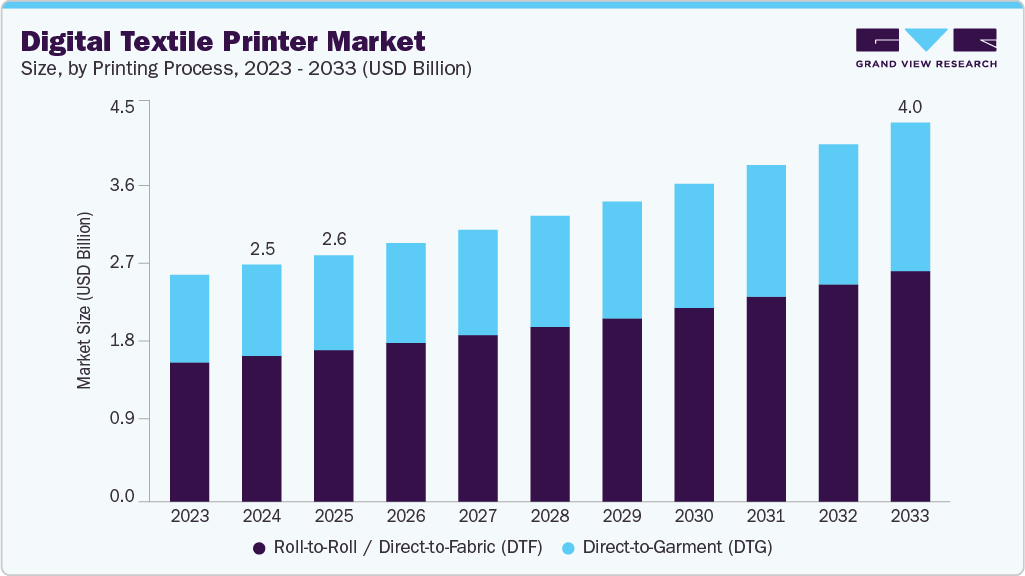
The global digital textile printer market size was estimated at USD 2.52 billion in 2024, and is projected to reach USD 4.03 billion by 2033, growing at a CAGR of 5.5% from 2025 to 2033. This steady growth is attributed to the rising demand for sustainable and on-demand textile printing, advancements in inkjet technology, increasing adoption in fashion and home décor sectors, and the shift from analog to digital workflows among textile manufacturers.
Key Market Trends & Insights
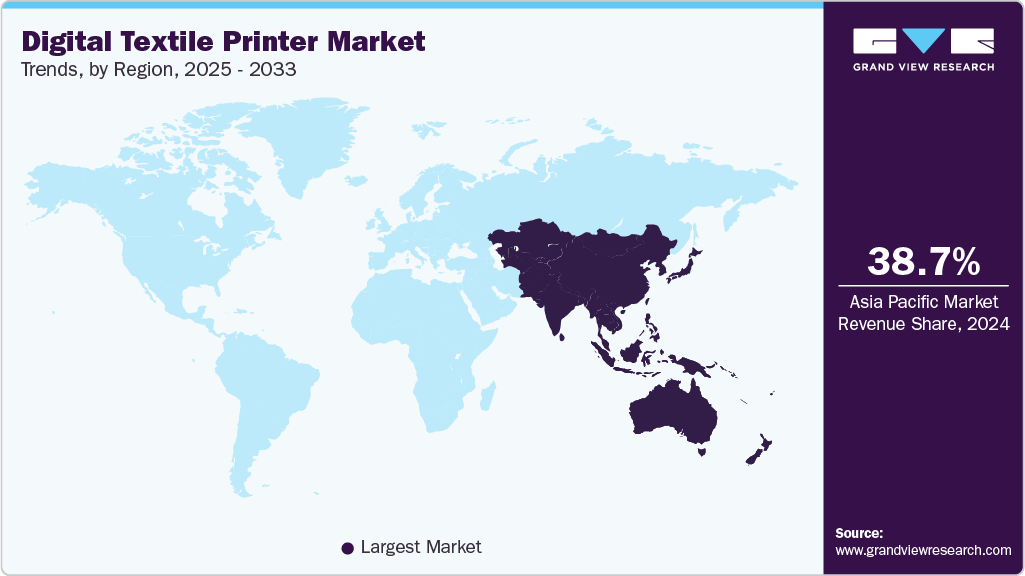
- The Asia Pacific digital textile printer market accounted for a 38.70% share of the overall market in 2024.
- The U.S. digital textile printer industry held a dominant position in 2024.
- By printing process, the roll-to-roll /direct-to-fabric segment accounted for the largest share of 66.9% in 2024.
- By operation mode, the multi-pass segment held the largest market share in 2024.
- By technology, the piezoelectric inkjet segment dominated the market in 2024.
Market Size & Forecast
- 2024 Market Size: USD 2.52 Billion
- 2033 Projected Market Size: USD 4.03 Billion
- CAGR (2025-2033):5.5%
- Asia Pacific: Largest market in 2024
The global shift towards sustainable textile manufacturing is strongly boosting the digital textile printer market. Traditional textile printing methods are water-intensive and produce large amounts of wastewater, prompting regulatory action in countries like India and China. Digital textile printing offers a eco-friendly alternative, using up to 90% less water and significantly reducing chemical discharge, as highlighted by the U.S. Environmental Protection Agency. In response, governments are promoting eco-compliant production through schemes like India’s Integrated Processing Development Scheme (IPDS), encouraging digital printer adoption in textile parks and processing zones.The e-commerce boom and consumer demand for personalized fashion are reshaping the textile industry and propelling the digital textile printer market forward. Small businesses and solo entrepreneurs are increasingly relying on print-on-demand business models to meet growing demand for custom apparel. According to the U.S. Small Business Administration, the number of apparel-based small businesses has steadily risen, especially through online platforms. With minimal setup costs and the ability to produce short runs efficiently, digital printers, particularly DTG (Direct-to-Garment) models, are becoming indispensable tools. This trend is further boosted by data from the U.S. Department of Commerce, which shows a strong increase in digital sales of personalized garments since 2021.
Government-funded innovation programs are playing a crucial role in fueling digital textile printer adoption. The European Union’s Horizon Europe initiative (2021-2027), for instance, is investing in sustainable digital technologies across industries, including textiles. As part of the EU’s “New European Bauhaus” project, funding is being directed to research in greener production processes, including single-pass digital printing and waterless ink technologies. These efforts are creating a favorable environment for small and mid-sized enterprises (SMEs) across Europe to modernize their operations with digital print capabilities. This wave of innovation and financial support is undeniably boosting the market.
The market is also being propelled by collaborative efforts between public institutions and private companies. U.S. agencies like the National Institute of Standards and Technology (NIST) have been working with textile research labs to develop better print durability and quality testing protocols. These partnerships are enhancing the reliability of digital textile printers and helping manufacturers scale up production. Programs like Manufacturing USA are actively supporting innovations in smart manufacturing, including high-speed digital printing solutions. These initiatives are not just enabling technological growth; they are actively boosting the market by building industry confidence in digital printing for large-scale production.
Global supply chain disruptions and shifting geopolitical strategies have led many countries to bring textile manufacturing back home, a move that is significantly boosting demand for digital textile printers. In the U.S., government departments like Homeland Security and Defense are allocating funds to reshoring critical industries, including textile production. Countries such as the UK and Australia are also implementing national strategies to support local textile hubs. Digital textile printers, known for their flexibility and cost-efficiency, are ideal for localized production setups. As governments roll out financial incentives and industrial stimulus packages, the demand for digital textile printing technology is experiencing strong upward momentum, further propelling the market growth.
Printing Process Insights
The Roll-to-Roll / Direct-to-Fabric (DTF) segment accounted for the largest share of 66.9% in 2024. This segment is gaining traction among manufacturers due to its ability to directly print onto a variety of fabrics, eliminating the need for transfer paper and pre-treatment processes. The flexibility it offers in handling large-scale, continuous fabric rolls is especially favored in the fashion and home décor industries. The U.S. Department of Commerce, through its textile modernization support programs, has highlighted the surge in adoption of direct-to-fabric solutions in domestic mills aiming for agile, just-in-time production. With growing demand for high-throughput, low-waste textile solutions, DTF printing is propelling market growth in both developed and emerging markets.
The Direct-to-Garment (DTG) segment is expected to grow at the fastest CAGR during the forecast period. DTG printers are particularly popular among small businesses and online clothing startups that operate on low inventory and cater to fast-changing consumer preferences. With the rise of platforms like Etsy and Shopify and a growing culture of print-on-demand, this segment has witnessed remarkable growth. According to the U.S. Small Business Administration, micro-businesses offering customized clothing grew steadily from 2021 to 2024. The DTG printing segment, with its ease of use and high-quality output for short-run orders, continues to be a key driver in the overall digital textile printing landscape.
Operation Mode Insights
The multi-pass segment held the largest market share in 2024. Multi-pass machines allow fine control over print resolution, making them ideal for short to medium production runs. This mode remains dominant in small textile units and design studios, particularly in regions like Southeast Asia and Eastern Europe, where cost-efficiency is critical. Government-supported digital manufacturing clusters in countries like Vietnam and Bangladesh have adopted multi-pass systems due to their affordability, helping to boost market uptake in emerging textile hubs steadily.
The single-pass segment is expected to grow at the fastest CAGR during the forecast period. The single-pass operation mode is driving the market toward industrial-scale production. Known for its high-speed capabilities, single-pass printing enables continuous, high-resolution printing at the commercial scale, significantly reducing turnaround times. Governments in the U.S., Germany, and South Korea have recognized this as a key technology within their Industry 4.0 programs. For example, U.S. smart manufacturing initiatives under the National Institute of Standards and Technology have supported automation pilots that incorporate single-pass systems in high-tech textile plants. These systems are increasingly used in fast-fashion manufacturing and large-scale home textile production, strengthening their role as a major market driver.
Technology Insights
The piezoelectric inkjet segment dominated the market in 2024, due to its superior control over droplet size and placement, enabling high-definition prints on diverse fabric types. This precision printing technology is ideal for both natural and synthetic textiles and is widely used in high-end fashion, signage, and interior design applications. European-funded research under Horizon Europe has highlighted piezoelectric systems as a key enabler for sustainable pigment ink usage, contributing to water and energy savings. The versatility and efficiency of piezoelectric inkjet heads are thus boosting their adoption in both SME-level and industrial operations.
The Others segment is projected to grow at a significant CAGR over the forecast period. Other digital print technologies, such as thermal inkjet and electrostatic systems, are carving out niche applications in the digital textile space, particularly in technical textiles and hybrid material printing. While they hold a smaller market share compared to piezoelectric systems, these technologies are propelling growth in applications like smart textiles and medical fabrics, where precision and specialized substrates are critical. Government-sponsored textile R&D, particularly in Japan and Switzerland, has emphasized the development of smart textiles using innovative print heads and functional inks, reinforcing growth in this emerging subsegment.
Application Insights
The clothing & apparel segment dominated the market in 2024 and is projected to grow at the fastest CAGR over the forecast period, driven by demand for fast fashion, custom wear, and eco-conscious manufacturing. Digital printing enables designers and brands to respond quickly to changing trends without holding excessive inventory. In countries like the UK and India, where small-scale garment producers are rising due to government-led MSME support schemes, the adoption of digital printing for apparel is surging. The segment benefits from streamlined sampling, cost-effective short runs, and minimal environmental impact, all crucial factors propelling the market in this space.
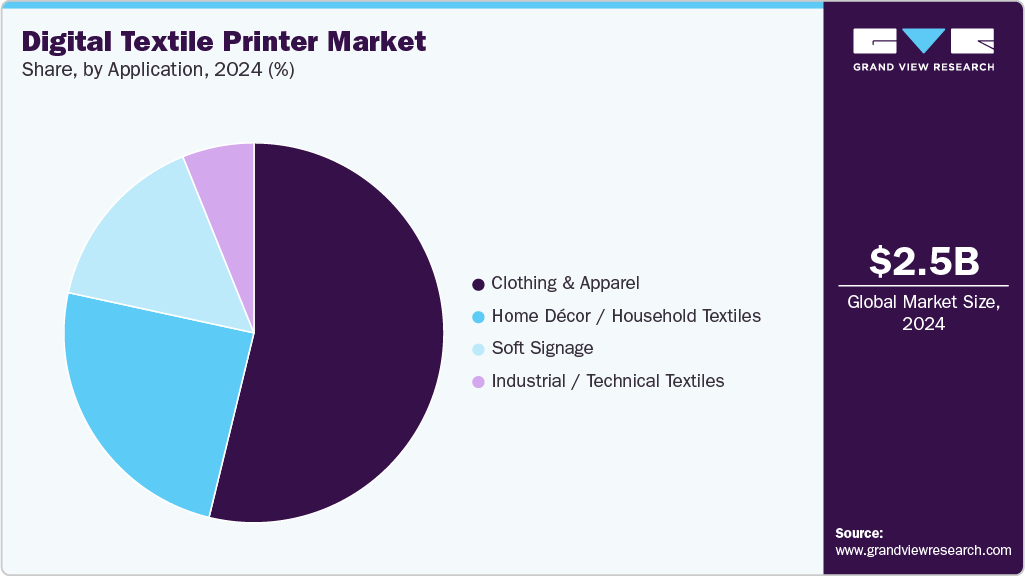
The soft signage segment is projected to grow at a significant CAGR over the forecast period. The soft signage segment is propelling growth through the increased use of fabric-based advertising and display solutions across retail, exhibitions, and events. Unlike traditional vinyl signage, soft signage offers lightweight, reusable, and aesthetically superior alternatives. As public sector campaigns and green policies promote sustainable advertising formats, especially in Europe and the U.S., demand for fabric-based digital printing is accelerating. According to recent U.S. Department of Energy efficiency recommendations, soft signage is favored due to lower transportation costs and reusability. This shift is creating fresh opportunities for digital printers, especially those compatible with polyester and backlit textile materials.
Regional Insights
The North America digital textile printer market accounted for a 21.3% share of the overall market in 2024 and is projected to grow at a significant CAGR over the forecast period. In North America, digital textile printing adoption is being boosted by government-supported innovation and reshoring strategies. The U.S. Department of Commerce has prioritized onshore textile production through its Manufacturing Extension Partnership (MEP) program, helping SMEs adopt advanced manufacturing, including digital textile printing, to increase flexibility and reduce overseas dependence. Digital printers support fast-turnaround domestic apparel manufacturing, aligning with the reshoring trend. The U.S. International Trade Commission noted increased imports of digital textile printing inks and machinery components from 2021-2023, pointing to a transition in domestic production infrastructure.
U.S. Digital Textile Printer Market Trends
The U.S. Digital Textile Printer industry held a dominant position in 2024.In the U.S., the rise in sustainable fashion and personalized apparel is propelling the digital textile printer market. According to the U.S. Environmental Protection Agency, digital printing significantly reduces water and chemical use compared to traditional screen printing, a key motivator for local producers facing environmental scrutiny. The SBA reports growing e-commerce entrepreneurship in customized clothing, driven by DTG (Direct-to-Garment) technology. Federal funding under NIST’s Manufacturing USA initiative also supports R&D for digitally-enabled textile production, fostering wider adoption of high-speed, low-waste printers.
Europe Digital Textile Printer Market Trends
Europe’s digital textile printing market is boosted by the EU’s commitment to sustainable and circular textile systems. The European Commission, through its Textiles Strategy for Sustainable and Circular Textiles (2022), emphasizes water-saving and chemical-free technologies like digital printing. The Horizon Europe 2021-2027 program invests in R&D for advanced print technologies and fabric recycling. These initiatives are directly fueling demand for digital printers that comply with eco-design and low-emission targets.
The Germany digital textile printer market is propelling due to smart manufacturing under the Industry 4.0 framework. Supported by the Federal Ministry for Economic Affairs and Climate Action, German textile firms are encouraged to digitize production chains. Programs like “Digital Jetzt” have supported SMEs in adopting high-efficiency, single-pass printing systems. Germany’s Federal Environment Agency also promotes digital printing for reducing textile sector emissions and aligning with EU climate goals.
The UK digital textile printer market is being boosted by efforts to revive domestic textile production, partly driven by post-Brexit trade shifts. The UK Research and Innovation (UKRI) agency has funded multiple projects that integrate digital print technologies with AI and robotics for apparel manufacturing. For example, the Future Fashion Factory initiative, supported by UKRI, is piloting real-time digital printing systems to enhance customization and reduce textile waste. These trends are helping small businesses scale sustainably using on-demand printing.
Asia Pacific Digital Textile Printer Market Trends
Asia-Pacific is propelling digital textile printer demand due to increasing exports and rapid factory modernization. According to the Asian Productivity Organization, member countries are prioritizing smart technologies for textile competitiveness. Digital textile printing, particularly in pigment-based and DTF applications, is replacing traditional dyeing to meet stricter Western environmental import standards. The WTO and regional trade compliance programs are indirectly encouraging digital printing as a cleaner and faster alternative for APAC exporters.
The China digital textile printer market is boosted by tightening environmental controls and export requirements. The Ministry of Ecology and Environment has enforced stricter wastewater discharge norms, pushing textile factories to adopt digital printing. At the same time, initiatives under “Made in China 2025” support the adoption of intelligent manufacturing systems, including high-speed textile printers. These twin factors, eco-regulations and automation incentives, are accelerating printer adoption in major textile clusters like Zhejiang and Guangdong.
The Japan digital textile printer market is propelled by R&D in smart textiles and industrial fabrics, supported by the National Institute of Advanced Industrial Science and Technology. Government programs encourage collaboration between universities and textile firms for advanced materials and printing innovations. Japan’s Ministry of Economy, Trade and Industry also promotes domestic adoption of digital printing to improve productivity in shrinking local apparel markets and strengthen exports of high-tech fabrics.
The India digital textile printer market is boosted by government-led MSME support and pollution reduction schemes. Under the Ministry of Textiles’ “Integrated Processing Development Scheme”, clusters are being upgraded with energy-efficient, low-water technologies like digital printers. Additionally, the Zero Liquid Discharge (ZLD) norms enforced by the Central Pollution Control Board are pressuring traditional dyeing units to switch to cleaner digital processes. The convergence of environmental policies and financial incentives is significantly propelling digital textile printing adoption in India.
Key Digital Textile Printer Company Insights
Some of the major players in the Digital Textile Printer market include Seiko Epson Corporation, Ricoh Company Ltd., Konica Minolta, Inc., MIMAKI ENGINEERING CO., LTD., Brother International Corporation, among others. These companies offer a diverse portfolio of high-performance printers tailored to various applications such as fashion apparel, home textiles, and soft signage. Their solutions feature proprietary printhead technology, eco-friendly pigment ink systems, and scalable platforms that cater to both small businesses and industrial-scale operations. Moreover, their strategic focus on sustainability, automation, and integration with digital workflows has allowed them to align with current industry trends such as on-demand printing and reduced water consumption. Continuous innovation, partnerships with textile producers, and presence at major global trade exhibitions further reinforce their dominance in this rapidly evolving market.
-
Seiko Epson Corporation is a global technology leader based in Japan, recognized for its precision printing solutions and a dominant presence in the digital textile printer market. The company’s digital textile printers, particularly the SureColor series, leverage its proprietary Micro Piezo printhead technology to deliver high-resolution, efficient, and reliable performance across applications such as fashion, home décor, and soft signage. With in-house development of inks, hardware, and software, Epson ensures seamless integration and operational consistency. Its focus on sustainability, through reduced water and energy use, combined with a strong global distribution network and continuous innovation, positions Epson as a top-tier player in the textile printing ecosystem.
-
Kornit Digital, headquartered in Israel, is a market innovator specializing in end-to-end direct-to-garment (DTG) and direct-to-fabric (DTF) digital textile printing solutions tailored for on-demand and sustainable production. The company’s proprietary NeoPigment ink technology enables vibrant, waterless printing on a variety of fabrics without the need for pre- or post-treatment, simplifying operations and reducing environmental impact. Kornit stands out for its scalable platforms, like the Apollo, and its unique All-Inclusive Click (AIC) pricing model, making industrial-grade printing accessible to businesses of all sizes. With a global customer base and a strong focus on automation, customization, and eco-efficiency, Kornit continues to lead digital transformation in the textile industry.
Key Digital Textile Printer Companies:
The following are the leading companies in the digital textile printer market. These companies collectively hold the largest market share and dictate industry trends.
- Seiko Epson Corporation
- Ricoh Company Ltd.
- Kornit Digital
- Konica Minolta, Inc.
- Brother International Corporation
- MIMAKI ENGINEERING CO., LTD.
- Electronics For Imaging, Inc.
- Colorjet Group
- Atexco
- aeoon Technologies GmbH
Recent Developments
-
In May 2025, Kornit Digital launched the Apollo, a high-throughput DTG printer capable of producing up to 400 garments per hour. Introduced alongside their new All-Inclusive Click (AIC) pay-per-print model at FESPA 2025, the solution is designed to lower total cost of ownership while enabling scalable, sustainable, on-demand textile production.
-
In July 2024, Seiko Epson Corporation introduced the SureColor SC‑F9500H dye-sublimation printer at FESPA, offering a 64″ print width, extended CMYK+Orange+Violet ink configuration, and PrecisionCore MicroTFP printheads. This upgrade delivers a 20% wider color gamut and up to 30% faster productivity for high-volume apparel and soft signage printing.
Digital Textile Printer Market Report Scope
Report Attribute
Details
Market size value in 2025
USD 2.63 billion
Revenue forecast in 2033
USD 4.03 billion
Growth rate
CAGR of 5.5% from 2025 to 2033
Base year for estimation
2024
Historical data
2021 - 2023
Forecast period
2025 - 2033
Quantitative units
Revenue in USD million/billion and CAGR from 2025 to 2033
Report coverage
Revenue forecast, company ranking, competitive landscape, growth factors, and trends
Segments covered
Printing process, operation mode, technology, application, region
Regional scope
North America; Europe; Asia Pacific; Latin America; Middle East & Africa
Country scope
U.S.; Canada; Mexico; Germany; UK; France; China; Japan; India; South Korea; Australia; Brazil; KSA; UAE; South Africa
Key companies profiled
Seiko Epson Corporation; Ricoh Company Ltd.; Kornit Digital; Konica Minolta, Inc.; Brother International Corporation; MIMAKI ENGINEERING CO., LTD.; Electronics For Imaging, Inc.; Colorjet Group; Atexco ; aeoon Technologies GmbH
Customization scope
Free report customization (equivalent up to 8 analysts working days) with purchase. Addition or alteration to country, regional & segment scope.
Pricing and purchase options
Avail customized purchase options to meet your exact research needs. Explore purchase options
Global Digital Textile Printer Market Report Segmentation
This report forecasts revenue growth at the global, regional, and country levels and provides an analysis of the latest industry trends in each of the sub-segments from 2021 to 2033. For this study, Grand View Research has segmented the global digital textile printer market report based on printing process, operation mode, technology, application, and region.
-
Printing Process Outlook (Revenue, USD Million, 2021 - 2033)
-
Roll-to-Roll / Direct-to-Fabric (DTF)
-
Direct-to-Garment (DTG)
-
-
Operation Mode Outlook (Revenue, USD Million, 2021 - 2033)
-
Multi-pass
-
Single-pass
-
-
Technology Outlook (Revenue, USD Million, 2021 - 2033)
-
Piezoelectric Inkjet
-
Electrophotography
-
Electrostatic Printing
-
Continuous Inkjet (CIJ)
-
Others
-
- Application Outlook (Revenue, USD Million, 2021 - 2033)
-
Clothing & Apparel
-
Home Décor / Household Textiles
-
Soft Signage
-
Industrial / Technical Textiles
-
-
Regional Outlook (Revenue, USD Million, 2021 - 2033)
-
North America
-
U.S.
-
Canada
-
Mexico
-
-
Europe
-
Germany
-
UK
-
France
-
-
Asia Pacific
-
China
-
Japan
-
India
-
South Korea
-
Australia
-
-
Latin America
-
Brazil
-
-
Middle East and Africa (MEA)
-
KSA
-
UAE
-
South Africa
-
-
Frequently Asked Questions About This Report
b. The global digital textile printer market size was estimated at USD 2.52 billion in 2024 and is expected to reach USD 2.63 billion in 2025.
b. The global digital textile printer market size is expected to grow at a significant CAGR of 5.5% to reach USD 4.03 billion in 2033.
b. Asia Pacific held the largest market share of 38.7% in 2024. Asia-Pacific is propelling digital textile printer demand due to increasing exports and rapid factory modernization. According to the Asian Productivity Organization, member countries are prioritizing smart technologies for textile competitiveness.
b. Some of the players in the digital textile printer market are Seiko Epson Corporation, Ricoh Company Ltd., Kornit Digital, Konica Minolta, Inc., Brother International Corporation, MIMAKI ENGINEERING CO., LTD., Electronics For Imaging, Inc., Colorjet Group, Atexco, and aeoon Technologies GmbH.
b. The key driving trend in the digital textile printer market is the push towards sustainable, on-demand, and highly customizable textile printing.


Share this report with your colleague or friend.
Need a Tailored Report?
Customize this report to your needs — add regions, segments, or data points, with 20% free customization.


ISO 9001:2015 & 27001:2022 Certified
We are GDPR and CCPA compliant! Your transaction & personal information is safe and secure. For more details, please read our privacy policy.
Trusted market insights - try a free sample
See how our reports are structured and why industry leaders rely on Grand View Research. Get a free sample or ask us to tailor this report to your needs.












