
- Home
- »
- Next Generation Technologies
- »
-
Decentralized Identity Market Size, Industry Report, 2033GVR Report cover
![Decentralized Identity Market Size, Share & Trends Report]()
Decentralized Identity Market (2026 - 2033) Size, Share & Trends Analysis Report By Identity Type (Non-biometrics, Biometrics), By End User (Individual, Enterprises), By Enterprise Size (Large Enterprises, Small & Medium Enterprises), By Vertical, By Region, And Segment Forecasts
- Report ID: GVR-4-68039-979-6
- Number of Report Pages: 120
- Format: PDF
- Historical Range: 2021 - 2025
- Forecast Period: 2026 - 2033
- Industry: Technology
- Report Summary
- Table of Contents
- Interactive Charts
- Methodology
- Download FREE Sample
-
 Download Sample Report
Decentralized Identity Market Summary
The global decentralized identity market size is estimated at USD 3.65 billion in 2025 and is projected to reach USD 258.18 billion by 2033, growing at a CAGR of 68.2% from 2026 to 2033. Privacy and security concerns have become increasingly prominent in today's digital landscape.
Key Market Trends & Insights
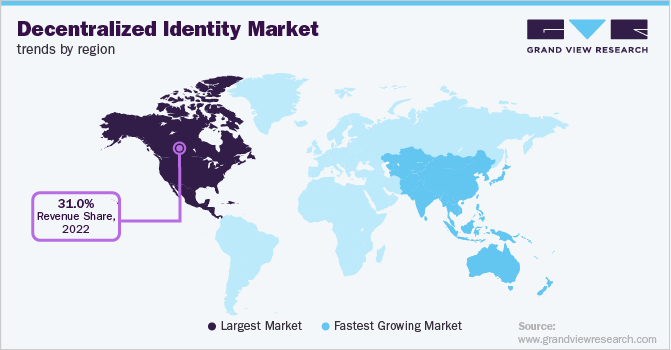
- North America dominated the global decentralized identity market with the largest revenue share of 32.8% in 2025.
- By identity type, the biometric segment led the market, holding the largest revenue share of 66.0% in 2025.
- By end user, the enterprises segment held the dominant position in the market and accounted for the leading revenue share of 64.5% in 2025.
- By vertical, the BFSI segment held the dominant position in 2025.
- By end user, an individual segment is expected to grow at the fastest CAGR of 69.4% from 2026 to 2033.
Market Size & Forecast
- 2025 Market Size: USD 3.65 Billion
- 2033 Projected Market Size: USD 258.18 Billion
- CAGR (2026-2033): 68.2%
- North America: Largest market in 2025
With traditional centralized identity systems, individuals have limited control over their data, which raises concerns about data breaches and unauthorized access. Decentralized identity (ID) solutions offer a more secure and privacy-centric approach by enabling individuals to own and control their digital identities.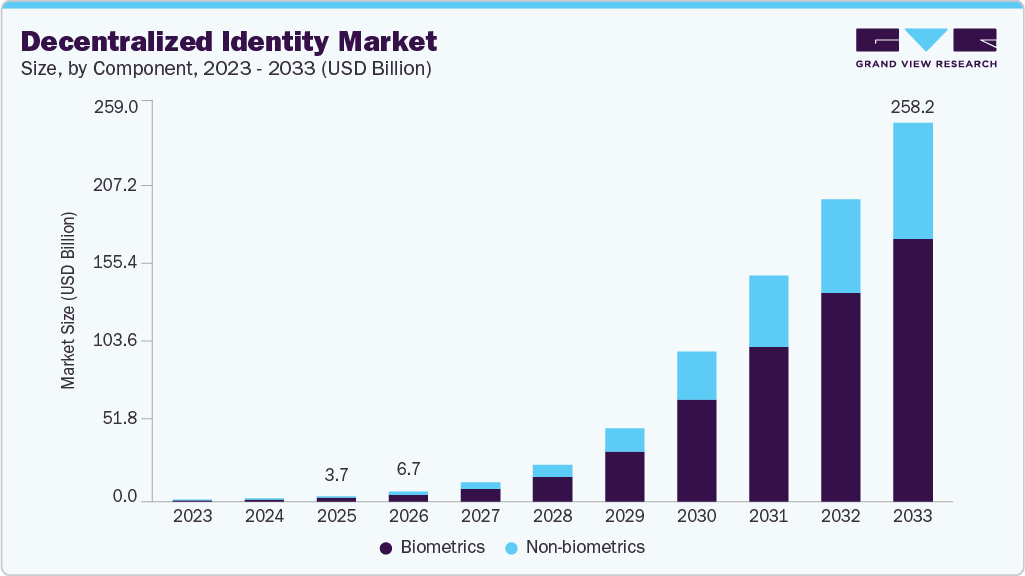
The rise of blockchain technology has paved the way for decentralized identity solutions. Blockchain provides a transparent and immutable ledger that can securely store and verify identity information. This eliminates the requirement for intermediaries and creates a trustless environment where identity verification can be done directly between parties, reducing costs and improving efficiency. Moreover, increasing demand for frictionless and seamless user experiences is accentuating the acceptance of decentralized ID worldwide.
Traditional identity verification processes can be cumbersome, involving multiple usernames, passwords, and authentication methods. Decentralized identity solutions offer a single, portable digital identity that can be easily verified across different platforms and services, simplifying the user experience. Furthermore, regulatory requirements and compliance standards are expected to push organizations to adopt decentralized identity solutions. Regulations such as the California Consumer Privacy Act (CCPA) and General Data Protection Regulation (GDPR) in Europe require businesses to handle personal data responsibly and provide individuals with greater control over their data. Decentralized identity solutions align with these regulations by giving individuals ownership and control over their personal information.
Increasing digitalization of various industries, such as finance, healthcare, and e-commerce, is fueling demand for decentralized identity. These sectors require robust identity verification processes to ensure secure transactions and protect sensitive data. Decentralized identity solutions offer a reliable and tamper-proof method of identity verification. As a result, it mitigates risks associated with identity theft and fraud.
However, the challenge of widespread adoption and interoperability is restraining market growth. While decentralized identity solutions offer numerous benefits, transitioning from traditional identity systems to decentralized models can be complex and require a significant shift in infrastructure and user behavior. In addition, different decentralized identity platforms may also use different standards and protocols, leading to interoperability issues between systems. To overcome this restraint, industry collaboration and the development of open standards are essential. Stakeholders, including technology providers, industry associations, and regulatory bodies, need to work in unison to establish common frameworks and interoperability standards for decentralized identity
Identity Type Insights
The biometrics segment accounted for the largest share of 66.0% in 2025. Biometric identifiers, such as fingerprints, facial recognition, iris scans, and voice recognition, provide a high level of precision and security in authenticating an individual's identity. This type of identity verification offers a strong level of verification and is difficult to forge or replicate, making it highly reliable for forming trust in digital interactions. Biometric identity also offers convenience and ease of use for users. With biometric authentication, individuals can confirm their identity quickly and seamlessly by solely using their distinctive biological traits. This excludes the necessity for passwords or other traditional forms of authentication, which can be easily forgotten, stolen, or compromised.
The non-biometrics segment is expected to grow at a significant CAGR during the forecast period. The non-biometrics segment in the market is anticipated to witness substantial growth over the forecast period, driven by rising consumer preference for convenient, portable, and device-agnostic authentication methods such as PINs, passwords, OTPs, smart cards, and token-based credentials. As digital services expand across banking, e-governance, travel, and e-commerce platforms, users increasingly demand identity solutions that can be easily deployed without specialized hardware or biometric capture devices. Non-biometric authentication methods offer greater flexibility, faster onboarding, and lower implementation costs, particularly in emerging markets where biometric infrastructure may be limited.
End User Insights
The enterprises segment held the largest market share in 2025. Growing concern for reducing business risk is a significant factor driving segment growth. Moreover, a decentralized identity framework enables enterprises to control users’ identities independently of the identity issuer. Furthermore, a decentralized identity eliminates the initial need for organizations to gather and store personal data. Additionally, the rising frequency of cyberattacks and data breaches has compelled enterprises to invest heavily in advanced identity verification, authentication, and governance solutions to safeguard sensitive information and maintain customer trust.
The individual segment is expected to register the fastest CAGR during the forecast period. Scalability and flexibility offered by the cloud segment fuel its growth in the market. The individual segment growth can be attributed to the increasing adoption of decentralized identity solutions by individuals for creating and maintaining their identities. Furthermore, decentralized identity solutions help individuals verify and authenticate themselves in various identification processes for different use cases, such as loan sanctioning, bank account opening, and other KYC processes, among others. Thus, such wide use cases of decentralized identity to individual users are further expected to drive growth of the segment over the forecast period.
Enterprise Size Insights
The large enterprise segment dominated the market in 2025. Large organizations across sectors such as banking, telecom, healthcare, and government are prioritizing advanced digital identity and access management solutions to secure multi-cloud environments, enable secure remote workforce access, and streamline customer onboarding processes. The increasing adoption of zero-trust architectures, single sign-on (SSO), and multi-factor authentication (MFA) frameworks has further accelerated investments among large enterprises, as they require scalable and interoperable identity systems capable of managing millions of user credentials and transactions.
The small & medium enterprises segment is projected to grow at the fastest CAGR over the forecast period. The Small enterprises typically try to digitalize their services and enhance customer experience. Furthermore, the application of blockchain technology-based identity management can be widely adopted as a means of guaranteeing the protection of private information and improving accountability and trust between parties. In addition, SMEs also benefit from increased product and service efficiency and quality, improved supply chain management, and blockchain-driven business model innovation.
Vertical Insights
The BFSI segment dominated the market in 2025. Banks are required to conduct KYC checks to confirm customers' identity and ensure they are not involved in any illegal activity, such as bribery or money laundering. Financial institutions are increasingly investing in advanced digital identity verification, e-KYC, and multi-factor authentication solutions to combat rising incidents of identity theft, account takeover fraud, and money laundering. The surge in online account openings, mobile banking adoption, and cross-border digital transactions has further accelerated the need for secure, seamless, and real-time identity authentication systems.
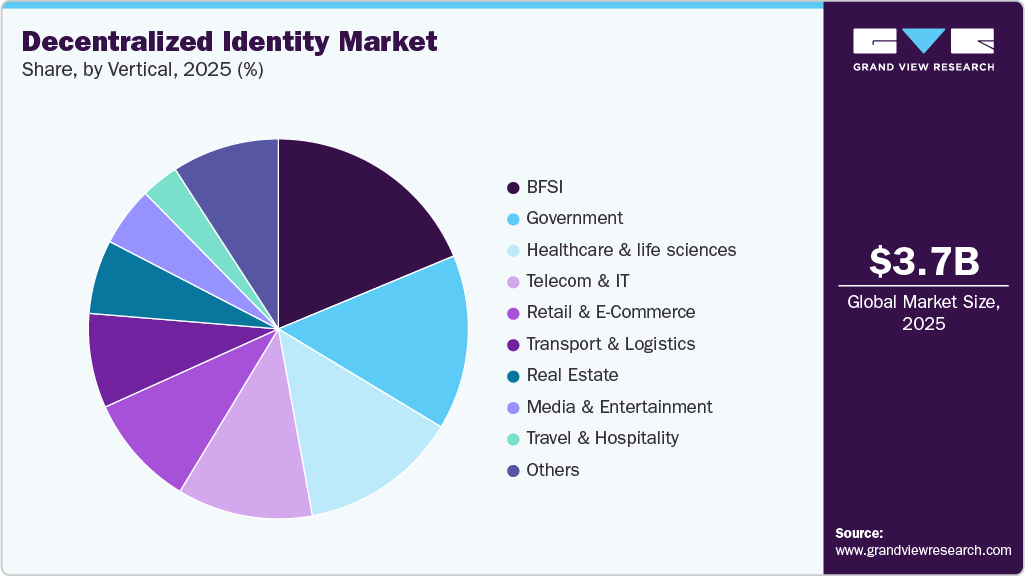
The telecom & IT segment is expected to witness the fastest CAGR over the forecast period. With increasing digitization of communication and growing demand for secure and seamless identity verification, the telecom & IT segment is actively exploring decentralized identity solutions to enhance user experiences and ensure robust security. Telecom and IT companies often handle a vast amount of sensitive customer data, including personal information and authentication credentials. By adopting decentralized identity solutions, they can provide their customers with greater control and ownership over their identity information while also enhancing data privacy and protection.
Regional Insights
The North America decentralized identity market held a significant share in 2025. Public and private sector organizations are actively investing in decentralized identity frameworks to enhance data privacy, strengthen cybersecurity, and enable secure digital service delivery. Integration of decentralized identity into broader digital infrastructure strategies, including e-government services and financial systems, is supporting regional growth.
U.S. Decentralized Identity Market Trends
The decentralized identity market in the U.S. dominated the North American market in 2025, fueled by rapid technological innovation and strong regulatory emphasis on data protection and identity security. Increasing adoption of blockchain-based identity platforms, self-sovereign identity (SSI) models, and zero-trust security architectures across BFSI, healthcare, and government sectors is accelerating market expansion.
Europe Decentralized Identity Market Trends
The decentralized identity market in Europe was identified as a lucrative region in 2025. Regulatory frameworks such as eIDAS 2.0 and the European Digital Identity Wallet initiative are encouraging widespread adoption of interoperable decentralized identity systems. Countries such as Germany and France are actively implementing blockchain-based digital identity programs to improve cross-border authentication and secure digital transactions.
The UK decentralized identity market is expected to grow rapidly in the coming years due to increasing digital service adoption and strong fintech innovation. Public and private institutions are investing in decentralized identity to enhance secure online verification, combat identity fraud, and improve trust in digital interactions.
Asia Pacific Decentralized Identity Market Trends
The decentralized identity market in the Asia Pacific accounted for a 24.3% share of the overall market in 2025. Countries such as China, India, Japan, and others are actively exploring and piloting decentralized identity frameworks to enhance secure digital payments, streamline e-governance services, and facilitate trusted cross-border digital trade. The rising incidence of cyber threats, data breaches, and identity fraud has prompted enterprises and governments to shift toward privacy-centric, blockchain-enabled identity architectures that provide greater user control and data security. Additionally, increasing smartphone penetration, expanding internet connectivity, and the rapid growth of digital wallets and super apps are creating a strong foundation for decentralized identity adoption.
Japan decentralized identity market is expected to grow rapidly in the coming years, owing to strong growth due to its focus on secure digital infrastructure and increasing demand for user-friendly digital authentication systems.
The decentralized identity market in China held a substantial market share in 2025, owing to the large-scale digital infrastructure expansion and integration of blockchain technologies into government and commercial identity systems.
Key Decentralized Identity Company Insights
Some of the key companies in the market include Microsoft Corporation, Accenture plc, Persistent Systems Limited, Wipro Limited, and others. Organizations are focusing on increasing their customer base to gain a competitive edge in the industry. Therefore, key players are taking several strategic initiatives, such as mergers and acquisitions, and partnerships with other major companies.
-
Microsoft Corporation is one of the global technology leaders offering comprehensive decentralized identity solutions through its Azure Active Directory and Microsoft Entra platforms. The company focuses on enabling secure, passwordless authentication, self-sovereign identity (SSI), and enterprise-grade identity governance across cloud and hybrid environments. Microsoft leverages blockchain technology, advanced cryptography, and AI-driven security to ensure robust identity verification while giving users greater control over personal data.
-
Accenture plc is a global professional services company providing consulting, technology, and implementation services for decentralized identity solutions. Through its Identity & Security practice, Accenture helps organizations design, deploy, and manage blockchain-based identity frameworks, including self-sovereign identity systems and digital credentialing platforms. The company partners with public and private sector entities to improve secure access, compliance, and trust in digital interactions.
Key Decentralized Identity Companies:
The following key companies have been profiled for this study on the decentralized identity market.
- Microsoft Corporation
- Accenture plc
- Wipro Limited
- SecureKey Technologies Inc.
- Persistent Systems Limited
- Avast Software s.r.o.
- Civic Technologies, Inc.
- R3
- Validated ID, SL
- Dragonchain
- Nuggets
- 1Kosmos Inc.
Recent Developments
-
In June 2025, Microsoft Entra introduced Microsoft Entra Agent ID, a capability designed to bring decentralized identity and access management to AI agents across enterprise environments. This innovation assigns each AI agent a unique verifiable identity, enabling secure authentication, authorization, and lifecycle management across tools and systems. Organizations can apply Conditional Access policies, enforce least-privilege access, and monitor agent activity just like they would for human users. By integrating Agent ID with existing Microsoft Entra Verified ID workflows, enterprises can issue, verify, and manage decentralized credentials at scale, enhancing security, privacy, and compliance across cloud, hybrid, and AI-driven operations.
-
In January 2025, Identity.com launched a mobile app on the Apple App Store and Google Play Store for decentralized identity management. The app allowed individuals to store verifiable credentials, such as IDs and proof of uniqueness, and use them to validate their identity and prove age while retaining control over personal data. Businesses leveraged the platform to simplify Know Your Customer (KYC) processes and streamline identity verification using self-sovereign identity (SSI) principles. The company highlighted trends for 2025, emphasizing growing consumer demand for data privacy, the expansion of global privacy laws, and the rise of privacy-enhancing technologies such as homomorphic encryption.
Decentralized Identity Market Report Scope
Report Attribute
Details
Market size value in 2026
USD 6.77 billion
Revenue forecast in 2033
USD 258.18 billion
Growth rate
CAGR of 68.2% from 2026 to 2033
Actual data
2021 - 2025
Forecast period
2026 - 2033
Quantitative units
Revenue in USD million/billion and CAGR from 2026 to 2033
Report coverage
Revenue forecast, company ranking, competitive landscape, growth factors, and trends
Segments covered
Identity type, end user, enterprise size, vertical, region
Regional scope
North America, Europe, Asia Pacific, Latin America, MEA
Country scope
U.S.; Canada; Mexico; Germany; UK; France; Spain; Italy; China; Japan; India; South Korea; Australia; Brazil; KSA; UAE; South Africa
Key companies profiled
Microsoft Corporation; Accenture plc; Wipro Limited; SecureKey Technologies Inc.; Persistent Systems Limited; Avast Software s.r.o.; Civic Technologies, Inc.; R3; Validated ID, SL; Dragonchain; Nuggets; 1Kosmos Inc.
Customization scope
Free report customization (equivalent up to 8 analysts working days) with purchase. Addition or alteration to country, regional & segment scope.
Pricing and purchase options
Avail customized purchase options to meet your exact research needs. Explore purchase options
Global Decentralized Identity Market Report Segmentation
This report forecasts revenue growth at global, regional, and country levels and provides an analysis of the latest industry trends in each of the sub-segments from 2021 to 2033. For this study, Grand View Research has segmented the decentralized identity market report based on identity type, end user, enterprise size, vertical, and region:
-
Identity Type Outlook (Revenue, USD Million, 2021 - 2033)
-
Biometric
-
Non Biometric
-
-
End User Outlook (Revenue, USD Million, 2021 - 2033)
-
Individual
-
Enterprises
-
-
Enterprise Size Outlook (Revenue, USD Million, 2021 - 2033)
-
Large Enterprises
-
Small & Medium Enterprises
-
-
Verticals Outlook (Revenue, USD Million, 2021 - 2033)
-
BFSI
-
Government
-
Healthcare & Life Sciences
-
Retail & E-Commerce
-
Telecom & IT
-
Transportation & Logistics
-
Real Estate
-
Media & Entertainment
-
Travel & Hospitality
-
Others
-
-
Regional Outlook (Revenue, USD Billion, 2021 - 2033)
-
North America
-
U.S.
-
Canada
-
Mexico
-
-
Europe
-
Germany
-
UK
-
France
-
Spain
-
Italy
-
-
Asia Pacific
-
China
-
Japan
-
India
-
South Korea
-
Australia
-
-
Latin America
-
Brazil
-
-
Middle East and Africa (MEA)
-
KSA
-
UAE
-
South Africa
-
-
Frequently Asked Questions About This Report
b. Some key players operating in the decentralized Identity market include Microsoft Corporation, Accenture plc, Wipro Limited and Subsidiaries, Secure Technologies Inc., Persistent Systems Limited, Avast Software s.r.o., Civic Technologies, Inc., R3, Validated ID, SL; Dragonchain, Nuggets, and Kosmos Inc.
b. Key factors that are driving the decentralized identity market growth include increasing thefts and fraudulent incidences and increasing applications of blockchain technology
b. The global decentralized identity market size was estimated at USD 3.65 billion in 2025 and is expected to reach USD 6.77 billion in 2026.
b. The global decentralized identity market is expected to grow at a compound annual growth rate of 68.2% from 2026 to 2033 to reach USD 258.18 billion by 2033.
b. North America dominated the decentralized identity market with a share of 32.80% in 2025 . The growing preference to protect against identity thefts across North America is anticipated to propel regional market growth over the forecast period.


Share this report with your colleague or friend.
Need a Tailored Report?
Customize this report to your needs — add regions, segments, or data points, with 20% free customization.


ISO 9001:2015 & 27001:2022 Certified
We are GDPR and CCPA compliant! Your transaction & personal information is safe and secure. For more details, please read our privacy policy.
Trusted market insights - try a free sample
See how our reports are structured and why industry leaders rely on Grand View Research. Get a free sample or ask us to tailor this report to your needs.












