
- Home
- »
- Advanced Interior Materials
- »
-
Construction Adhesives Market Size, Industry Report, 2033GVR Report cover
![Construction Adhesives Market Size, Share & Trends Report]()
Construction Adhesives Market (2026 - 2033) Size, Share & Trends Analysis Report By Resin Type (Acrylic Adhesive, Polyurethanes, Polyvinyl Acetate, Epoxy, Others), By Technology, By Application, By Region, And Segment Forecasts
- Report ID: GVR-1-68038-684-4
- Number of Report Pages: 80
- Format: PDF
- Historical Range: 2021 - 2024
- Forecast Period: 2026 - 2033
- Industry: Advanced Materials
- Report Summary
- Table of Contents
- Segmentation
- Methodology
- Download FREE Sample
-
 Download Sample Report
Construction Adhesives Market Summary
The global construction adhesives market size was valued at USD 11.7 billion in 2025 and is projected to reach USD 16.6 billion by 2033, growing at a CAGR of 4.3% from 2026 to 2033. The market is expanding because builders need stronger, faster, and cleaner bonding solutions that improve durability, reduce installation time, support modern materials, and meet rising performance expectations.
Key Market Trends & Insights
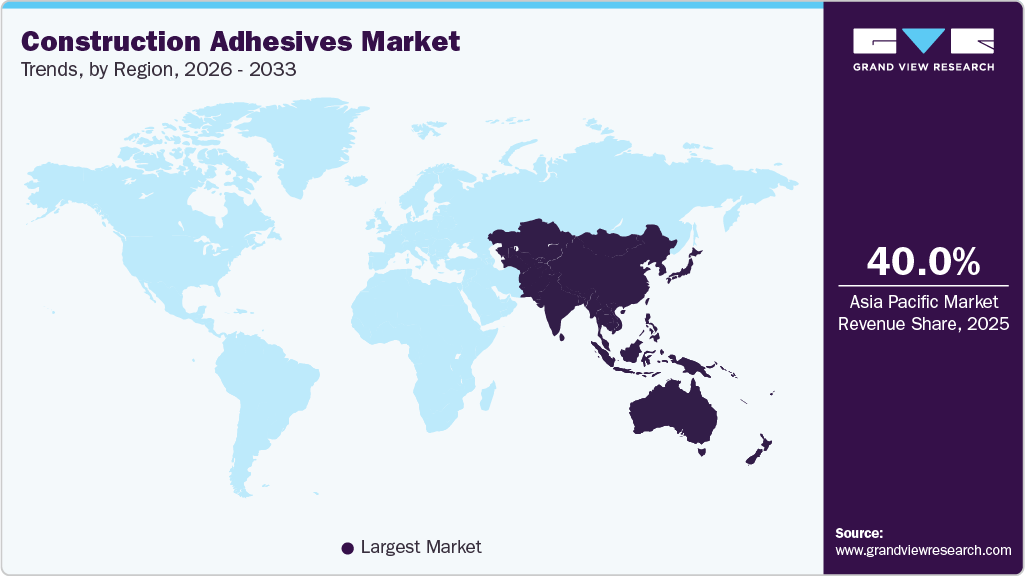
- Asia Pacific held the largest share of the market in 2025, accounting for 40.0% of revenue.
- The China construction adhesives industry led Asia Pacific, with a revenue share of 51.3% in 2025.
- By resin type, the acrylic adhesive segment dominated the market and accounted for the largest revenue share of 44.6% in 2025.
- By technology, reactive & others segment is projected to grow at a CAGR of 4.5% from 2026 to 2033.
- By application, the commercial segment held the largest revenue share of 35.2% in 2025.
Market Size & Forecast
- 2025 Market Size: USD 11.7 Billion
- 2033 Projected Market Size: USD 16.6 Billion
- CAGR (2026-2033): 4.3%
- Asia Pacific: Largest market in 2025
Construction adhesives are gaining wider acceptance as construction methods increasingly prioritize efficiency, precision, and material compatibility. Traditional fastening methods often create limitations in design flexibility, surface finish, and labor productivity. Adhesives solve these issues by enabling uniform bonding across varied substrates while reducing visible mechanical joints. Their ability to improve structural integrity, vibration resistance, and moisture performance makes them valuable in both structural and non-structural applications. As construction projects become more quality-focused, adhesives are being selected not only as supporting materials but as performance-enhancing inputs that contribute directly to long-term asset reliability.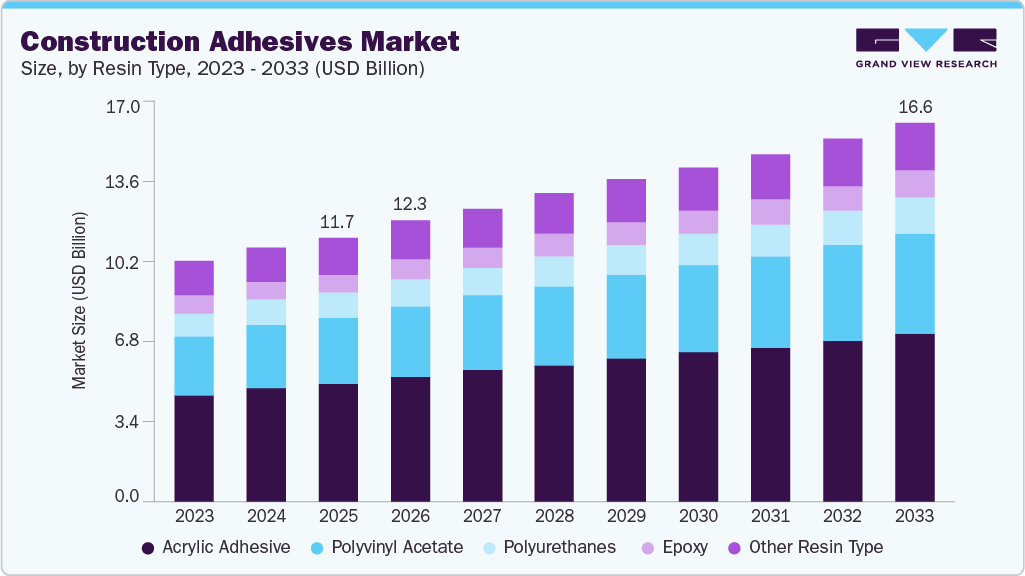
The market is also growing because building materials are becoming more specialized, requiring bonding solutions tailored to changing technical standards. Engineered wood, composites, insulation products, decorative panels, and lightweight assemblies require adhesives that maintain strength under varying environmental and loading conditions. This shift increases demand for formulations with better curing behavior, chemical resistance, and flexibility. Product development is helping manufacturers address concerns about indoor air quality, ease of application, and lifecycle performance. As buyers pay closer attention to durability and compliance, value is moving toward advanced adhesive systems rather than basic bonding products.
Market Concentration & Characteristics
The construction adhesives market shows moderate concentration, with established chemical manufacturers holding strong positions due to their technical expertise, product reliability, and long-standing relationships with construction material suppliers and contractors. Their presence is strengthened by extensive research capabilities and the ability to supply specialized adhesive formulations that meet evolving building performance standards.
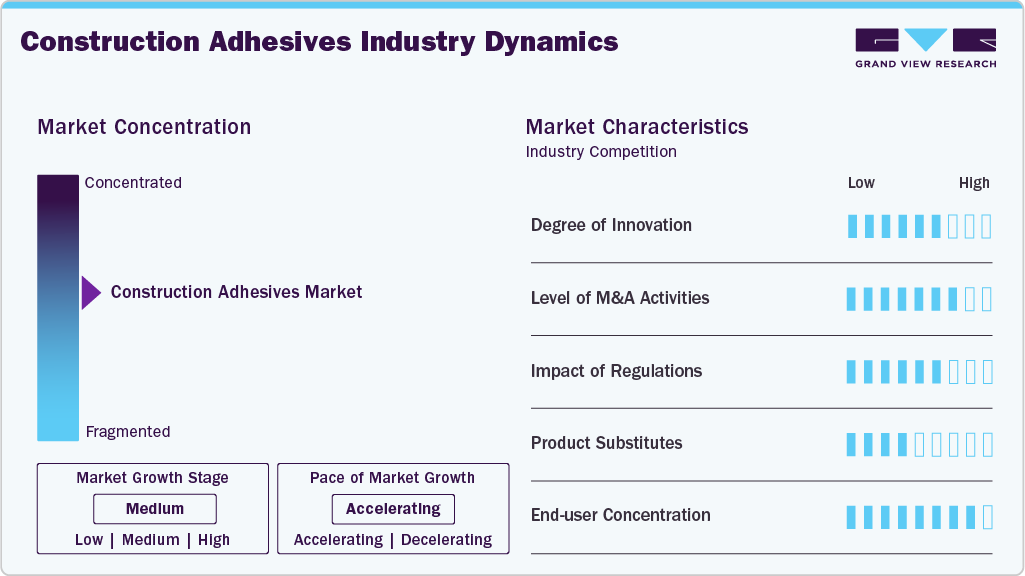
The market also demonstrates characteristics of continuous product innovation and application-specific development because construction materials and installation practices are constantly changing. Manufacturers focus on improving bonding performance, curing efficiency, and environmental compatibility to remain competitive. Demand for consistent quality and regulatory compliance encourages suppliers to develop advanced formulations and technical support services, which help differentiate products and maintain customer loyalty across construction projects.
Resin Type Insights
Acrylic adhesives held the leading share of 44.6% in 2025 due to their strong bonding capability, durability, and compatibility with a wide range of construction materials. These adhesives perform well on substrates such as concrete, metal, glass, plastics, and composites, which makes them suitable for multiple construction applications, including panels, flooring, and insulation systems. Their resistance to moisture, temperature variation, and environmental stress allows structures to maintain long-term stability. Builders often prefer acrylic-based formulations because they cure quickly and provide reliable adhesion across both porous and non-porous surfaces. This versatility increases their adoption across many installation processes, strengthening their revenue contribution within the construction adhesives market.
Polyvinyl acetate adhesives are projected to expand at a CAGR of 5.3% from 2026 to 2033 as construction activities increasingly use wood-based components, laminates, and interior finishing materials. These adhesives are widely used for bonding wood, plywood, and decorative surfaces because they provide strong adhesion while remaining easy to apply and cost-efficient. Their water-based composition also supports safer indoor applications and simpler cleanup during installation. As interior construction and renovation projects focus on efficient bonding solutions for cabinetry, flooring, and joinery components, polyvinyl acetate formulations become attractive to contractors seeking reliable performance with straightforward application.
Technology Insights
Water based adhesives accounted for 44.8% of total revenue in 2025 as they are widely used in construction activities that require safe application, easy handling, and strong bonding across common building materials. These formulations rely on water as the primary carrier, which helps reduce emissions and improve workplace safety during installation. Contractors frequently prefer water based systems for flooring, wall panels, laminates, and insulation bonding because they provide consistent adhesion and relatively simple cleanup. Their compatibility with porous materials such as wood, drywall, and concrete also increases adoption. Reliable curing behavior and cost efficiency further strengthen their role across multiple construction processes.
Reactive and others construction adhesive technologies are projected to grow at a CAGR of 4.5% from 2026 to 2033 as construction projects increasingly require higher strength bonding for demanding structural applications. These adhesives cure through chemical reactions that form durable, highly stable bonds capable of withstanding moisture, temperature variations, and mechanical stress. Their performance advantages make them suitable for advanced construction materials, prefabricated components, and engineered assemblies where long-term reliability is essential. As building designs incorporate stronger yet lighter materials, reactive adhesive systems are becoming important solutions for achieving secure bonding while maintaining structural efficiency and durability.
Application Insights
The commercial segment dominated the market, accounting for the largest revenue share of 35.2% in 2025. It is also expected to register the leading CAGR of 4.8% from 2026 to 2033, as construction adhesives are extensively used in offices, retail spaces, healthcare facilities, educational buildings, and hospitality infrastructure. These buildings require strong bonding solutions for flooring systems, wall panels, ceiling installations, insulation materials, and decorative surfaces. Adhesives help improve installation efficiency while maintaining structural stability and surface aesthetics. Large-scale commercial projects typically involve diverse materials such as metal, glass, concrete, and composites, which increases the demand for versatile adhesive solutions. Continued expansion of commercial infrastructure and renovation of existing buildings support the segment’s expected CAGR of 4.8% from 2026 to 2033.
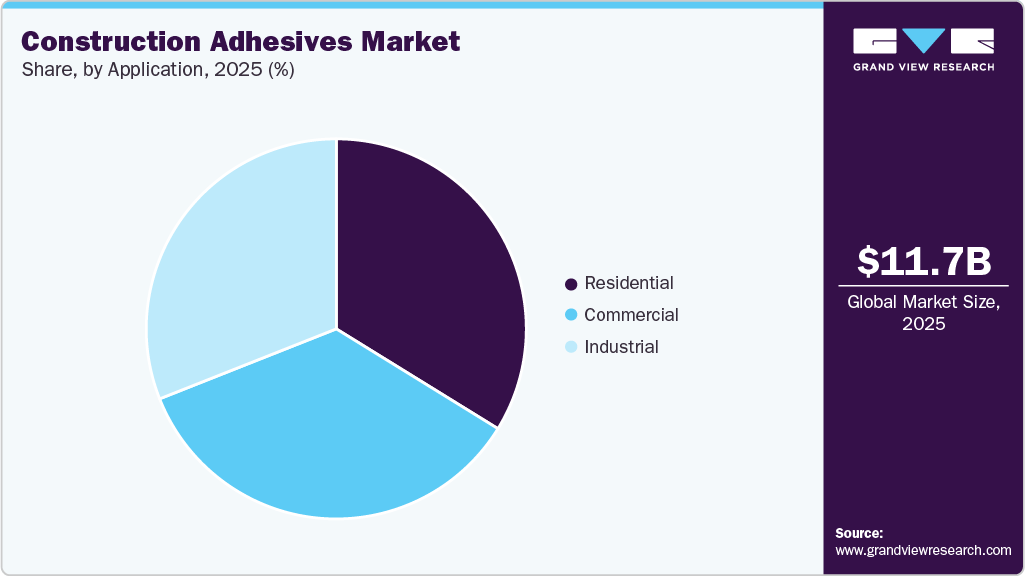
The Industrial segment is expanding as adhesives are increasingly used in facilities that require durable and high strength bonding solutions. Industrial buildings such as manufacturing plants, warehouses, logistics hubs, and processing facilities require materials that can maintain stability under heavy mechanical loads and operational stress. Construction adhesives are used in flooring installations, insulation panels, structural joints, and equipment base assemblies where durability and long term reliability are important. Adhesives help distribute stress more evenly than mechanical fasteners, which supports structural performance and reduces maintenance needs. As industrial facilities continue to adopt stronger building materials and efficient construction practices, adhesives are becoming an important component for improving bonding strength and installation efficiency.
Regional Insights
Asia Pacific construction adhesives market accounted for 40.0% of global revenue in 2025, due to large scale expansion of residential, commercial, and infrastructure construction across the region, supporting growth in the adhesives and sealants industry. Increasing investments in buildings, transportation networks, and public infrastructure continue to generate strong demand for bonding materials used in flooring, insulation, panels, and structural assemblies. The India construction adhesives market also contributes to regional demand as large housing developments, commercial complexes, and infrastructure upgrades require efficient bonding solutions. Construction adhesives are widely adopted because they support faster installation and improved durability across diverse building materials, strengthening the region’s expected CAGR of 5.1% through 2033.
China construction adhesives market represents a major segment within the broader construction materials sector due to extensive construction activities and continuous expansion of residential and commercial infrastructure. Large scale development of high rise buildings, transportation facilities, and public infrastructure projects increases the need for reliable bonding materials used in flooring, insulation panels, wall systems, and structural assemblies. Construction adhesives are widely used to support faster installation and improved durability across various building materials. Growth in prefabricated construction methods and engineered components also aligns with developments in the construction adhesive tapes market, as both solutions support efficient bonding across large construction projects.
North America Construction Adhesives Market Trends
North America held a significant position in the construction adhesives market due to strong demand from renovation activities and commercial infrastructure development. The region shows consistent use of construction adhesives in flooring systems, insulation installation, wall panels, and structural bonding where reliable performance is required. Contractors prefer adhesive solutions because they support precise application and reduce reliance on mechanical fastening methods. Renovation of aging buildings and modernization of commercial facilities continue to increase the need for efficient bonding materials. High standards for building durability and material performance encourage wider adoption of advanced construction adhesive formulations.
U.S. Construction Adhesives Market Trends
The construction adhesives market in the U.S.demonstrates strong demand for construction adhesives due to significant renovation and remodeling activities across residential and commercial buildings. Many existing structures require upgrades to flooring systems, insulation installations, and interior panels, which increases the need for dependable bonding materials. Construction adhesives are commonly used to improve installation efficiency and structural stability while maintaining clean finishing surfaces. The presence of advanced building technologies and strict performance standards encourages the use of high quality adhesive systems that support long term durability and compatibility with modern construction materials.
Europe Construction Adhesives Market Trends
Europe shows steady demand for construction adhesives as building projects increasingly emphasize energy efficient structures and durable installation methods, supporting expansion in the construction adhesives and sealants market. Adhesives are widely used in insulation bonding, façade panels, flooring systems, and interior assemblies where long term performance is required. Construction companies in the region rely on adhesive solutions to improve bonding strength and reduce the use of mechanical fasteners that may affect structural finishing. The region also maintains a strong presence in the automotive adhesives and sealants market, encouraging innovation in bonding technologies that influence applications across construction materials. Continuous renovation of older buildings and modernization of infrastructure support the use of adhesives that enhance building performance and installation efficiency.
Germany construction adhesives market plays an important role within the European construction adhesives market due to its advanced construction practices and strong focus on high quality building materials. Adhesives are widely used in flooring installations, insulation panels, wood based assemblies, and structural components where precision and durability are required. The country’s well developed construction sector emphasizes reliable bonding solutions that improve structural performance and installation accuracy. Adoption of engineered wood products, prefabricated construction elements, and energy efficient building systems further supports the use of specialized adhesive formulations.
Latin America Construction Adhesives Market Trends
Latin America demonstrates increasing use of construction adhesives as building projects expand across residential housing, commercial spaces, and public infrastructure. Adhesives are widely applied in flooring installation, wall panels, insulation materials, and structural assemblies where consistent bonding performance is required. Construction companies often use adhesives to simplify installation processes and improve structural durability across different building materials. Growing demand for modern building techniques and improved construction efficiency contributes to the wider adoption of adhesive solutions throughout construction activities in the region.
Middle East & Africa Construction Adhesives Market Trends
The Middle East and Africa region shows rising adoption of construction adhesives due to large scale infrastructure development and expansion of commercial and hospitality buildings. Construction projects such as airports, commercial complexes, hotels, and urban development programs require strong bonding materials for panels, insulation systems, flooring, and structural assemblies. Adhesives support faster installation and improved structural reliability across a wide range of building materials used in modern construction. Continuous investment in new infrastructure and large architectural developments encourages the use of high performance construction adhesive solutions.
Key Construction Adhesives Company Insights
The two key dominant manufacturers in the market are 3M Company and Henkel AG & Co. KGaA. These companies hold strong positions through broad adhesive technologies, extensive product portfolios, and continuous innovation supporting diverse construction bonding applications.
-
3M Company is a global technology focused organization known for its extensive expertise in adhesive and bonding technologies used across construction and industrial applications. The company develops advanced adhesive solutions designed to enhance bonding strength, durability, and installation efficiency. Its research driven approach supports the development of specialized products that improve structural reliability and material compatibility in modern construction projects.
-
Henkel AG & Co. KGaA is a multinational chemical and consumer goods company recognized for its strong presence in adhesive technologies used in construction and industrial applications. The company focuses on developing high performance bonding solutions designed to improve durability, application efficiency, and structural performance. Its innovation oriented strategy emphasizes advanced formulations that support evolving construction material requirements and modern building practices.
Key Construction Adhesives Companies:
The following key companies have been profiled for this study on the construction adhesives market.
- H.B. Fuller
- 3M Company
- Sika AG
- The DOW Chemical Company
- Bostik SA (An Arkema Company)
- Henkel AG & Co. KGaA
- Dap Products
- Franklin International
- Illinois Tool Works Incorporation
- Avery Dennison Corporation
Recent Developments
-
In January 2026, Henkel signed an agreement to acquire Switzerland-based ATP Adhesive Systems, expanding its Adhesive Technologies portfolio with high-performance water-based specialty tapes and strengthening capabilities in sustainable bonding solutions for industries including building and construction.
-
In November 2025, Bostik announced the launch of a curated range of professional grade sealants and adhesives on Amazon, enabling contractors and consumers to conveniently access high performance bonding solutions for home improvement and construction applications.
-
In October 2025, Henkel announced enhancements to sustainability across its construction adhesives portfolio by expanding Environmental Product Declarations, enabling transparent reporting of product environmental footprints across the life cycle and supporting customers in making informed material choices.
Construction Adhesives Market Report Scope
Report Attribute
Details
Market size value in 2026
USD 12.3 billion
Revenue forecast in 2033
USD 16.6 billion
Growth rate
CAGR of 4.3% from 2026 to 2033
Base year for estimation
2025
Historical data
2021 - 2024
Forecast period
2026 - 2033
Quantitative units
Revenue in USD million/billion, volume in kilotons, and CAGR from 2026 to 2033
Report coverage
Revenue forecast, company ranking, competitive landscape, growth factors, and trends
Segments covered
Resin type, technology, application, region
Regional scope
North America; Europe; Asia Pacific; Latin America; Middle East & Africa
Country scope
U.S.; Canada; Mexico; Brazil; Argentina; Germany; UK; Italy; Spain; France; China; Japan; South Korea; Saudi Arabia; South Africa
Key companies profiled
H.B. Fuller; 3M Company; Sika AG; The Dow Chemical Company; Bostik SA (An Arkema Company); Henkel AG & Co. KGaA; DAP Products; Franklin International; Illinois Tool Works Incorporated; Avery Dennison Corporation
Customization scope
Free report customization (equivalent to up to 8 analysts’ working days) with purchase. Addition or alteration to country, regional & segment scope.
Pricing and purchase options
Avail customized purchase options to meet your exact research needs. Explore purchase options
Global Construction Adhesives Market Report Segmentation
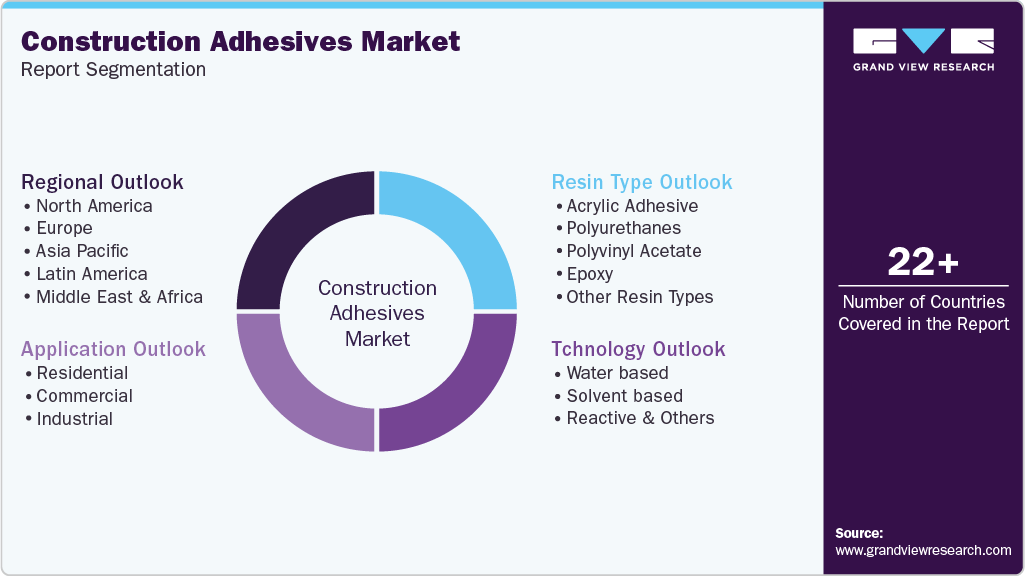
This report forecasts revenue growth at global, regional, and country levels and provides an analysis of the latest industry trends in each of the sub-segments from 2021 to 2033. For this study, Grand View Research has segmented the global construction adhesives market report based on resin type, technology, application, and region.
-
Resin Type Outlook (Volume, Kilotons; Revenue, USD Billion; 2021 - 2033)
-
Acrylic Adhesive
-
Polyurethanes
-
Polyvinyl Acetate
-
Epoxy
-
Other Resin Types
-
-
Technology Outlook (Volume, Kilotons; Revenue, USD Billion; 2021 - 2033)
-
Water based
-
Solvent based
-
Reactive & Others
-
-
Application Outlook (Volume, Kilotons; Revenue, USD Billion; 2021 - 2033)
-
Residential
-
Ceramic Tiles
-
Countertop Lamination
-
Carpet Laying
-
Floor Coverings
-
Gypsum Boards
-
Other Residential Applications
-
-
Commercial
-
Ceramic Tiles
-
Countertop Lamination
-
Carpet Laying
-
Floor Coverings
-
Gypsum Boards
-
Other Commercial Applications
-
-
Industrial
-
Ceramic Tiles
-
Countertop Lamination
-
Carpet Laying
-
Floor Coverings
-
Gypsum Boards
-
Other Industrial Applications
-
-
-
Regional Outlook (Volume, Kilotons; Revenue, USD Billion; 2021 - 2033)
-
North America
-
U.S.
-
Canada
-
Mexico
-
-
Europe
-
Germany
-
UK
-
Italy
-
Spain
-
France
-
-
Asia Pacific
-
China
-
Japan
-
South Korea
-
-
Latin America
-
Brazil
-
Argentina
-
-
Middle East & Africa
-
Saudi Arabia
-
South Africa
-
-
Frequently Asked Questions About This Report
b. Water based adhesives accounted for 44.8% of total revenue in 2025 as they are widely used in construction activities that require safe application, easy handling, and strong bonding across common building materials. These formulations rely on water as the primary carrier, which helps reduce emissions and improves workplace safety during installation. Contractors frequently prefer water based systems for flooring, wall panels, laminates, and insulation bonding because they provide consistent adhesion and relatively simple cleanup.
b. Some of the key players operating in the construction adhesives market include H.B. Fuller, 3M Company, Sika AG, The Dow Chemical Company, Bostik SA (An Arkema Company), Henkel AG & Co. KGaA, DAP Products, Franklin International, Illinois Tool Works Incorporated, Avery Dennison Corporation.
b. The global construction adhesives market size was estimated at USD 11.7 billion in 2025 and is expected to reach USD 12.3 billion in 2026.
b. The global construction adhesives market is expected to grow at a compound annual growth rate of 4.3% from 2026 to 2033, reaching USD 16.6 billion by 2033.
b. Construction adhesives are gaining wider acceptance as construction methods increasingly prioritize efficiency, precision, and material compatibility. Traditional fastening methods often create limitations in design flexibility, surface finish, and labor productivity. Adhesives solve these issues by enabling uniform bonding across varied substrates while reducing visible mechanical joints. Their ability to improve structural integrity, vibration resistance, and moisture performance makes them valuable in both structural and non structural applications.


Share this report with your colleague or friend.
Need a Tailored Report?
Customize this report to your needs — add regions, segments, or data points, with 20% free customization.


ISO 9001:2015 & 27001:2022 Certified
We are GDPR and CCPA compliant! Your transaction & personal information is safe and secure. For more details, please read our privacy policy.
Trusted market insights - try a free sample
See how our reports are structured and why industry leaders rely on Grand View Research. Get a free sample or ask us to tailor this report to your needs.












