Brazil Small Home Appliances Market Summary
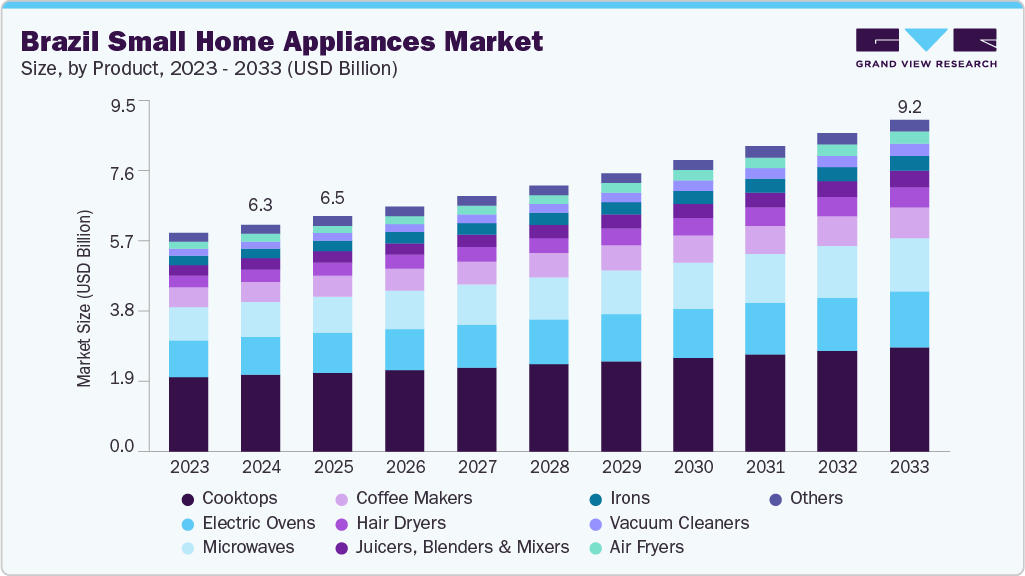
The Brazil small home appliances market size was estimated at USD 6.29 billion in 2024 and is projected to reach USD 9.22 billion in 2033, growing at a CAGR of 4.4% from 2025 to 2033. The increasing need for compact, multifunctional appliances for city living is a key factor driving the growth. Brazilian consumers' growing focus on energy-efficient and eco-friendly products will support this growth.
Key Market Trends & Insights
- Brazil's small home appliances market is growing at a 4.4% CAGR from 2025 to 2033.
- By product, the cooktops segment accounted for the largest revenue share of 34.02% in 2024.
- By distribution channel, the online segment is expected to grow at a significant CAGR of 5.0% from 2025 to 2033.
Market Size & Forecast
- 2024 Market Size: USD 6.29 Billion
- 2033 Projected Market Size: USD 9.22 Billion
- CAGR (2025-2033): 4.4%
Additionally, online and regional retail channels are expanding and catering to a variety of consumer preferences. The Brazilian home appliances market largely relies on replacement and upgrade needs from a growing middle-income group. A notable number of price-sensitive consumers prioritize cost and financing options. The major trends driving demand include rapid urbanization, more access to digital retail, heightened awareness of energy efficiency and health, and a shift towards smart appliances. The retail landscape features a mix of major physical stores, integrated omnichannel retailers, and leading online marketplaces that increasingly affect pricing and logistics.
Energy efficiency standards, labeling requirements, and public clean-cooking initiatives are important factors influencing product offerings and increasing demand for rated and induction units in regions with supportive policies and incentives. The growing government programs that subsidize cleaner cooking solutions or promote electrification help more people adopt modern stoves and cooktops. The G20 clean-cooking roadmap is one example of a policy pushing for a shift toward electric, induction, and certified clean-fuel appliances. This would propel the market growth.
The Brazil small home appliances industry includes players such as Electrolux AB, Midea, and Whirlpool (which operates brands such as Brastemp and Consul), as well as strong regional and local brands like Atma and Philco. Global manufacturers often compete on technology and premium positioning, while local brands focus on competitive pricing, broad distribution networks, and customized product offerings. Many international companies use local manufacturing, joint ventures, or import models to stay competitive.
Consumer Insights for Brazil Small Home Appliances
The Brazil small home appliances market is greatly affected by household income. This income influences both purchasing power and product choices. About 40% of Brazilian families are in the low-income group. They often focus on affordability and basic functions rather than brand names or design. Typical items bought by this group include cooktops, coffee makers, juicers, blenders, and mixers. These consumers frequently rely on installment plans or sales to buy products, showing their strong sensitivity to price.
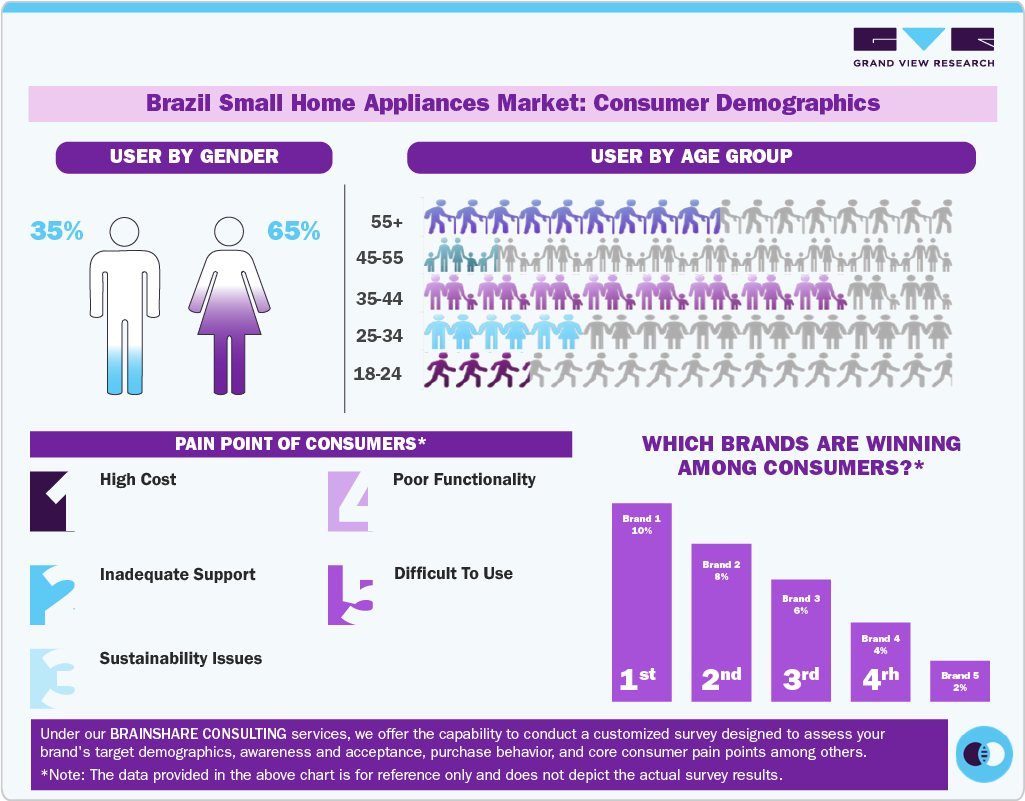
Regional income differences also shape market dynamics. In the North and Northeast regions, lower-income households often adopt new small appliances more slowly. This is due to limited retail options and reduced access to formal credit. However, this group is slowly gaining access to mid-range appliances through mass-market retail chains and online marketplaces that provide discounted prices. This change expands their options for different products.
Energy efficiency and low electricity use are important factors across all product categories, mainly because of Brazil's high electricity cost. Data from the Energy Research Company (EPE) shows that electric stoves are more common in areas without piped gas. This highlights how basic appliances remain essential in Brazilian households. Another example is the dry iron, which continues to be a popular item in regular retail stores. This reflects a lasting demand for simple, functional products.
Product Insights
Cooktops led the Brazil small home appliances market with the largest revenue share of 34.02% in 2024. The cooktop market in Brazil is growing with rising urbanization, and changing housing trends are reshaping consumer preferences. As more families move into smaller, modern apartments, built-in cooktops are replacing traditional freestanding stoves. These built-ins save space and fit well with contemporary kitchen designs. Features like sleek finishes, glass surfaces, and induction technology match the “gourmet kitchen” trend, which is especially popular among younger households. This change meets practical needs and reflects a broader lifestyle shift, where kitchens are seen as social and attractive spaces. This is increasing demand for stylish, high-performance cooktops.
In 2025, portable induction cooktops will be considered efficient alternatives to gas stoves. Reports indicate that compact single-burner models start at around USD 60. Built-in cooktops with two to four burners typically cost between USD 150 and USD 300. Prices vary based on features like tempered glass surfaces, stainless steel finishes, and integrated safety sensors.
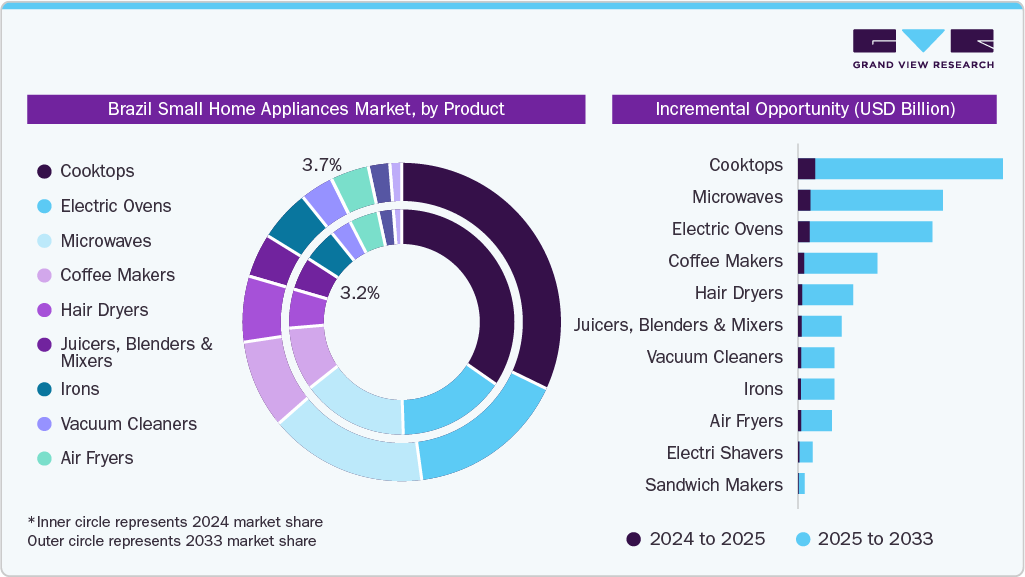
The Brazil vacuum cleaners market segment is expected to grow at a CAGR of 6.1% from 2025 to 2033. Vacuum cleaners are in high demand in Brazil's small home appliances market. This trend results from socio-economic changes and evolving lifestyles. Rising disposable incomes and a growing middle class allow more households to invest in modern cleaning solutions. Rapid urbanization has also led to smaller living spaces. This increases the need for compact, lightweight, and easy-to-store vacuum cleaners that fit apartments and small homes. Moreover, increased awareness of hygiene and the need for a clean-living environment, especially after the COVID-19 pandemic, has made many consumers focus on the adoption of technologically advanced vacuum cleaners.
Distribution Channel Insights
The sale of small home appliances through the electronic stores distribution channel accounted for a share of 45.91% in 2024. The Brazil small home appliances industry is growing rapidly, with electronic stores playing an important role in this expansion. Some of the prominent factors include increasing urbanization, higher disposable incomes, and the growing middle class. These trends are driving demand for modern and high-end appliances. Electronic retailers are taking advantage of this situation by offering a wide range of products that match the changing tastes of Brazilian consumers.
Moreover, the rise of buy now, pay later (BNPL) options and retail credit facilities has made it easier for consumers to purchase appliances, contributing to the market's growth. Government energy-efficiency programs, such as PROCEL, encourage the use of energy-efficient appliances, further supporting the market's expansion. Together, these factors would propel the market growth.
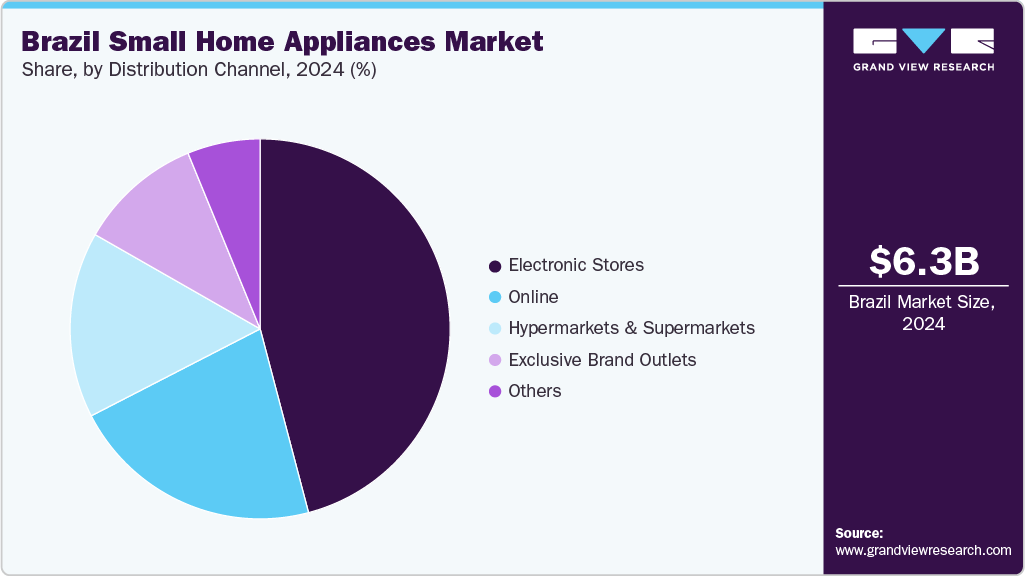
The sale of small home appliances through online distribution channels is anticipated to grow at a CAGR of 5.0% from 2025 to 2033. Growing digital adoption and shifting consumer habits are driving Brazil's small home appliance online market. Due to increased internet usage and the widespread ownership of smartphones, more households now have easy access to e-commerce platforms. Customers can compare prices, models, and brands at these online retailers, which frequently have better offers than brick-and-mortar establishments. Online shopping is made even more alluring by the availability of promotions, a large selection of goods, and access to both domestic and foreign brands. Additionally, a growing middle class and increasing disposable incomes drive consumers to look for smart, efficient, and modern appliances. Thus, the growing need to find small home appliances easily through online platforms would propel the growth of the market during the forecast period.
Market players are focusing on innovation, with smart and energy-efficient appliances gaining traction. Detailed product descriptions, reviews, and promotional videos available online also boost consumer confidence in remote purchasing.
Key Brazil Small Home Appliances Company Insights
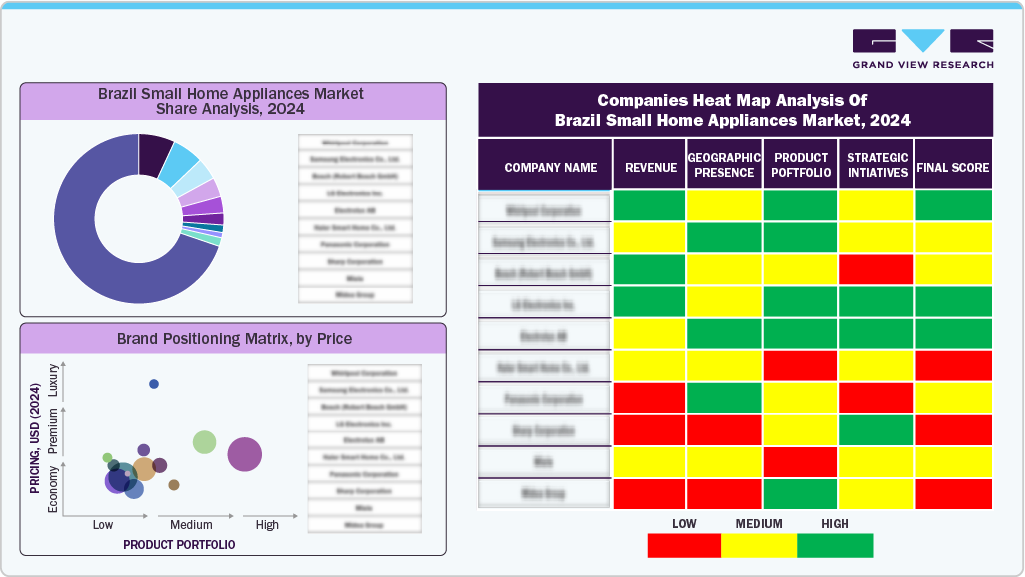
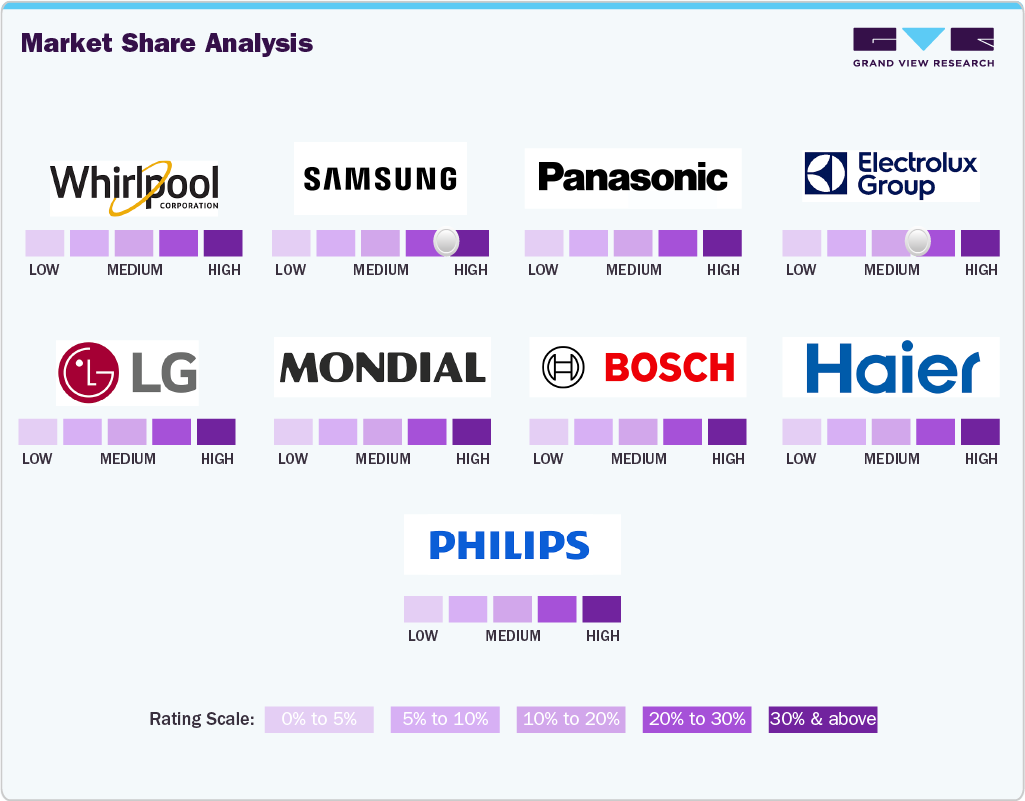
The small home appliances market in Brazil is highly competitive, with both international and local manufacturers serving a diverse consumer and business base. Competition is driven by ongoing innovation in product functionality, energy efficiency, and smart technologies, as brands strive to attract and retain consumer interest. Rising demand for sustainable, eco-friendly, and multifunctional appliances adds to the market intensity, encouraging companies to stand out through superior quality, distinctive offerings, and improved customer experiences.
Key Brazil Small Home Appliances Companies:
- Samsung Electronics Co., Ltd.
- Whirlpool Corporation
- AB Electrolux
- LG Electronics
- Panasonic Corporation
- Miele & Cie. KG
- Robert Bosch GmbH
- Sharp Corporation
- iRobot Corporation
- Midea Group
- Haier Group
- Britânia Ecom SA
- Koninklijke Philips N.V.
- Breville Group Limited
- Mondial
Recent Developments
-
In March 2025, Whirlpool announced that it matched 100% of its electricity consumption across manufacturing operations and regional headquarters with renewable energy credits (RECs) in the previous year.
-
In December 2024, Midea, one of the key market participants in the home appliances market, inaugurated its newly built facility in Pouso Alegre. The facility is over 80,000 square meters and has a capacity to produce 1.3 million units of kitchen and small appliances per year. This is expected to strengthen Midea's presence in Brazil's small home appliances market.
-
In November 2024, Panasonic do Brasil (PANABRAS) announced a new brand campaign named MAGIC in Brazil. It also marked its entry into the hair dryer segment with the introduction of Nanocare, which is equipped with nanoe technology.
Brazil Small Home Appliances Market Report Scope
|
Report Attribute
|
Details
|
|
Market size value in 2025
|
USD 6.54 billion
|
|
Revenue forecast in 2033
|
USD 9.22 billion
|
|
Growth rate
|
CAGR of 4.4% from 2025 to 2033
|
|
Actuals
|
2021 - 2024
|
|
Forecast period
|
2025 - 2033
|
|
Quantitative units
|
Revenue in USD million/billion, volume in thousand units, and CAGR from 2025 to 2033
|
|
Report coverage
|
Revenue and volume forecast, company ranking, competitive landscape, growth factors, and trends
|
|
Segments covered
|
Product, distribution channel
|
|
Key companies profiled
|
Whirlpool Corporation; Samsung Electronics Co., Ltd.; AB Electrolux; LG Electronics; Panasonic Corporation; Miele & Cie. KG; Robert Bosch GmbH; Sharp Corporation; iRobot Corporation; Midea Group; Haier Group; Britânia Ecom SA; Koninklijke Philips N.V.; Breville Group Limited; Mondial
|
|
Customization scope
|
Free report customization (equivalent up to 8 analysts’ working days) with purchase. Addition or alteration to country, regional & segment scope.
|
|
Pricing and purchase options
|
Avail customized purchase options to meet your exact research needs. Explore purchase options
|
Brazil Small Home Appliances Market Report Segmentation
This report forecasts volume & revenue growth at the country level and provides an analysis of the latest trends and opportunities in each of the sub-segments from 2021 to 2033. For this study, Grand View Research has segmented the Brazil small home appliances market report based on product and distribution channel:
-
Product Outlook (Volume, Thousand Units; Revenue, USD Million, 2021 - 2033)
-
Distribution Channel Outlook (Volume, Thousand Units; Revenue, USD Million, 2021 - 2033)
Frequently Asked Questions About This Report
b. The Brazil small home appliances market was valued at USD 6.29 billion in 2024 and is expected to reach USD 6.54 billion in 2025.
b. The Brazil small home appliances market was valued at USD 6.29 billion in 2024 and is projected to reach USD 9.22 billion in 2033, growing at a CAGR of 4.4% from 2025 to 2033
b. Cooktops accounted for the largest share of 34.02% in Brazil small home appliances industry in 2024. The cooktop market in Brazil is growing. Urbanization and changing housing trends are reshaping consumer preferences.
b. Whirlpool Corporation, Samsung Electronics Co., Ltd., AB Electrolux, LG Electronics, Panasonic Corporation, Miele & Cie. KG, Robert Bosch GmbH, Sharp Corporation, iRobot Corporation, Midea Group, Haier Group, Britânia Ecom SA, Koninklijke Philips N.V., Breville Group Limited, and Mondial
b. The increasing need for compact, multifunctional appliances for city living is a key factor in the market's growth. Brazilian consumers' growing focus on energy-efficient and eco-friendly products will support this growth. Additionally, online and regional retail channels are expanding and catering to a variety of consumer preferences.

 Download Sample Report














