Brazil Milk Protein Market Summary
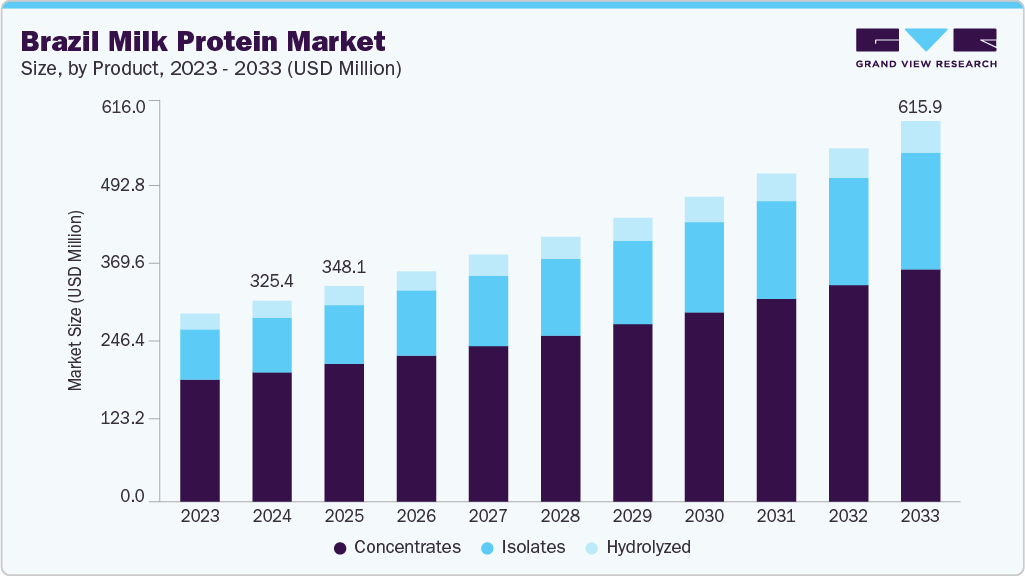
The Brazil milk protein market size was estimated at USD 325.4 million in 2024 and is projected to reach USD 615.9 million by 2033, growing at a CAGR of 7.4% from 2025 to 2033. This market is driven by increasing awareness about clean-label products and the growing popularity of flavored variants across various food and beverage applications.
Key Market Trends & Insights
- By product, the concentrates segment held the highest market share of 64.3% in 2024.
- By form, the powder segment held the highest market share of 91.2% in 2024.
- By application, the food and beverages segment held the highest market share of 47.3% in 2024.
Market Size & Forecast
- 2024 Market Size: USD 325.4 Million
- 2033 Projected Market Size: USD 615.9 Million
- CAGR (2025-2033): 7.4%
The increasing prevalence of active lifestyles and urban living has accelerated demand for convenient, on-the-go nutritional formats. The broader availability of such products through expanded retail networks and digital commerce channels has further enabled this demand.
Simultaneously, there is a rising inclination toward clean-label products, particularly among health-conscious urban consumers. Offerings with minimal ingredients, free from artificial additives, and featuring transparent sourcing are experiencing rising popularity. Milk protein isolates, recognized for their high purity and low fat and lactose content, are well-aligned with these clean-label expectations, especially in the functional food and sports nutrition segments.
Product Insights
The concentrates segment dominated the market with a revenue share of 64.3% in 2024. It is driven by increasing consumer demand for high-protein nutritional products aligned with functional health goals among fitness enthusiasts performing strength and endurance training. Factors such as increasing gym memberships and growing awareness of sports nutrition are expected to fuel market growth.Companies are focusing on launching innovative products in line with these trends.
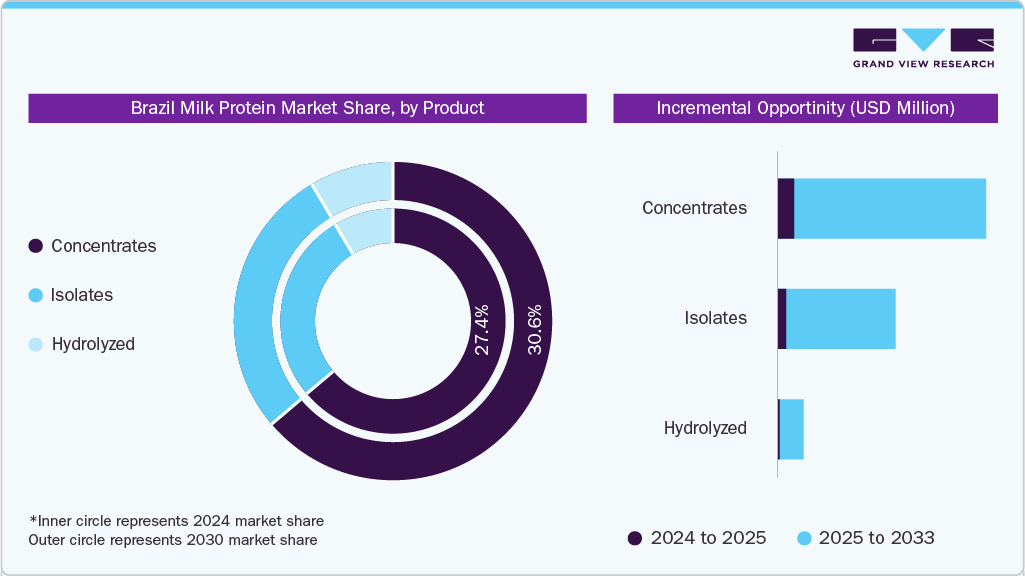
The isolates segment is expected to register the fastest CAGR of 8.7% from 2025 to 2033.The increasing prevalence of lactose intolerance among consumers and the preference for high-protein milk among health-conscious consumers are key factors driving the growth of this segment. According to the World Population Review, approximately 60% of the population in Brazil is lactose intolerant, significantly contributing to the shift toward lactose-free or low-lactose dairy alternatives such as milk protein isolates.
Form Insights
The powder segment accounted for the largest revenue share in 2024. This segment is driven by a shift in consumer preferences for convenient, shelf-stable protein formats. Powdered milk proteins offer advantages such as long shelf life, ease of storage, and incorporation into various food and beverage formulations, which enhance their appeal among manufacturers looking to meet the demand of consumers seeking quick and healthy products.In response to this demand, businesses are increasingly investing in process innovation and product development to enhance the functional properties of powdered proteins. In June 2024, ioWhey Protein was launched in Brazil through a partnership between Plasma Nutrition and Nutrata. The product features innovative ingredient optimization technology and is available online and in stores.
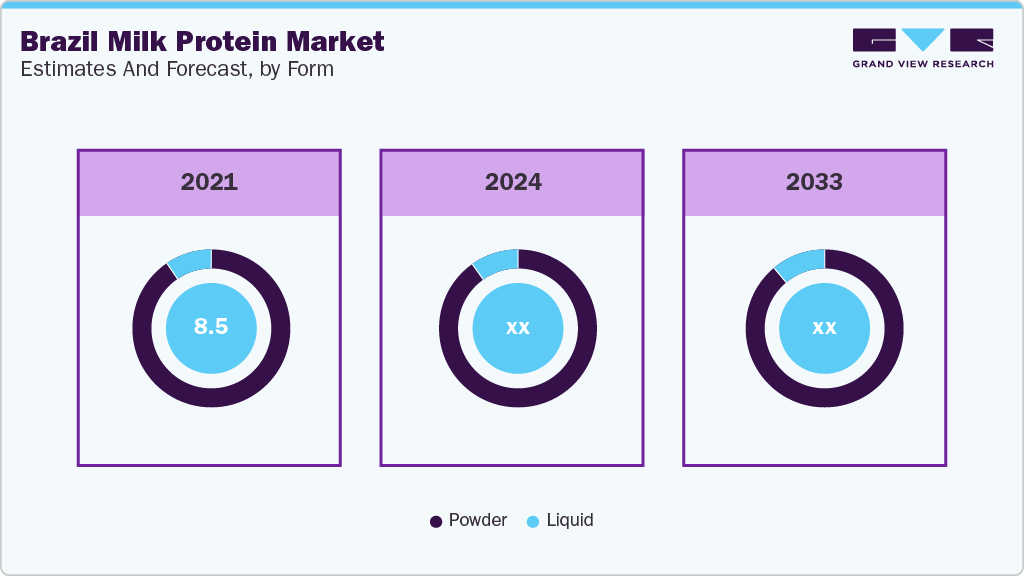
The liquid segment is anticipated to record the fastest CAGR from 2025 to 2033. The market is driven by increasing demand for ready-to-consume and easily digestible nutritional drinks. Manufacturers are increasingly engaged in innovating products and launching new liquid milk protein formulations that incorporate added vitamins, minerals, and flavor options. Key players are focused on enhancing product appeal and developing products that align with diverse consumer preferences.In March 2025, FrieslandCampina Ingredients launched Nutri Whey ProHeat in Brazil, a heat-stable whey protein solution designed for ready-to-drink beverages using microparticulation technology to overcome challenges faced by manufacturers, including viscosity due to whey protein’s sensitivity to heat treatment.
Application Insights
The food and beverages segmentheld the largest revenue share of the milk protein market in 2024. The segment is driven by surging demand for functional and fortified food products. Increasing health awareness has led to incorporating milk proteins, including casein, whey protein, milk protein concentrates, and milk protein isolates, in various food and beverage products. In June 2025, Brazil-based brand Mu (Mais Mu) introduced its first ready-to-drink protein beverage, the Mulkshake. The 250 ml formulation delivers 12 g of protein from whole milk and whey concentrate and was launched in five flavors: chocolate, vanilla, cappuccino, strawberry, and coconut caramel.
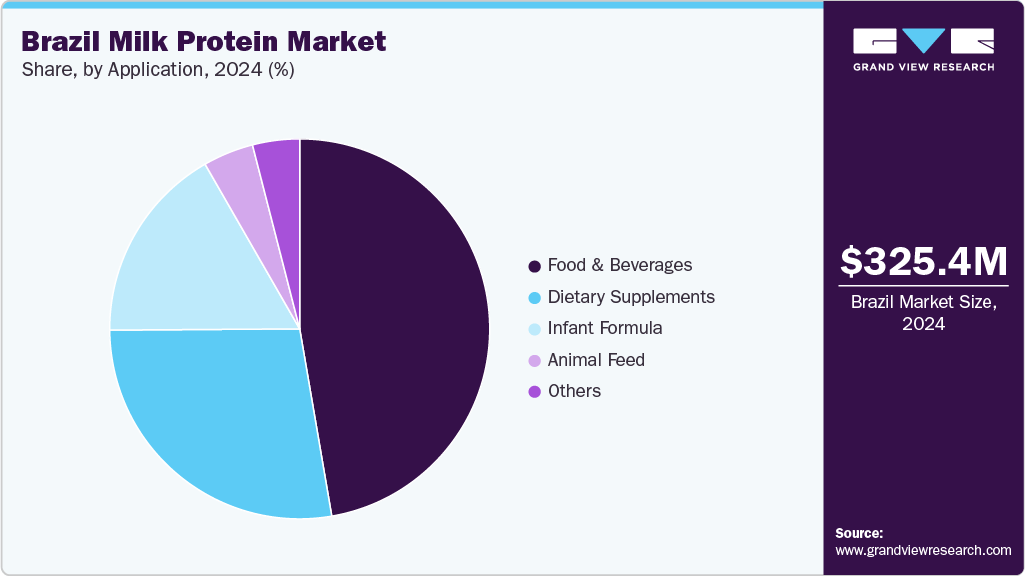
The dietary supplements segment is anticipated to experience the fastest CAGR from 2025 to 2033.This segment is driven by increasing health consciousness among consumers, adoption of fitness and wellness routines, and a growing demand for high-quality protein sources. In addition, the expanding sports nutrition category, innovation in product formats such as powders and ready-to-drink shakes, and the expansion of e-commerce and specialty health retail channels are further expected to fuel the segment growth over the coming years.
Key Brazil Milk Protein Company Insights
Some key players in the Brazil milk protein industry include Hilmar, Arla Food Ingredients Group, Glanbia plc and FrieslandCampina.
- Arla Foods Ingredients offers innovative, high-quality milk-based and whey-based nutrition solutions, specializing in organic, infant, medical, and sports nutrition. Committed to sustainability and food safety.
Key Brazil Milk Protein Companies:
- Hilmar
- Arla Food Ingredients Group
- Glanbia plc
- FrieslandCampina
Recent Developments
- In June 2025, Future Cow, a precision fermentation startup, raised USD 885,000 to expand its animal-free casein and whey protein platform. The company uses precision fermentation to create next-generation proteins.
Brazil Milk Protein Market Report Scope
|
Report Attribute
|
Details
|
|
Market size value in 2025
|
USD 348.1 million
|
|
Revenue forecast in 2033
|
USD 615.9 million
|
|
Growth rate
|
CAGR of 7.4% from 2025 to 2033
|
|
Actual data
|
2021 - 2024
|
|
Forecast period
|
2025 - 2033
|
|
Quantitative units
|
Revenue in USD million, volume in kilo tons, and CAGR from 2025 to 2033
|
|
Report coverage
|
Revenue forecast, company ranking, competitive landscape, growth factors, trends
|
|
Segments covered
|
Product, form, application
|
|
Key companies profiled
|
Hilmar, Arla Food Ingredients Group, Glanbia plc, FrieslandCampina
|
|
Customization scope
|
Free report customization (equivalent up to 8 analysts working days) with purchase. Addition or alteration to country, regional & segment scope.
|
|
Pricing and purchase options
|
Avail customized purchase options to meet your exact research needs. Explore purchase options
|
Brazil Milk Protein Market Report Segmentation
This report forecasts revenue growth at the country level and provides an analysis of the latest industry trends in each of the sub-segments from 2021 to 2033. For this study, Grand View Research has segmented the Brazil milk protein market report based on product, form, and application:
-
Product Outlook (Volume, Kilotons; Revenue, USD Million, 2021 - 2033)
-
Concentrates
-
Isolates
-
Hydrolyzed
-
Form Outlook (Volume, Kilotons; Revenue, USD Million, 2021 - 2033)
-
Application Outlook (Volume, Kilotons; Revenue, USD Million, 2021 - 2033)
-
Food & Beverages
-
Dairy Products
-
Bakery & Confectionery
-
Functional Foods
-
Beverages
-
Others
-
Infant Formula
-
Dietary Supplements
-
Animal Feed
-
Others

 Download Sample Report














