
- Home
- »
- Beauty & Personal Care
- »
-
Baby Toiletries Market Size & Share, Industry Report, 2030GVR Report cover
![Baby Toiletries Market Size, Share & Trends Report]()
Baby Toiletries Market (2025 - 2030) Size, Share & Trends Analysis Report By Product (Skin Care Products, Diapers, Hair Care Products, Wipes, Bathing Products ), By Distribution Channel (Hypermarkets, Chemist And Pharmacy Stores, E-commerce ), By Region, And Segment Forecasts
- Report ID: GVR-4-68038-467-3
- Number of Report Pages: 115
- Format: PDF
- Historical Range: 2018 - 2023
- Forecast Period: 2025 - 2030
- Industry: Consumer Goods
- Report Summary
- Table of Contents
- Interactive Charts
- Methodology
- Download FREE Sample
-
 Download Sample Report
Baby Toiletries Market Summary
The global baby toiletries market size was estimated at USD 113.33 billion in 2024 and is projected to reach USD 161.74 billion by 2030, growing at a CAGR of 6.2% from 2025 to 2030. The baby toiletries industry is witnessing remarkable growth, driven by rising awareness among parents about the importance of hygiene and health for their children.
Key Market Trends & Insights
- The baby toiletries market in North America accounted for 34.2% of the market revenue in 2024.
- The baby toiletries market in the U.S. is expected to grow significantly over the forecast period.
- By product, baby diapers accounted for a revenue share of over 29% in 2024.
- By distribution channel, sales of baby toiletries though hypermarkets accounted for a revenue share of over 39% in 2024.
Market Size & Forecast
- 2024 Market Size: USD 113.33 Billion
- 2030 Projected Market Size: USD 161.74 Billion
- CAGR (2025-2030): 6.2%
- North America: Largest market in 2024
Parents are increasingly opting for specialized products that cater to their baby’s delicate and sensitive skin. This trend, combined with growing birth rates in various regions and higher disposable incomes, has expanded the market significantly. As families prioritize high-quality options, the baby toiletries industry continues to benefit from their willingness to invest in superior toiletries.The growing e-commerce sector has also played a crucial role in propelling the baby toiletries industry forward. With online platforms making products more accessible to a wider audience, parents can easily explore and purchase premium products from the comfort of their homes. Social media and celebrity endorsements further amplify this trend, encouraging parents to try high-end baby care items. These factors have collectively contributed to the increasing popularity of premium products within the baby care industry.
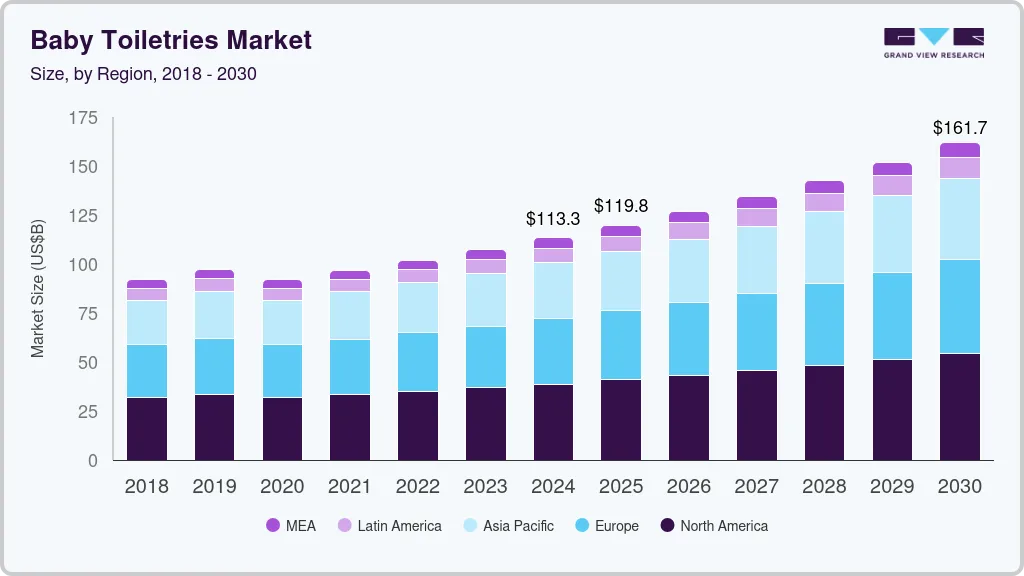
Ongoing product innovation and the introduction of eco-friendly options have attracted environmentally conscious parents, adding momentum to the baby products industry. In December 2024, R for Rabbit, a leading brand in premium baby care products, launched its ‘Feather Diapers’ campaign with a focus on ‘Next-Gen Parenting.’ The innovative diapers featured advanced wetness detection technology and ultra-soft materials, catering to the needs of modern parents.
Similarly, in February 2025, Ontex Group NV launched its Dreamshields technology for baby diapers across Europe, further driving innovation in the market. With features like a unique channel design for enhanced absorption, SeconDRY technology for instant dryness, and sustainable materials, these diapers provide parents with superior comfort and leakage protection for their babies. Such innovations highlight the evolving preferences in the baby products industry, where convenience, sustainability, and advanced functionality are at the forefront of consumer demand.
Consumer Survey & Insights
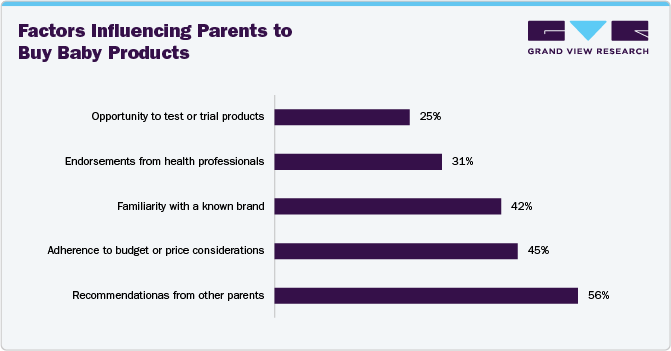
An insights project conducted by ParentsandBrands in 2021 involved an online survey and a panel discussion with 18 parents, resulting in 164 responses related to their purchasing decisions for baby toiletries. Key factors influencing these decisions included recommendations from other parents (56%), adherence to budget or price considerations (45%), familiarity with a known brand (42%), endorsements from health professionals (31%), and the opportunity to test or trial products (25%). This data highlights the significance of social validation and personal experience in the decision-making process.
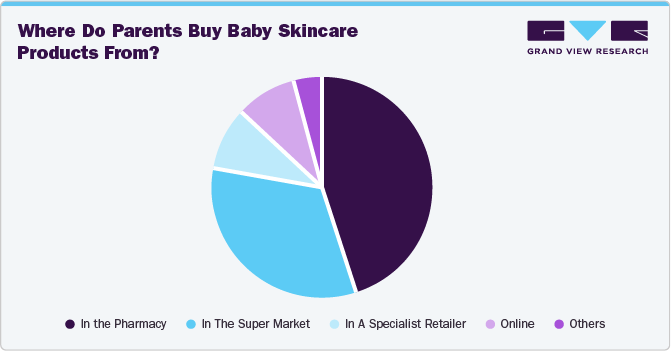
Additionally, according to this insight, 45% of respondents prefer purchasing from a pharmacy, while 33% shop at supermarkets. Additionally, 9% choose specialist retailers, another 9% opt for online shopping, and 4% explore other avenues.
Product Insights
Baby diapers accounted for a revenue share of over 29% in 2024. The increasing awareness among parents regarding the importance of hygiene and the convenience provided by disposable diapers play a crucial role. Moreover, innovations in diaper technology, such as biodegradable and eco-friendly options, have attracted environmentally conscious consumers. The rising disposable income of families has further boosted the demand for premium and high-quality diapers. Additionally, the growing availability of diapers through online retail channels has made it easier for parents to access and purchase these essential products, contributing to the segment's growth.
Demand for baby skin care products is expected to grow at a CAGR of 6.5% from 2025 to 2030. Increasing awareness among parents about the importance of maintaining their baby's skin health is a significant driver. Parents are becoming more cautious and selective about the products they use on their baby's delicate skin, favoring gentle care and protection. Additionally, the growing trend towards using natural and organic skin care products propels the demand for such items in the market. The availability of a wide range of specialized skin care products, including lotions, creams, oils, and powders, also contributes to this segment's growth. Furthermore, product formulations and packaging advancements are enhancing the appeal of baby skin care products, making them more attractive to consumers.
Distribution Channel Insights
Sales of baby toiletries though hypermarkets accounted for a revenue share of over 39% in 2024. Hypermarkets offer a wide variety of baby toiletries under one roof, providing consumers with the convenience of one-stop shopping. They also frequently run promotional campaigns and discounts, making them an attractive option for cost-conscious parents. Furthermore, hypermarkets often have dedicated sections for baby products, which enhances the shopping experience by making it easier for parents to find and compare different brands and products. The physical presence of these stores allows consumers to directly inspect and choose products, which is particularly important for items meant for babies. Additionally, the expanding footprint of hypermarkets in both urban and rural areas has made them more accessible to a broader demographic, further solidifying their dominant position in the market.
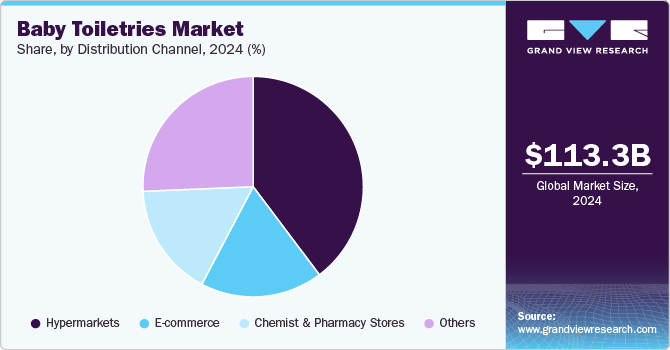
Sales of baby toiletries through e-commerce are set to grow at a CAGR of 7.6% from 2025 to 2030. The convenience and ease of online shopping are major drivers, allowing parents to purchase baby toiletries from the comfort of their homes. Additionally, e-commerce platforms often offer a wider variety of products compared to physical stores, giving consumers more choices. The ability to easily compare prices and read reviews also plays a crucial role in the growing popularity of e-commerce. Furthermore, the increasing penetration of smartphones and the internet, especially in emerging markets, is expanding the reach of online retail. Many e-commerce platforms also provide attractive discounts and subscription services, making them a cost-effective option for parents.
Regional Insights
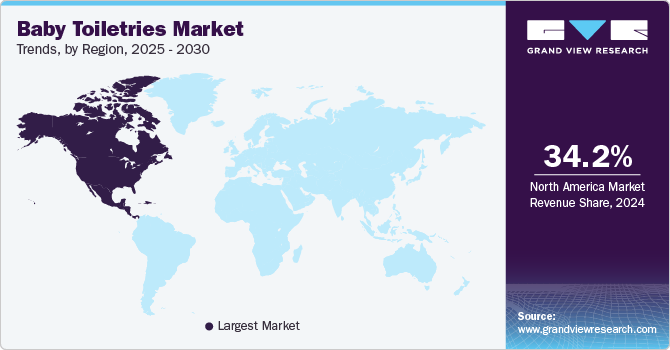
The baby toiletries market in North America accounted for 34.2% of the market revenue in 2024 owing to the high awareness and concern among parents in North America regarding baby hygiene and health drives the demand for baby toiletries. Additionally, the region's robust retail infrastructure, including well-established hypermarkets, supermarkets, and e-commerce platforms, facilitates easy access to a wide range of baby care products. The region's strong presence of major baby toiletries brands further fuels market growth through extensive marketing and promotional activities.
U.S. Baby Toiletries Market Trends
The baby toiletries market in the U.S. is expected to grow significantly over the forecast period. The strong emphasis on hygiene and health in American parenting culture significantly boosts the demand for baby toiletries. The country's high birth rate and large consumer base create a substantial market for these products. Economic factors such as higher disposable incomes and a trend towards smaller family sizes enable parents to allocate more resources to high-quality baby care products. The well-established e-commerce sector in the U.S. plays a crucial role, offering a vast array of baby toiletries and convenient shopping experiences that appeal to busy parents.
Europe Baby Toiletries Market Trends
The baby toiletries market in Europe accounted for a revenue share of over 29% in 2024. European parents are highly conscious of product ingredients and sustainability, leading to a strong preference for organic and eco-friendly baby toiletries. The increasing trend of dual-income households results in higher disposable incomes, allowing parents to invest in premium baby care products. Additionally, the region's advanced retail infrastructure, including the widespread availability of products in supermarkets, pharmacies, and specialized baby stores, facilitates easy access to various baby toiletries. The presence of leading and local brands and extensive marketing campaigns further stimulate demand. Moreover, the influence of social media and parenting blogs in promoting specific baby care products plays a significant role in shaping consumer preferences in Europe.
Asia Pacific Baby Toiletries Market Trends
The baby toiletries market in Asia Pacific is set to grow at a CAGR of 6.6% from 2025 to 2030. The increasing birth rate in many countries within the region, particularly in India and China, provides a large consumer base for baby toiletries. Additionally, the rising disposable income among middle-class families is enabling parents to spend more on high-quality baby care products. The growing awareness about baby hygiene and health, coupled with the influence of Western parenting practices, is also propelling the demand for baby toiletries in the region.
Key Baby Toiletries Company Insights
Some key companies in the baby toiletries industry are Johnson & Johnson Services, Inc., KCWW, Procter & Gamble, Hengan International Group Company Ltd, and others.
-
Hengan International Group Company Ltdis one of the largest manufacturers of maternal & child hygiene products. The company produces sanitary napkins, baby diapers, adult diapers, and other personal hygiene products. Hengan International has a significant market presence in China and exports its products to over 63 countries. The company is known for its continuous innovation and commitment to sustainable development, having received several awards for its low-carbon and green initiatives.
Key Baby Toiletries Companies:
The following are the leading companies in the baby toiletries market. These companies collectively hold the largest market share and dictate industry trends.
- Johnson & Johnson Services, Inc.
- KCWW
- Procter & Gamble
- Hengan International Group Company Ltd.
- Beiersdorf
- Dabur
- Unilever
- Avon Healthcare
- Himalaya Wellness Company
Recent Developments
-
In January 2025, CITTA, a premium baby bath and skincare brand based in Pune, launched an innovative baby care range featuring humus extract to enhance skin health and immunity. Their 'Protection Range' includes Protecting Body Lotion and Protecting Sunscreen, designed to nourish delicate skin and support its microbiome. These products merging cultural wisdom with scientific research to provide safe and effective skincare solutions for infants.
-
In September 2024, Dove unveiled its Baby Dove Eczema Care range, specifically designed for the delicate needs of eczema-prone baby skin. This new line includes the Baby Dove Eczema Care Soothing Bath Treatment and Eczema Care Cream, both formulated to nourish and protect sensitive skin. Free from phthalates, dyes, parabens, steroids, and fragrances, the products enriched with 100% natural nutrients and are approved by the National Eczema Association, ensuring effective relief from symptoms of eczema while maintaining skin’s natural moisture barrier.
-
In June 2024, Johnson’s Baby launched a new Coconut and Honeysuckle Skin Nourish line, featuring pediatrician- and dermatologist-tested products designed to relieve dry skin and provide 24-hour moisture. This new line includes Johnson’s Baby Skin Nourish Creamy Oil with Coconut & Honeysuckle scents, Baby Lotion with Coconut & Honeysuckle, and Johnson’s Baby Coconut & Honeysuckle Skin Nourish Moisture Wash. All products are hypoallergenic.
Baby Toiletries Market Report Scope
Report Attribute
Details
Market size value in 2025
USD 119.76 billion
Revenue forecast in 2030
USD 161.74 billion
Growth Rate
CAGR of 6.2% from 2025 to 2030
Base year for estimation
2024
Historical data
2018 - 2023
Forecast period
2025 - 2030
Quantitative units
Revenue in USD million and CAGR from 2025 to 2030
Report coverage
Revenue forecast, company ranking, competitive landscape, growth factors, and trends
Segments covered
Product, distribution channel, region
Regional scope
North America; Europe; Asia Pacific; Latin America; MEA
Country scope
U.S.; Canada; Mexico; Germany; UK; France; Italy; Spain; China; Japan; India; South Korea; Brazil; Argentina; South Africa; Saudi Arabia
Key companies profiled
Johnson & Johnson Services, Inc.; KCWW; Procter & Gamble; Hengan International Group Company Ltd.; Beiersdorf; Dabur; Unilever; Avon Healthcare; Himalaya Wellness Company
Customization scope
Free report customization (equivalent up to 8 analysts working days) with purchase. Addition or alteration to country, regional & segment scope.
Pricing and purchase options
Avail customized purchase options to meet your exact research needs. Explore purchase options
Global Baby Toiletries Market Report Segmentation
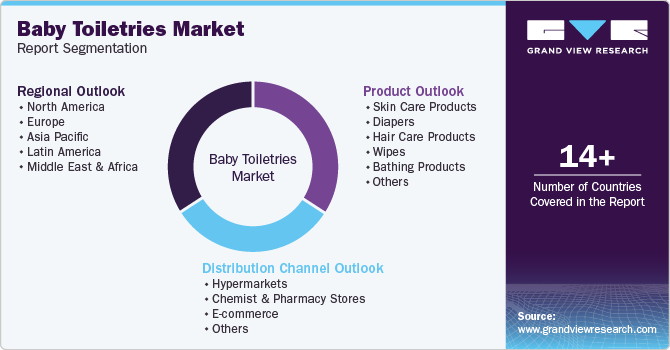
This report forecasts revenue growth at regional and country levels and provides an analysis of the latest industry trends in each of the sub-segments from 2018 to 2030. For this study, Grand View Research has segmented the global baby toiletries market report based on product, distribution channel, and region:
-
Product Outlook (Revenue, USD Million; 2018 - 2030)
-
Skin Care Products
-
Diapers
-
Hair Care Products
-
Wipes
-
Bathing Products
-
Others
-
-
Distribution Channel Outlook (Revenue, USD Million; 2018 - 2030)
-
Hypermarkets
-
Chemist and Pharmacy Stores
-
E-commerce
-
Others
-
-
Regional Outlook (Revenue, USD Million; 2018 - 2030)
-
North America
-
U.S.
-
Canada
-
Mexico
-
-
Europe
-
UK
-
Germany
-
France
-
Italy
-
Spain
-
-
Asia Pacific
-
Japan
-
China
-
India
-
South Korea
-
-
Latin America
-
Brazil
-
Argentina
-
-
Middle East and Africa (MEA)
-
South Africa
-
Saudi Arabia
-
-
Frequently Asked Questions About This Report
b. The baby toiletries market size was estimated at USD 113.33 billion in 2024 and is expected to reach USD 119.76 billion in 2025
b. The baby toiletries market is expected to grow at a compound annual growth rate of 6.2% from 2025 to 2030 to reach USD 161.74 billion by 2030
b. The diaper segment dominated the baby toiletries market, with a share of 29.2% in 2024. Parents' increasing awareness of the importance of hygiene and the convenience provided by disposable diapers play crucial roles.
b. Some key players operating in the baby toiletries market include Johnson & Johnson, Kimberly-Clark Corporation, Procter & Gamble, Hengan, Beiersdorf AG, Dabur India Limited, Unilever, Avon Healthcare Limited Company, Himalaya Drug Company, and Reckitt Benckiser Group.
b. Key factors that are driving the market growth include an increase in the awareness among parents pertaining to baby's health and hygiene, a growing number of working women across the globe, and increasing product innovations by the manufacturers.

Share this report with your colleague or friend.
Need a Tailored Report?
Customize this report to your needs — add regions, segments, or data points, with 20% free customization.


ISO 9001:2015 & 27001:2022 Certified
We are GDPR and CCPA compliant! Your transaction & personal information is safe and secure. For more details, please read our privacy policy.
Trusted market insights - try a free sample
See how our reports are structured and why industry leaders rely on Grand View Research. Get a free sample or ask us to tailor this report to your needs.












