
- Home
- »
- Homecare & Decor
- »
-
Australia & New Zealand Cycle Tourism Market Report, 2033GVR Report cover
![Australia & New Zealand Cycle Tourism Market Size, Share & Trends Report]()
Australia & New Zealand Cycle Tourism Market (2025 - 2033) Size, Share & Trends Analysis Report By Group (Groups/Friends, Couples, Family, Solo), By Booking Mode (Direct, Travel Agent), By Age Group, By Country, And Segment Forecasts
- Report ID: GVR-4-68040-725-8
- Number of Report Pages: 80
- Format: PDF
- Historical Range: 2021 - 2023
- Forecast Period: 2025 - 2033
- Industry: Consumer Goods
- Report Summary
- Table of Contents
- Segmentation
- Methodology
- Download FREE Sample
-
 Download Sample Report
Market Size & Trends
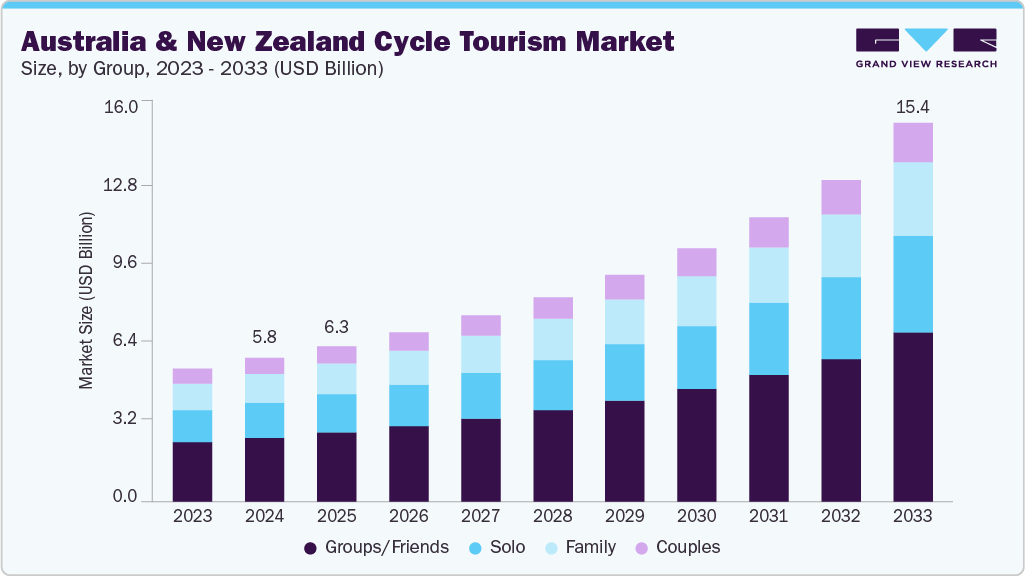
The Australia & New Zealand cycle tourism market size was estimated at USD 5.84 billion in 2024 and is projected to reach USD 15.40 billion by 2033, growing at a CAGR of 11.8% from 2025 to 2033. Cycling tourism in Australia & New Zealand thrives on immersive, multi-sensory experiences drawn from diverse and pristine landscapes.
In New Zealand, trails like the 133 km West Coast Wilderness Trail guide cyclists through lush rainforests, sparkling glacial rivers, coastal vistas, and historical pockets of heritage, generating “unique stops” such as Cowboy’s Paradise and the historic Theatre Royal Hotel that deepen traveler engagement. These experiential hallmarks, natural beauty along cultural touchpoints, drive the Australia & New Zealand cycle tourism industry.
Similarly, Australia’s Blue Derby mountain-bike network in Tasmania spans over 125 km through temperate rainforest and rugged terrain, drawing approximately 30,000 annual visitors and catalyzing investments in local eco-lodging like the Blue Derby Pods Ride. These environments attract cyclists not just with physical challenge, but with narrative-rich and visually compelling contexts, elevating cycling from mere transport to an experiential journey.
Visitors repeatedly cite well-being, connection, and personal transformation as powerful outcomes of immersion in the natural environment through cycle-tourism. Most of the Australia & New Zealand cycle tourism industry’s leisure travel is driven by opportunities to relax or reconnect with family and friends. 90% of the Australian cycle tourism market find New Zealand appealing for a short break or holiday destination.
According to the New Zealand Ministry of Business, Innovation & Employment, in Australia, the most cited reason is relaxation (62%), compared to 56% in New Zealand. Spending time with family, friends, or partners ranks second, at 55% in both countries. Visiting friends or family in the region is also significant, with 46% in Australia and 44% in New Zealand. Escaping and disconnecting from routine follows, motivating 38% of Australians and 32% of New Zealanders. Exploration and discovery of unique places attracts 30% in New Zealand and 26% in Australia, while being active outdoors appeals to 30% of Australians and 24% of New Zealanders.
Finally, enjoying local food, wine, or beer is a factor for 25% in Australia and 20% in New Zealand. Overall, Australians emphasize relaxation, outdoor activity, and gastronomy more strongly, while New Zealanders place slightly more emphasis on discovery and cultural exploration. This deep personal impact strengthens repeat visitation, word-of-mouth endorsements, and loyalty, driving sustainable demand in the Australia & New Zealand cycle tourism industry.
Australia and New Zealand have actively invested in cycling infrastructure and iconic trail networks, which in turn attract cycle tourists and strengthen regional tourism economies. In New Zealand, the Ngā Haerenga “Great Rides” network recorded 2.19 million trips in the year to June 2021, an increase of 204,000 trips or a 10.3% uptick in usage compared to the previous year. These trails generated 3.62 million visitor nights (+18 %) and delivered USD 553.52 million in regional economic activity (+31 %). This demonstrates how trail infrastructure drives the Australia & New Zealand cycle tourism industry.
Similarly, the Great Taste Trail in Nelson-Tasman delivered more than USD 19.78 million in visitor spending for the year ending June 2023. In Australia, We-Ride Australia’s 2022 'Cycling Economy Report' found that cycle tourism contributed USD 1.2 billion in direct economic output, supporting 58,000 jobs (FTE) and generating USD 10.85 billion in total economic and social benefits. These tangible outcomes underscore that targeted public and private investment, notably trail building, supporting amenities, and sustainable infrastructure, serve as a reliable catalyst for market growth.
Consumer Insights
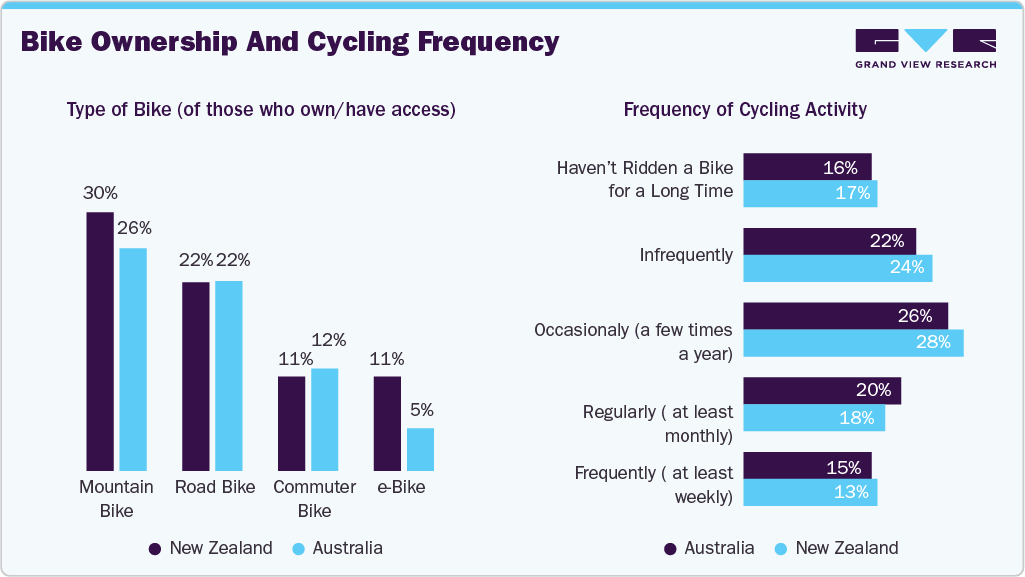
According to the New Zealand Ministry of Business, Innovation & Employment, cycle tourism participation in Australia and New Zealand over the past year witnessed a blend of urban and natural cycling demand. In New Zealand, the most common activity was cycling in an urban area, undertaken by 35% of participants. This was followed by cycling in national, regional, or state parks (18%), cycling on a bike or mountain bike trail (17%), and cycling to or around a specific destination or attraction (13%). In addition, 11% cycled at a mountain bike park, 8% attended a cycling event as participants, 7% attended as spectators, and 4% went on a multi-day bike-packing or cycle touring trip.
In Australia, the trends were slightly different, with 34% of participants cycling in an urban area, showing strong urban engagement similar to New Zealand. However, cycling in national, regional, or state parks had a higher share (25%), indicating a stronger interest in nature-based cycling experiences. 17% cycled on a bike or mountain bike trail, 12% cycled to or around a destination or attraction, and 10% visited mountain bike parks. Participation in organized activities was also present, with 7% attending cycling events as participants and another 7% as spectators. A small but notable 5% engaged in multi-day bike-packing or touring trips.
According to Ngā Haerenga New Zealand, on average, trail users spend USD 228 per day and their total trip expenditure averages USD 697 per person. Spending patterns vary significantly depending on user characteristics. Among lower-spending groups, bikepackers spend an average of USD155 daily and USD 361 in total, while those on a single-day trip spend USD 197 daily with a USD 412 total trip cost. First-time trail users record slightly higher expenditures, with USD 212 per day and USD 647 total per trip.
Conversely, higher-spending groups show notably greater economic impact. E-bike users spend on average USD 294 per day, contributing to a USD 994 total trip expenditure. Australian visitors report similar daily expenditure at USD 272, but with higher total trip spending of USD 1,176, reflecting longer stays or broader travel-related expenses. The highest spending is observed among those on multi-day rides of 5+ days, with a daily expenditure of USD 241 but a significantly higher total trip spend of USD 1,462, indicating extended travel duration drives higher economic value.
Group Insights
The groups/friends cycle tours segment led the market with the largest revenue share of 44.54% in 2024, driven by the rising preference for shared experiential travel, where participants value both the recreational and social aspects of cycling. In recent years, demand has been reinforced by corporate team-building retreats and wellness-focused leisure activities, encouraging groups to book customized cycling packages. Moreover, scenic routes across Tasmania, Queensland, and New Zealand’s South Island are increasingly marketed with group-focused itineraries, which enhance bonding experiences and promote safety, thereby solidifying their leadership in the Australia & New Zealand cycle tourism industry.
The solo cycle tours segment is projected to grow at the fastest CAGR of 12.5% over the forecast period, due to driven by the broader cultural shift toward personal wellness, self-discovery, and flexible travel preferences post-pandemic. Many solo travelers are leveraging cycling as a way to combine fitness with leisure, particularly across safe and well-signposted routes such as New Zealand’s Great Rides. Advancements in digital navigation tools and social media communities have further reduced the barriers to solo travel, empowering individuals to explore independently while still feeling connected to like-minded cycling enthusiasts online.
Booking Mode Insights
The direct bookings segment led the market with the largest revenue share of 57.30% in 2024, due to the high level of trust and transparency it provides to travelers, especially when engaging with tour operators or local cycling associations. In Australia & New Zealand cycle tourism industry, several cycling tour operators have enhanced their websites with instant booking functionalities, flexible payment options, and loyalty rewards, reducing reliance on intermediaries. This direct engagement enables providers to customize itineraries, accommodate dietary or equipment needs, and offer exclusive discounts, which strengthens traveler confidence and maintains direct booking’s leadership.
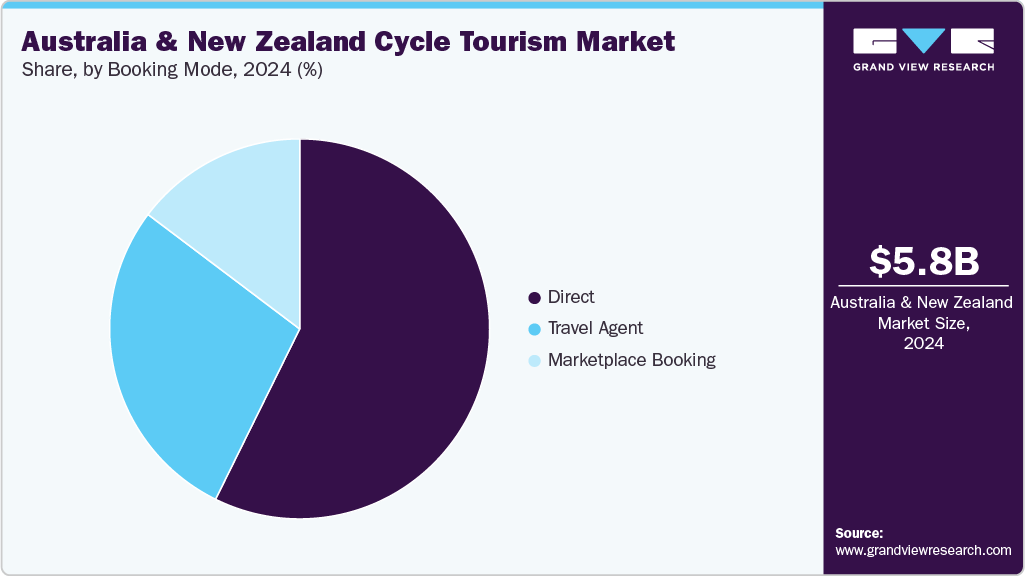
The marketplace bookings segment is projected to grow at the fastest CAGR of 12.5% over the forecast period, driven by the digital shift toward convenience and price comparison, particularly among younger, tech-savvy travelers. Online aggregators such as TripAdvisor Experiences and regional platforms now bundle cycling tours with accommodation and transport options, allowing seamless booking. The rapid adoption of mobile apps and digital wallets in both countries has further enhanced the growth trajectory, as travelers increasingly prioritize flexible booking options and last-minute deals accessible via online marketplaces.
Age Group Insights
The 31 to 50 years segment led the market with the largest revenue share of 47.71% in 2024, due to their higher disposable income, inclination toward active lifestyles, and preference for sustainable leisure activities. Many in this age group are balancing work and family responsibilities, but actively pursue adventure-oriented short breaks or long weekends. With increasing corporate emphasis on work-life balance, this demographic is prioritizing wellness-centric holidays, making mid-aged professionals the most consistent contributors to in Australia & New Zealand cycle tourism industry revenue.
The 18 to 30 years segment is projected to grow at the fastest CAGR of 12.2% over the forecast period, due to their preference for adventure-driven, low-cost, and environmentally conscious travel. This group is highly responsive to social media promotion and influencer-driven content showcasing scenic cycle trails, making them key adopters of shorter, more affordable cycling experiences. With backpacking culture deeply rooted in both countries, cycling is increasingly perceived by this demographic as a budget-friendly, flexible, and socially engaging way to explore natural landscapes, driving rapid adoption.
Country Insights
Australia Cycle Tourism Market Trends
Australia dominated the cycle tourism market with the largest revenue share of 72.02% in 2024, due to its extensive cycling infrastructure and government-backed initiatives promoting active travel. Investments in cycling-friendly regions such as Victoria’s High Country and Tasmania’s Blue Derby trails have positioned Australia as a premier hub for both domestic and inbound tourists. Furthermore, the integration of cycling with food, wine, and cultural tourism offerings creates value-added packages that attract diverse traveler segments, reinforcing Australia’s stronghold in the Australia & New Zealand cycle tourism industry.
New Zealand Cycle Tourism Market Trends
The cycle tourism market in New Zealand is projected to grow at the fastest CAGR of 12.6% over the forecast period, driven by its international recognition as a safe, scenic, and adventure-rich destination. The government’s ongoing expansion of Ngā Haerenga, The New Zealand Cycle Trail, provides well-maintained and interconnected routes that appeal to both domestic and international travelers. Coupled with increasing promotion of eco-tourism and adventure sports, New Zealand’s natural landscapes, ranging from coastal tracks to alpine trails, are stimulating rapid growth in demand, particularly among international markets seeking sustainable adventure travel.
Key Australia & New Zealand Cycle Tourism Company Insights
The competitive landscape of the Australia & New Zealand cycle tourism industry is characterized by a mix of specialized tour operators, local businesses, and government-backed initiatives that collectively shape industry dynamics. In Australia, operators such as Tour de Vines, Velo Tours Australia, and AllTrails Bicycle Tours dominate through curated packages that combine cycling with regional food, wine, and cultural experiences. Strong competition also stems from adventure travel companies integrating cycling with broader multi-activity holidays, catering to both domestic and international travelers. Government support has reinforced competitiveness by investing in cycling infrastructure across regions such as Victoria’s High Country and Tasmania’s Blue Derby, enabling operators to differentiate offerings through premium services, guided tours, and wellness-oriented packages.
In New Zealand, the competitive environment is centered around the Ngā Haerenga Great Rides network, which provides a structured platform for both small and large operators to develop cycling experiences. Companies such as Adventure South NZ, PureTrails New Zealand, and Cycle Journeys leverage this infrastructure by offering logistics, equipment hire, and guided multi-day trips. Competition is increasingly shaped by sustainability and eco-tourism trends, with operators aligning services to international expectations of low-impact travel. In addition, partnerships between local councils, regional tourism boards, and private players ensure that marketing efforts and product innovations remain coordinated, making New Zealand’s cycle tourism market highly competitive while maintaining strong growth momentum.
Key Australia & New Zealand Cycle Tourism Companies:
- Australian Cycle Tours
- Tour de Vines
- Adventure South NZ
- Trail Journeys
- Cycle Journeys
- AllTrails Bicycle Tours
- Ride International Tours
- Travel & Sports Australia
- PureTrails New Zealand
- Velo Tours Australia
Recent Developments
-
In December 2024,Adventure firm Trailworx began building the Angry Bull Trails, a 174 km mountain-biking network straddling the Queensland-NSW border. The project, slated for completion by mid-2025, aims to attract 35,000 visitors annually.
-
In August 2024, Australian Cycle Tours announced the launch of two new “Short Break” cycling itineraries in the Northern Rivers Rail Trail and Mudgee, NSW, targeting travelers with limited time and enhancing accessibility to key regions.
Australia & New Zealand Cycle Tourism Market Report Scope
Report Attribute
Details
Market size value in 2025
USD 6.33 billion
Revenue forecast in 2033
USD 15.40 billion
Growth rate
CAGR of 11.8% from 2025 to 2033
Base year for estimation
2024
Historical data
2021 - 2023
Forecast period
2025 - 2033
Quantitative units
Revenue in USD million/billion and CAGR from 2025 to 2033
Report coverage
Revenue forecast, company ranking, competitive landscape, growth factors, and trends
Segments covered
Group, booking mode, age group, country
Country scope
Australia & New Zealand
Key companies profiled
Australian Cycle Tours; Tour de Vines; Adventure South NZ; Trail Journeys; Cycle Journeys; AllTrails Bicycle Tours; Ride International Tours; Travel & Sports Australia; PureTrails New Zealand; Velo Tours Australia
Customization scope
Free report customization (equivalent up to 8 analysts working days) with purchase. Addition or alteration to country, regional & segment scope.
Pricing and purchase options
Avail customized purchase options to meet your exact research needs. Explore purchase options
Australia & New Zealand Cycle Tourism Market Report Segmentation
This report forecasts revenue growth at country levels and provides an analysis of the latest trends and opportunities in each of the sub-segments from 2021 to 2033. For this study, Grand View Research has segmented the Australia & New Zealand cycle tourism market report based on the group, booking mode, age group, and country.
-
Group Outlook (Revenue, USD Billion, 2021 - 2033)
-
Groups/Friends
-
Couples
-
Family
-
Solo
-
-
Booking Mode Outlook (Revenue, USD Billion, 2021 - 2033)
-
Direct
-
Travel Agent
-
Marketplace Booking
-
-
Age Group Outlook (Revenue, USD Billion, 2021 - 2033)
-
18 to 30 Years
-
31 to 50 Years
-
Above 50 Years
-
-
Country Outlook (Revenue, USD Billion, 2021 - 2033)
-
Australia
-
New Zealand
-
Frequently Asked Questions About This Report
b. Key factors that are driving the Australia & New Zealand cycle tourism market growth include experiential hallmarks and natural beauty along cultural touchpoints, attracting cyclists not just with physical challenge, but with narrative-rich and visually compelling contexts, elevating cycling from mere transport to an experiential journey.
b. The Australia & New Zealand cycle tourism market was estimated at USD 5.84 billion in 2024 and is expected to reach USD 6.33 billion in 2025.
b. The Australia & New Zealand cycle tourism market is expected to grow at a compound annual growth rate of 11.8% from 2025 to 2033 to reach USD 15.40 billion by 2033.
b. Groups/friends cycle tours held the largest market share in 2024, with a share of about 44.54%, due to the rising preference for shared experiential travel, where participants value both the recreational and social aspects of cycling.
b. Key players in the Australia & New Zealand cycle tourism market are Australian Cycle Tours, Tour de Vines, Adventure South NZ, Trail Journeys, Cycle Journeys, AllTrails Bicycle Tours, Ride International Tours, Travel & Sports Australia, PureTrails New Zealand, Velo Tours Australia, among others.


Share this report with your colleague or friend.
Need a Tailored Report?
Customize this report to your needs — add regions, segments, or data points, with 20% free customization.


ISO 9001:2015 & 27001:2022 Certified
We are GDPR and CCPA compliant! Your transaction & personal information is safe and secure. For more details, please read our privacy policy.
Trusted market insights - try a free sample
See how our reports are structured and why industry leaders rely on Grand View Research. Get a free sample or ask us to tailor this report to your needs.












