
- Home
- »
- Next Generation Technologies
- »
-
AI In Sports Market Size And Share, Industry Report, 2033GVR Report cover
![AI In Sports Market Size, Share & Trends Report]()
AI In Sports Market (2026 - 2033) Size, Share & Trends Analysis Report By Offerings (Solution, Services), By Technology (GenAI, Other AI), By Sports Type (Individual, Team Sports, E Sports), By Region (North America, Europe, Asia Pacific, MEA), And Segment Forecasts
- Report ID: GVR-4-68040-588-9
- Number of Report Pages: 100
- Format: PDF
- Historical Range: 2021 - 2024
- Forecast Period: 2026 - 2033
- Industry: Technology
- Report Summary
- Table of Contents
- Interactive Charts
- Methodology
- Download FREE Sample
-
 Download Sample Report
AI In Sports Market Summary
The global AI in sports market size was estimated at USD 10.61 billion in 2025 and is projected to reach USD 49.92 billion by 2033, growing at a CAGR of 21.6% from 2026 to 2033. The market is driven by the rising use of AI-driven technologies by sports organizations to boost performance, streamline training, and elevate fan engagement.
Key Market Trends & Insights
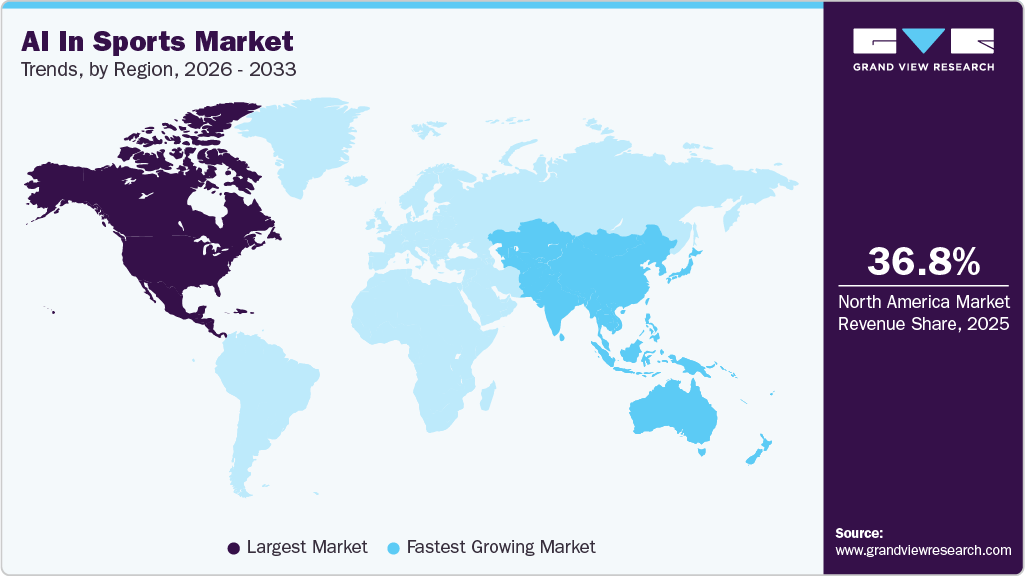
- North America AI in sports dominated the global market with the largest revenue share of 36.8% in 2025.
- The AI in sports market in the U.S. led the North America market and held the largest revenue share in 2025.
- By offerings, solutions led the market and held the largest revenue share of 58.9% in 2025.
- By technology, the gen AI segment held the dominant position in the market and accounted for the largest revenue share of 52.1% in 2025.
- By sports type, the esports segment is expected to grow at the fastest CAGR of 24.5% from 2026 to 2033.
Market Size & Forecast
- 2025 Market Size: USD 10.61 Billion
- 2033 Projected Market Size: USD 49.92 Billion
- CAGR (2026-2033): 21.6%
- North America: Largest market in 2025
- Asia Pacific: Fastest growing market
Major growth factors include AI’s capability to process large volumes of data, deliver real-time insights, and automate various tasks, thereby enhancing decision-making and operational efficiency. AI is expanding beyond the field into sports marketing, analytics, reporting, and performance evaluation. AI writing tools help coaches document training sessions efficiently, while journalists use AI to generate match reports quickly.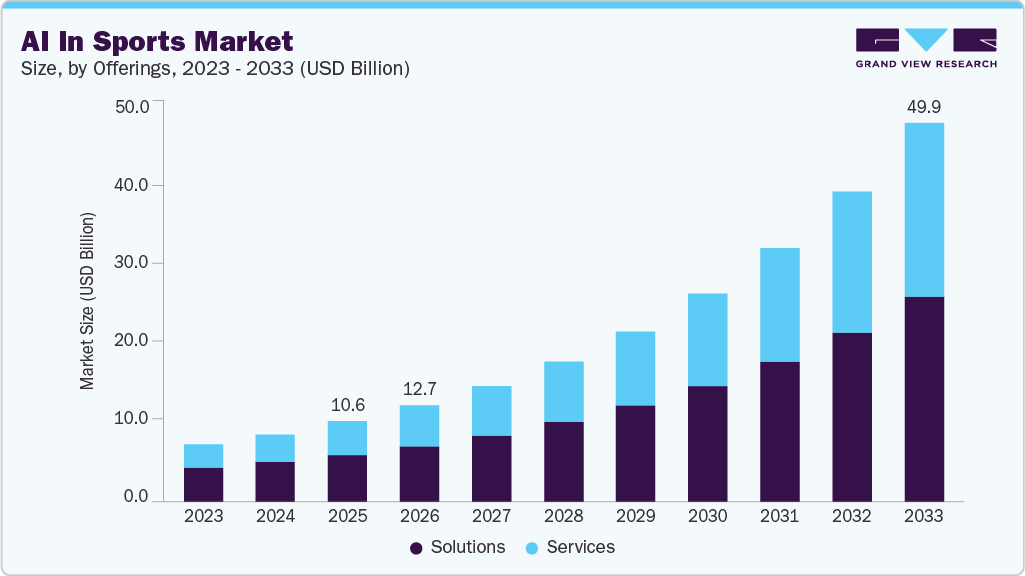
The sports industry is witnessing increased adoption of AI-driven digital coaching platforms to enhance training and performance analysis. Advanced technologies such as computer vision and generative AI enable personalized feedback through mobile applications. These platforms make high-quality coaching more accessible to both professional and recreational players. The integration of analytics, content, and community features creates a comprehensive digital sports ecosystem. This trend is contributing to the rapid market growth. For instance, in November 2025, IBM Corporation and Agassi Sports Entertainment, a U.S. racquet sports media and technology company, announced a multi-year collaboration to develop an AI-powered digital platform for global racquet sports. Leveraging IBM’s watsonx.ai and computer vision technology, the platform aims to provide AI-driven video coaching, performance analytics, and integrated fan engagement features.
Artificial intelligence (AI) - powered technologies are increasingly used to enhance real-time fan engagement in live sports. Advanced data analytics enables brands to deliver targeted and personalized advertisements during key game moments. Smart advertising platforms integrate live data signals to optimize campaign timing and impact. These solutions enhance viewer experience while improving measurable marketing outcomes. This trend is contributing significantly to market expansion. For instance, in November 2025, Genius Sports partnered with Publicis Sports, a U.S.-based sports marketing agency under Publicis Groupe, to enhance fan engagement through its AI-driven FANHub platform. The collaboration enables real-time, data-powered advertising and immersive ad innovations, allowing brands to connect with fans more effectively during live sporting events.
The increasing adoption of AI-powered analytics platforms is significantly expanding the sports technology market. These tools generate deep insight into team dynamics, individual player performance, and opponent strategies. Advanced algorithms process large volumes of data from video footage, player-tracking systems, and wearable sensors. AI systems can rapidly identify patterns, trends, and anomalies that may not be visible through traditional analysis. This enhances the accuracy and speed of performance evaluation. Coaches and management teams can use these insights to refine tactics and training programs. AI-driven analytics is strengthening competitive advantage and driving market growth.
Offering Insights
The solutions segment accounted for the highest revenue share of 58.9% in 2025. The solutions segment in the market is rising for performance analytics, player monitoring, coaching, and game strategy in sports is largely driven by the adoption of advanced technologies such as machine learning, computer vision, and wearable sensors that deliver real-time, in-depth data to optimize performance and prevent injuries. The growing need for data-informed decision-making allows teams and coaches to customize training plans, refine strategies, and minimize injury risks. Moreover, the surge in sports betting, fantasy leagues, and demand for personalized fan experiences is boosting investment in AI. Innovations in cloud computing, improved connectivity, and backing from major tech companies are further accelerating the development and widespread use of AI in sports for a competitive edge.
The services segment is projected to witness strong growth from 2026 to 2033. The services segment is growing due to the increasing use of AI and advanced analytics by sports organizations, driving demand for expert training, consulting, and customized system integration. As AI platforms become more complex, there is a greater need for ongoing support, maintenance, and managed services to ensure smooth performance and data security. Rising investments by professional teams and media companies in AI for performance analysis, injury prevention, and fan engagement are also growing the demand for service solutions. Moreover, the shift to cloud-based systems and real-time analytics rises for scalable integration and continuous support. Modified training and consulting services further help coaches, players, and analysts to make sense of AI insights, improving strategy and decision-making across the industry.
Technology Insights
The generative AI accounted for the largest market revenue share in 2025. The market is majorly driven by the rapid growth of data from smart devices, significant improvements in computing power, and the capability to convert data into meaningful insights. Sports organizations are playing a key role in bringing together different parts of the sports world. They handle important areas like facilities, fan experience, infrastructure, and extra events, making them a perfect fit for GenAI improvements. GenAI helps these organizations become more creative, offer personalized experiences, and focus on meaningful goals, all while reducing repetitive work. This benefits both team leaders and those involved in the actual game.
The other AI is projected to grow significantly over the forecast period. The market is driven by significant growth in machine learning, computer vision, predictive analysis, and natural language processing (NLP), enabling advanced data processing and real-time insights. These technologies enhance athlete performance, injury prevention, and strategic decision-making by analyzing player movements, game data, and physiological signals. Moreover, predictive analytics forecast outcomes and manage workloads, while NLP improves fan engagement through personalized training and content. Together, they enhance sports by delivering data-driven solutions that optimize training, gameplay, and fan experiences for sports.
Sports Type Insights
Team sports accounted for the largest market revenue share in 2025. AI significantly enhances team strategy and game tactics by evaluating both team and opponent performances, enabling coaches to make well-informed decisions. Through predictive modeling, AI simulates various strategies and forecasts their success rates against specific opponents, helping teams craft winning game plans tailored to real-time conditions. Moreover, AI tools analyze player performance, injury risks, and training efficiency, allowing teams and athletes to optimize workloads and improve outcomes. Real-time data insights also empower coaches to adjust tactics dynamically during matches, providing a competitive edge. This growing adoption of AI-driven performance optimization is transforming how teams prepare and compete at all levels.
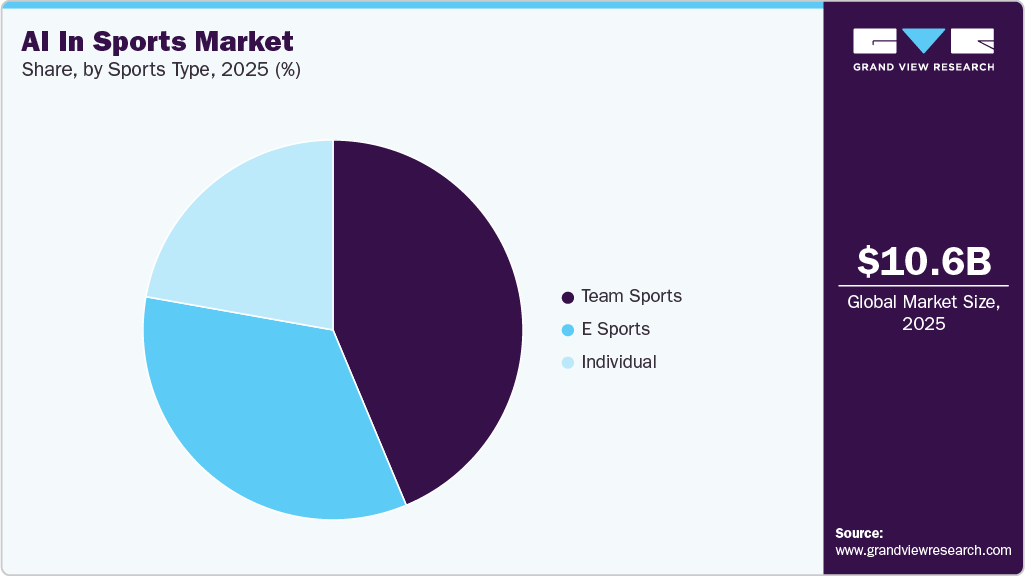
Esports are projected to grow significantly over the forecast period. The market is driven by simplifying tournament organization and enhancing the viewer’s experience. It automates key tasks like scheduling and match tracking, ensuring smooth event management. For sports fans, AI offers real-time insights and highlights, making broadcasts more engaging and interactive to give them a real-time experience. It also supports player training through AI-powered bots that simulate skilled opponents. In-game development, AI replicates player behavior to help developers fine-tune game mechanics and create more immersive experiences. These advancements are enhancing both the competitive gameplay and entertainment value of esports.
Regional Insights
North America dominated the market and accounted for a 36.8% share in 2025. The market is driven by the presence of major tech companies and top sports organizations that encourage innovation and early adoption of AI technologies. The region’s strong tech infrastructure and talent workforce from leading AI-focused universities support this growth. Major leagues in the region, like the NFL, NBA, and MLS, are investing heavily in AI to boost player performance, fan engagement, and game strategy. The extensive use of data analytics and machine learning also allows for real-time performance tracking, injury forecasting, and personalized coaching.
U.S. AI in Sports Market Trends
The AI in sports market in the U.S. is rising the demand in the region. The country market is driven by significant investments in AI platforms that enhance player performance, injury prevention, strategic decision-making, and personalized fan engagement. The growing demand for real-time data analytics and AI-driven fan experiences further propels market growth. For instance, the sportsbox.ai launches a 3D golf swing analysis application in the U.S., which uses AI and computer vision to provide the swing analysis in 3D motion from a single video taken on your phone.
Europe AI in Sports Market Trends
The AI in sports market in Europe is driven by fostering physical activity and enhancing social cohesion across member states. A strong focus on data privacy within Europe ensures that the ethical use of AI in sports remains a priority, keeping a balance between technological innovation and the protection of athlete and fan data. To support this vision, the European Commission actively promotes the growth of AI in sports through various initiatives and funding mechanisms, driving research, development, and adoption of AI technologies. For instance, in March 2025, Catapult introduced Vector 8, a state-of-the-art athlete monitoring system that provides real-time, AI-powered performance insights with exceptional speed and accuracy. Equipped with advanced wearables and a cloud-based platform, Vector 8 helps coaches make quicker, more informed decisions while simplifying data handling and improving athlete preparedness.
Asia Pacific AI in Sports Market Trends
The AI in sports market in the Asia-Pacific region is expected to witness the fastest growth due to rising demand for AI-powered sports solutions. Growing internet and smartphone usage allow amateur clubs and individual athletes wider access to AI tools, making advanced training and performance analysis more accessible. Countries such as China, India, and Japan are making significant investments in AI-based training, performance tracking, and fan engagement, supported by government initiatives and improved sports infrastructure. Moreover, the region’s large youth population and the booming popularity of esports are further accelerating the adoption of AI in sports.
Key AI in Sports Company Insights
Some of the key companies in the industry include International Business Machines Corporation (IBM), Microsoft, Catapult, SAP SE, or an SAP affiliate company, and others. Organizations are focusing on increasing their customer base to gain a competitive edge in the industry. Therefore, key players are taking several strategic initiatives, such as mergers and acquisitions, and partnerships with other major companies.
-
Microsoft is expanding its presence in the market through cloud-based analytics and generative AI solutions. Its Azure AI platform enables real-time data processing, player performance analysis, and intelligent match insights. The company is collaborating with sports leagues and broadcasters to enhance fan engagement through AI-driven content personalization. Microsoft’s AI tools also support automated highlight generation and predictive analytics.
-
Catapult Sports is advancing AI-powered athlete monitoring and performance analytics solutions. The company integrates wearable sensor data with machine learning algorithms to track player workload and injury risk. Its AI-driven platforms provide detailed tactical and biomechanical insights to coaching staff. Catapult is also enhancing video analysis tools with automated tagging and pattern recognition capabilities. These innovations are improving performance optimization and strategic planning in elite sports.
Key AI In Sports Companies:
The following key companies have been profiled for this study on the AI in sports market
- International Business Machines Corporation (IBM)
- Microsoft
- Catapult
- SAP SE or an SAP affiliate company
- SAS Institute Inc.
- Oracle
- Sportradar AG
- Pixellot
- SwingVision Inc.
- Zone7 Technologies Inc.
Recent Developments
-
In January 2026, Microsoft and the Mercedes-AMG PETRONAS F1 Team formed a multiyear partnership that integrates Microsoft Azure and enterprise AI technologies into team operations from factory to racetrack, and enables real-time insights, race strategy, and performance analysis in Formula 1 racing.
-
In May 2025, IBM Corporation and Scuderia Ferrari HP launched a mobile app powered by IBM watsonx AI to enhance Formula 1 fan engagement with AI-generated race summaries, interactive data visualizations, past race comparisons, polls, race highlights, and direct messaging to the Ferrari team.
-
In February 2025, Major League Baseball (MLB) and Sportradar extended their exclusive partnership through 2032, with MLB also taking an ownership stake in Sportradar. As part of the agreement, Sportradar will have exclusive rights to distribute MLB’s official data and audiovisual content globally. The partnership also focuses on developing innovative, AI-powered fan engagement experiences and integrity services to help drive MLB’s international expansion.
AI in Sports Market Report Scope
Report Attribute
Details
Market size in 2026
USD 12.68 billion
Revenue forecast in 2033
USD 49.92 billion
Growth rate
CAGR of 21.6% from 2026 to 2033
Base year for estimation
2025
Historical data
2021 - 2033
Forecast period
2026 - 2033
Quantitative units
Revenue in USD million/billion and CAGR from 2026 to 2033
Report coverage
Revenue forecast, company ranking, competitive landscape, growth factors, and trends
Segments covered
Offering, technology, sports type, region
Regional scope
North America; Europe; Asia Pacific; Latin America; MEA
Country scope
U.S.; Canada; Mexico; UK; Germany; France; China; Japan; India; South Korea; Australia; Brazil; KSA; UAE; South Africa
Key companies profiled
International Business Machines Corporation (IBM); Microsoft; Catapult; SAP SE or an SAP affiliate company; SAS Institute Inc.; Oracle; Sportradar AG; Pixellot; SwingVision Inc.; Zone7 Technologies Inc.
Customization scope
Free report customization (equivalent to 8 analysts working days) with purchase. Addition or alteration to country, regional & segment scope.
Pricing and purchase options
Avail customized purchase options to meet your exact research needs. Explore purchase options
Global AI in Sports Market Report Segmentation
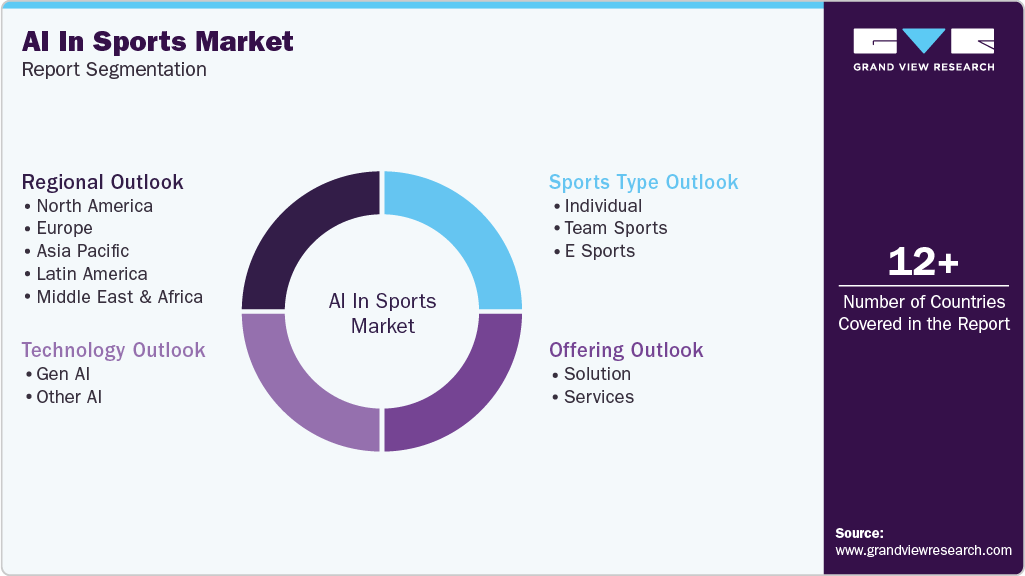
This report forecasts revenue growth at global, regional, and country levels and provides an analysis of the latest industry trends in each of the sub-segments from 2021 to 2033. For this study, Grand View Research has segmented the global AI in sports market based on offering, technology, sports type, and region:
-
Offering Outlook (Revenue, USD Million, 2021 - 2033)
-
Solution
-
Services
-
-
Technology Outlook (Revenue, USD Million, 2021 - 2033)
-
Gen AI
-
Other AI
-
-
Sports Type Outlook (Revenue, USD Million, 2021 - 2033)
-
Individual
-
Team Sports
-
E Sports
-
-
Regional Outlook (Revenue, USD Million, 2021 - 2033)
-
North America
-
U.S.
-
Canada
-
Mexico
-
-
Europe
-
UK
-
Germany
-
France
-
-
Asia Pacific
-
China
-
Japan
-
India
-
South Korea
-
Australia
-
-
Latin America
-
Brazil
-
-
Middle East and Africa (MEA)
-
KSA
-
UAE
-
South Africa
-
-
Frequently Asked Questions About This Report
b. The global AI in sports market is expected to grow at a compound annual growth rate of 21.6% from 2026 to 2033 to reach USD 49.92 billion by 2033.
b. North America dominated the AI in sports market with a share of 36.8% in 2025. The market is driven by the presence of major tech companies and top sports organizations that encourage innovation and early adoption of AI technologies.
b. Some key players operating in the AI in sports market include International Business Machines Corporation (IBM); Microsoft; Catapult; SAP SE or an SAP affiliate company; SAS Institute Inc.; Oracle; Sportradar AG; Pixellot; SwingVision Inc., and Zone7 Technologies Inc.
b. The global AI in sports market size was estimated at USD 10.61 billion in 2025 and is expected to reach USD 12.69 billion in 2026.
b. Key factors that are driving the market growth include increasing adoption of artificial intelligence and machine learning, rising demand for high-quality training datasets, and the expansion of computer vision and natural language processing applications.


Share this report with your colleague or friend.
Need a Tailored Report?
Customize this report to your needs — add regions, segments, or data points, with 20% free customization.


ISO 9001:2015 & 27001:2022 Certified
We are GDPR and CCPA compliant! Your transaction & personal information is safe and secure. For more details, please read our privacy policy.
Trusted market insights - try a free sample
See how our reports are structured and why industry leaders rely on Grand View Research. Get a free sample or ask us to tailor this report to your needs.












