
- Home
- »
- Automotive & Transportation
- »
-
Agricultural Electric Tractors Market, Industry Report, 2033GVR Report cover
![Agricultural Electric Tractors Market Size, Share & Trends Report]()
Agricultural Electric Tractors Market (2026 - 2033) Size, Share & Trends Analysis Report By Type, By Power Output (Below 30 HP, 31-70 HP, Above 70 HP), By Battery Capacity, By Battery Type, By Drive Type, By End-use, By Region, And Segment Forecasts
- Report ID: GVR-4-68040-855-8
- Number of Report Pages: 120
- Format: PDF
- Historical Range: 2021 - 2024
- Forecast Period: 2026 - 2033
- Industry: Technology
- Report Summary
- Table of Contents
- Segmentation
- Methodology
- Download FREE Sample
-
 Download Sample Report
Agricultural Electric Tractors Market Summary
The global agricultural electric tractors market size was estimated at USD 624.8 million in 2025 and is projected to reach USD 2,408.5 million by 2033, growing at a CAGR of 18.9% from 2026 to 2033. The rising cost of fossil fuels and the growing economic demand for electric power as a cost-effective alternative are driving the agricultural electric tractors industry.
Key Market Trends & Insights
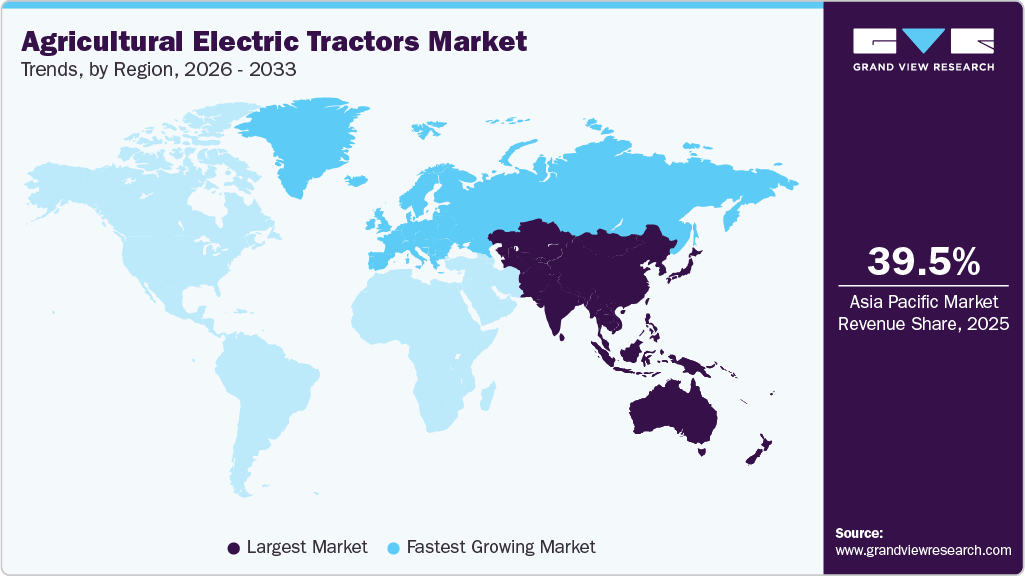
- Asia Pacific dominated the global agricultural electric tractors market with the largest revenue share of 39.5% in 2025.
- The agricultural electric tractors industry in China accounted for the largest market revenue share in the Asia Pacific in 2025.
- By type, the battery electric tractors segment led the market with the largest revenue share of 61.4% in 2025.
- By power output, the below 30 HP segment accounted for the largest market revenue share in 2025.
- By battery capacity, the 21-50 kWh segment accounted for the largest market revenue share in 2025.
Market Size & Forecast
- 2025 Market Size: USD 624.8 Million
- 2033 Projected Market Size: USD 2,408.5 Million
- CAGR (2026-2033): 18.9%
- Asia Pacific: Largest market in 2025
- Europe: Fastest growing market
The increasing mechanization of agriculture in developing economies is driving the market growth. Countries in the Asia-Pacific, Latin America, and Africa are experiencing a growing demand for agricultural machinery as farmers seek to boost productivity and reduce manual labor. As electrification infrastructure improves and renewable energy adoption rises in rural regions, electric tractors are becoming a viable option for small and medium-sized farms. The combination of affordability, sustainability, and operational simplicity makes them particularly appealing in markets transitioning from manual to mechanized farming.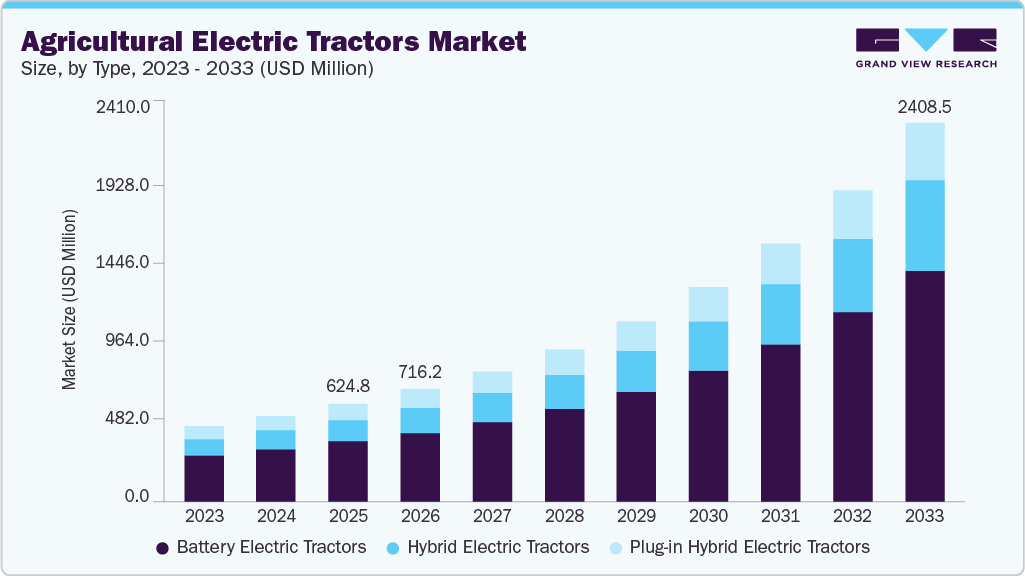
The growing role of agricultural equipment manufacturers and startups in innovating and commercializing electric tractor technologies is fueling market expansion. Established agricultural machinery companies are partnering with technology firms to develop efficient electric tractor models with enhanced battery performance and smart connectivity. Simultaneously, startups are introducing compact, affordable electric tractors tailored for small-scale farmers, particularly in emerging markets. This surge in product innovation and market competition is driving continuous improvements in design, performance, and cost efficiency, ensuring that electric tractors become an integral part of the future agricultural landscape.
The increasing electrification of farm infrastructure and the expansion of rural energy access are fueling market expansion. Many agricultural regions are witnessing rapid improvements in grid connectivity and in the installation of renewable microgrids, particularly solar and wind-based systems. This development allows farmers to efficiently charge electric tractors without relying on unstable fuel supply chains or expensive off-farm charging infrastructure. The combination of electric tractors and on-site renewable power generation creates an energy-efficient, self-sustaining agricultural ecosystem. As rural electrification projects continue to expand, especially in the Asia-Pacific and Africa, electric tractors are becoming a logical extension of sustainable farm modernization initiatives.
The growing focus on automation and autonomous farming machinery is driving market growth. Electric tractors are inherently better suited to automation technologies than traditional diesel-powered ones because of their electronic control systems and compatibility with precision sensors, GPS guidance, and machine-learning algorithms. This makes them ideal for autonomous operations such as seeding, spraying, and harvesting, thereby reducing labor dependency and improving efficiency. The global shortage of skilled agricultural labor, particularly in developed economies like the U.S., Japan, and Germany, has accelerated the need for robotic and semi-autonomous equipment. As manufacturers integrate autonomous capabilities into electric tractors, adoption is expected to grow rapidly across large and small farms alike.
The growing emphasis on noise reduction and operator comfort is also driving the adoption of electric tractors. Unlike traditional diesel tractors, electric models operate with minimal vibration and noise, significantly improving the working conditions for farmers and operators. This is particularly advantageous for agricultural operations conducted near residential areas or livestock farms, where noise pollution can disrupt local environments and animal well-being. The quieter operation also enables farmers to extend working hours into early mornings or late evenings without disturbance, thereby improving productivity. The improved ergonomics, smoother handling, and lower fatigue associated with electric tractors make them increasingly appealing to modern farmers seeking comfort and efficiency.
The development of advanced energy storage and charging infrastructure tailored for agriculture is contributing to market expansion. Manufacturers and energy companies are collaborating to design fast-charging stations and battery storage units optimized for rural and off-grid environments. Mobile charging units powered by solar or hybrid systems are also being introduced to provide flexibility during peak farming seasons. These innovations are addressing range anxiety and downtime issues that once hindered adoption, making electric tractors more practical for continuous, large-scale farming operations.
Type Insights
The battery electric tractors segment led the market with the largest revenue share of 61.4% in 2025. The growing integration of renewable energy systems with battery electric tractors is also accelerating market growth. Farms equipped with solar or wind power can use their self-generated renewable energy to charge electric tractors, reducing reliance on external power grids and fossil fuels. This combination of renewable generation and electric mobility creates a closed-loop, energy-efficient farming ecosystem that minimizes operational costs and enhances energy independence. In regions such as India, Australia, and parts of Africa, where solar adoption is rapidly expanding in rural areas, the synergy between electric tractors and renewable energy infrastructure is creating new opportunities for sustainable agricultural mechanization.
The hybrid electric tractors segment is projected to grow at the fastest CAGR from 2026 to 2033. The expanding adoption of precision agriculture and smart power management systems further enhances the appeal of hybrid electric tractors. Equipped with advanced sensors, telematics, and GPS-based systems, hybrid tractors can optimize engine-electric coordination based on real-time field data. This ensures that power output matches task requirements, minimizing wastage and improving productivity. For example, during idling or transport, the electric mode can automatically engage to reduce energy use, while during plowing or heavy tillage, both power sources can synchronize for maximum efficiency. Such intelligent control systems are transforming hybrid tractors into high-tech tools for modern, data-driven farming practices.
Power Output Insights
The below 30 HP segment accounted for the largest market revenue share in 2025. The growth of niche and high-value agricultural activities, such as organic farming, horticulture, viticulture, and greenhouse cultivation, is driving this segment's growth. These specialized sectors often require smaller, maneuverable, and emission-free equipment capable of working in confined spaces without damaging crops or soil. Electric tractors under 30 HP are ideal for these applications, as they combine compact design with smooth, vibration-free operation. Their precision control and lightweight build make them suitable for delicate crop environments, while their emission-free nature supports organic certification and sustainable farming branding. The expanding popularity of premium farming sectors globally is therefore contributing to the growing adoption of compact electric tractor models.
The above 70 HP segment is projected to grow at the fastest CAGR from 2026 to 2033. The integration of smart technologies and automation features is a key factor driving the growth of the above 70 HP segment. These high-end electric tractors are increasingly equipped with advanced technologies, including GPS-based guidance systems, IoT-enabled telematics, and AI-powered performance optimization. Such systems enable autonomous or semi-autonomous operations, predictive maintenance, and real-time monitoring of tractor health, energy consumption, and field conditions. Large agricultural enterprises are leveraging these digital capabilities to improve productivity, optimize resource utilization, and reduce operational costs. The combination of high mechanical power and intelligent automation makes electric tractors in this segment a cornerstone of precision agriculture and smart farming strategies.
Battery Capacity Insights
The 21-50 kWh segment accounted for the largest market revenue share in 2025. The increasing digitalization and data-driven decision-making in modern agriculture fuel the demand for tractors within this segment. The integration of sensors, IoT connectivity, and advanced telematics in electric tractors allows farmers to monitor performance metrics such as battery health, energy usage, and operating efficiency in real time. The 21-50 kWh models are especially suited for such digital adoption because their energy systems can support integrated electronics and connectivity modules without significantly impacting operational endurance. This capability helps farmers make informed decisions about usage patterns, preventive maintenance, and energy management.
The above 50 kWh segment is projected to grow at the fastest CAGR from 2026 to 2033. The advancement of high-capacity lithium-ion and solid-state battery technologies drives segment growth. Modern battery systems not only extend operational range but also enhance power delivery, reducing performance losses during peak agricultural workloads. These technological developments have enabled tractors with batteries above 50 kWh to operate for extended hours on a single charge, matching or even surpassing the uptime of diesel-powered counterparts in certain use cases. Furthermore, improvements in battery management systems (BMS) and thermal regulation technologies ensure consistent performance even under harsh field conditions, minimizing the risk of overheating or energy loss.
Battery Type Insights
The lithium-ion battery segment accounted for the largest market revenue share in 2025. The global shift toward sustainable, low-emission farming practices is further underscoring the importance of lithium-ion technology in agriculture. Governments across regions are implementing policies and incentive programs that encourage the use of clean energy equipment, including electric tractors. Subsidies, tax credits, and grants are being offered to promote the transition from diesel-powered to electric alternatives. Lithium-ion batteries, being central to electric vehicle technology, benefit directly from these initiatives. Moreover, the environmental advantages of zero emissions, minimal noise pollution, and improved energy efficiency align perfectly with the goals of sustainable agriculture and climate-smart farming.
The lead-acid battery segment is projected to grow at the fastest CAGR from 2026 to 2033. The continued technological improvements in lead-acid battery design, such as valve-regulated lead-acid (VRLA) and absorbent glass mat (AGM) technologies, are bolstering this segment. These innovations have significantly enhanced energy efficiency, reduced maintenance requirements, and extended cycle life compared to traditional flooded lead-acid batteries. Such advancements make modern lead-acid batteries more competitive for use in electric tractors, where longer operational life and improved performance are increasingly valued. Enhanced charge acceptance, better resistance to deep discharge, and improved safety profiles have made VRLA batteries particularly suitable for agricultural machinery that demands consistent energy delivery.
Drive Type Insights
The two-wheel drive (2WD) segment accounted for the largest market revenue share in 2025. The integration of regenerative braking and energy recapture technologies in electric 2WD tractors is driving segment adoption. These systems allow the tractor to recover kinetic energy during deceleration or downhill operation, improving energy efficiency and extending operational range. In agricultural contexts involving frequent stop-and-go movement, such as plowing or harvesting, regenerative systems significantly enhance productivity by reducing the frequency of recharges. This advancement not only improves tractor efficiency but also aligns with the growing emphasis on sustainable energy utilization and minimal environmental impact in modern agriculture. Manufacturers are leveraging these innovations to promote their tractors as high-performing, energy-conscious solutions, thereby attracting environmentally conscious buyers.
The four-wheel drive (4WD) segment is projected to grow at the fastest CAGR from 2026 to 2033. The rise in demand for multi-functional tractors that can support various attachments and implements is another important driver. Electric 4WD tractors, due to their higher power capacity, can efficiently handle diverse equipment such as front loaders, rotary tillers, and balers without performance degradation. This versatility allows farmers to perform multiple field operations with a single machine, thereby reducing capital investment and operational complexity. The integration of advanced power management systems ensures that sufficient energy is distributed to auxiliary implements without overloading the system. The ability to manage multiple high-power functions efficiently makes electric 4WD tractors particularly appealing to commercial farms and agricultural service providers that require versatile equipment.
End-use Insights
The small and medium farms segment accounted for the largest market revenue share in 2025. The growing role of microfinance and digital lending platforms in agricultural equipment purchases is supporting adoption among small- and medium-sized farms. Traditional credit systems often limited access to new technology due to constraints on collateral or income verification. However, fintech-based microloan solutions are now providing affordable, flexible payment options for purchasing electric tractors. These platforms use digital risk assessments and mobile payment systems to make financing more accessible to small farmers. Coupled with leasing and cooperative ownership models, microfinancing is lowering the entry barrier for adopting electric tractors, especially in emerging markets where small farms dominate. This democratization of financial access is contributing to faster adoption and diffusion of electric farming technologies across rural regions.
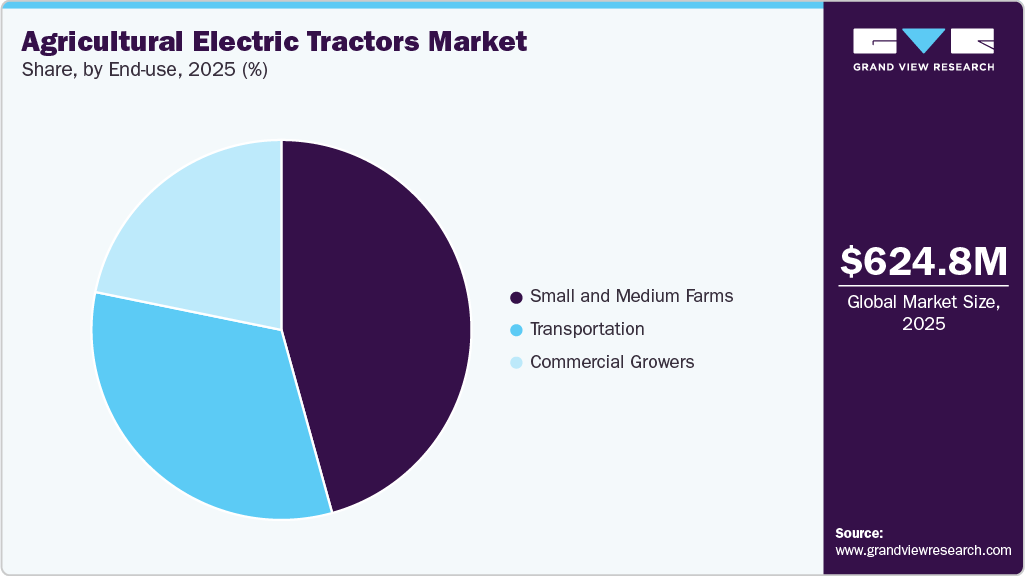
The commercial growers segment is projected to grow at the fastest CAGR from 2026 to 2033. The rapid development of high-capacity batteries and fast-charging infrastructure is fueling adoption among commercial growers who require continuous, heavy-duty operation. Early concerns about limited battery capacity and long charging times are being mitigated by innovations in lithium-ion and solid-state battery technologies, which offer higher energy densities and faster recharge times. Commercial-scale farms can now operate electric tractors for extended hours with minimal interruptions by integrating on-site charging stations powered by renewable sources or energy storage systems. Some manufacturers are also introducing swappable battery packs to enable uninterrupted fieldwork. These advancements are particularly beneficial to commercial growers managing time-sensitive cultivation activities, as they ensure consistent equipment availability and operational flexibility across large farming areas.
Regional Insights
The North America agricultural electric tractors market is expected to grow at a significant CAGR during the forecast period. The expansion of regenerative and organic farming practices across the region is creating a favorable environment for the adoption of electric tractors. These farming systems emphasize minimal soil disturbance, low-emission operations, and reduced reliance on fossil fuels, objectives that align perfectly with the use of electric machinery. As more North American farms transition to regenerative agriculture to qualify for carbon credits and sustainability incentives, electric tractors are becoming an integral part of eco-friendly farm management. Their quiet operation, zero tailpipe emissions, and compatibility with low-impact agricultural techniques make them especially suitable for organic farms, vineyards, and horticultural operations.
U.S. Agricultural Electric Tractors Market Trends
The agricultural electric tractors market in the U.S. is growing at a rapid pace. The expanding network of EV charging infrastructure and advancements in energy storage are further reinforcing the U.S. market. The federal government’s commitment to building nationwide EV charging networks under programs like the National Electric Vehicle Infrastructure (NEVI) initiative is extending to rural and agricultural regions. In parallel, improvements in lithium-ion and solid-state battery technologies are enhancing tractor performance, range, and charging speed. Modular, swappable battery designs now allow farmers to adjust capacity to field size and workload, increasing operational flexibility. As battery technology continues to evolve, electric tractors are becoming more efficient and viable for extended use across diverse farming conditions.
Asia Pacific Agricultural Electric Tractors Market Trends
Asia Pacific dominated the global agricultural electric tractors market with the largest revenue share of 39.5% in 2025. The growing participation of financial institutions and agricultural cooperatives in promoting the adoption of electric farm equipment is also stimulating growth in the region. Banks, microfinance organizations, and cooperatives are increasingly providing affordable credit facilities and leasing programs to help farmers acquire electric tractors. These financing models are reducing the high upfront investment barrier that has traditionally limited adoption in rural economies. Moreover, partnerships between equipment manufacturers and local financial service providers are introducing pay-as-you-go and subscription-based models tailored for small-scale farmers.
The agricultural electric tractors market in China accounted for the largest market revenue share in Asia Pacific in 2025. The expansion of rural electrification and renewable energy infrastructure across China is propelling the growth of the agricultural electric tractors market. The Chinese government’s investment in rural power grids, solar farms, and distributed renewable energy systems has provided the necessary foundation for electric tractor adoption. In many agricultural provinces, solar charging stations and energy storage systems are being deployed to enable farmers to charge electric equipment independently of the central grid. This localized energy ecosystem reduces operational costs and enhances energy security for rural communities. Moreover, the increasing integration of renewable energy with agricultural operations aligns perfectly with China’s broader vision of creating smart, green villages powered by sustainable technologies.
Europe Agricultural Electric Tractors Market Trends
The agricultural electric tractors market in Europe is expected to grow at the fastest CAGR over the forecast period. Europe’s mature electric vehicle (EV) ecosystem and strong battery technology infrastructure a key factors driving market growth. European countries host some of the most advanced EV research and production facilities globally, supported by leading automotive and battery manufacturers such as Volkswagen, Stellantis, and Northvolt. This technological advantage is spilling over into the agricultural machinery sector, enabling the development of highly efficient, durable, and fast-charging electric tractors. Advances in lithium-ion and emerging solid-state batteries have significantly improved tractor performance, enabling longer operation times and greater power output. Moreover, the growing network of EV charging infrastructure across rural Europe is helping address range and accessibility concerns.
The Germany agricultural electric tractors market held a significant share in Europe in 2025. The increasing integration of automation and robotics in farming operations is driving market adoption. German farms are progressively adopting autonomous machinery and AI-driven systems to address the growing labor shortage in the agricultural sector. Electric tractors, equipped with advanced control systems, are easier to automate and operate remotely compared to diesel counterparts, making them an ideal fit for modern, tech-enabled farms. Their compatibility with autonomous guidance, telematics, and machine learning algorithms enhances precision, efficiency, and operational safety. This shift toward robotics and unmanned machinery in farming is being accelerated by Germany’s innovation-friendly ecosystem, government-funded research projects, and collaborations between agricultural universities and technology companies.
Key Agriculture Electric Tractors Company Insights
Some of the key companies operating in the market, include Deere & Company and AGCO Corporation, among others are some of the leading participants in the agricultural electric tractors industry.
-
Deere & Company is a global agricultural, construction, and forestry machinery company. Deere & Company’s entry into the agricultural electric tractors segment represents a strategic step toward sustainable, intelligent farming. The Company has been developing and testing electric tractors and hybrid-electric machinery that aim to reduce reliance on fossil fuels, minimize maintenance requirements, and improve operational efficiency. These electric tractors are engineered to deliver high torque, instant power, and quieter operation than traditional diesel-powered models, enhancing environmental sustainability and operator comfort.
-
AGCO Corporation is a global manufacturer and distributor of agricultural machinery and precision ag technology. The company’s Fendt brand, known for its premium technology and precision engineering, has been instrumental in leading AGCO’s electric tractor development. Fendt’s electric tractor prototypes, such as the Fendt e100 Vario, exemplify AGCO’s approach to integrating sustainability with performance. The e100 Vario operates as a fully battery-electric tractor designed for light to medium-duty agricultural tasks, offering zero-emission operation without compromising power or reliability.
TAFE TRACTORS and SOLECTRAC are some of the emerging market participants in the agricultural electric tractors industry.
-
TAFE Tractors is India’s largest agricultural machinery manufacturer. TAFE has been actively working toward integrating sustainable technologies into its equipment portfolio. Recognizing the global shift toward green energy and carbon-neutral farming, the company has focused on developing electric and hybrid tractor solutions designed to minimize fuel consumption and emissions while maintaining robust performance. TAFE’s electric tractor initiatives reflect its strategic goal of delivering cost-effective mechanization to farmers without compromising environmental sustainability.
-
Solectrac is a pioneering manufacturer of electric tractors. Solectrac focuses on producing zero-emission tractors designed for small and medium-sized farms, vineyards, orchards, and equestrian centers. Its tractors are built to deliver comparable power and functionality to conventional tractors while offering the advantages of electric operation, such as lower maintenance, reduced noise, and zero tailpipe emissions. Solectrac’s product range is powered by high-efficiency lithium-ion battery systems that deliver long runtime per charge, enabling several hours of continuous fieldwork, depending on the task and terrain.
Key Agriculture Electric Tractors Companies:
The following key companies have been profiled for this study on the agricultural electric tractors market.
- Deere & Company
- Escorts Kubota Limited
- SOLECTRAC
- Monarch Tractor
- Sonalika
- AGCO Corporation
- CNH Industrial NV
- Mahindra & Mahindra
- TAFE TRACTORS
- TYM Corporation
- Montra Electric Tractor
Recent Developments
-
In July 2025, Fendt, a brand under AGCO Corporation, launched the e100 Vario in the UK and Ireland. The updated e100 Vario measures 2.16 meters wide and 2.64 meters tall with standard tires, matching the size of the diesel-powered Fendt 200 Vario. It can be factory-equipped with the Fendt Cargo 3X65 front loader, and its comfort cab, featuring a 100° roof window, is optimized for efficient front loader operations such as bale stacking.
-
In February 2025, Deere & Company launched its first lineup of electric-powered agricultural tractors. The initial three E-Power models are being tested in various sizes, tailored for operations in vineyards and dairies. These electric tractors deliver approximately 130 horsepower, similar to their diesel-powered counterparts. By developing a common platform for its electric tractors, the company enables future flexibility to produce versions with different tire sizes, axle widths, or even alternative fuel options.
Agricultural Electric Tractors Market Report Scope
Report Attribute
Details
Market size value in 2026
USD 716.2 million
Revenue forecast in 2033
USD 2,408.5 million
Growth rate
CAGR of 18.9% from 2026 to 2033
Base year for estimation
2025
Historical data
2021 - 2024
Forecast period
2026 - 2033
Quantitative units
Revenue in USD million/billion, and CAGR from 2026 to 2033
Report coverage
Revenue forecast, company share, competitive landscape, growth factors, and trends
Segments covered
Type, power output, battery capacity, battery type, drive type, end-use, region
Regional scope
North America; Europe; Asia Pacific; Latin America; MEA
Country scope
U.S.; Canada; Mexico; UK; Germany; France; China; India; Japan; Australia; South Korea; Brazil; UAE; Saudi Arabia; South Africa
Key companies profiled
Deere & Company; Escorts Kubota Limited; SOLECTRAC; Monarch Tractor; Sonalika; AGCO Corporation; CNH Industrial NV; Mahindra & Mahindra; TAFE TRACTORS; TYM Corporation; Montra Electric Tractor
Customization scope
Free report customization (equivalent to 8 analysts working days) with purchase. Addition or alteration to country, regional & segment scope.
Pricing and purchase options
Avail customized purchase options to meet your exact research needs. Explore purchase options
Global Agricultural Electric Tractors Market Report Segmentation
This report forecasts revenue growth at global, regional, and country levels and provides an analysis of the latest industry trends in each of the sub-segments from 2021 to 2033. For this study, Grand View Research has segmented the global agricultural electric tractors market report based on type, power output, battery capacity, battery type, drive type, end-use, and region.
-
Type Outlook (Revenue, USD Billion, 2021 - 2033)
-
Battery Electric Tractors
-
Hybrid Electric Tractors
-
Plug-in Hybrid Electric Tractors
-
-
Power Output Outlook (Revenue, USD Billion, 2021 - 2033)
-
Below 30 HP
-
31-70 HP
-
Above 70 HP
-
-
Battery Capacity Outlook (Revenue, USD Billion, 2021 - 2033)
-
Below 20 kWh
-
21-50 kWh
-
Above 50 kWh
-
-
Battery Type Outlook (Revenue, USD Billion, 2021 - 2033)
-
Lithium-ion Battery
-
Lead-acid Battery
-
Others
-
-
Drive Type Outlook (Revenue, USD Billion, 2021 - 2033)
-
Two-wheel Drive (2WD)
-
Four-wheel Drive (4WD)
-
-
End-use Outlook (Revenue, USD Billion, 2021 - 2033)
-
Small and Medium Farms
-
Large Farms
-
Commercial Growers
-
-
Regional Outlook (Revenue, USD Billion, 2021 - 2033)
-
North America
-
U.S.
-
Canada
-
Mexico
-
-
Europe
-
Germany
-
UK
-
France
-
-
Asia Pacific
-
China
-
India
-
Japan
-
South Korea
-
Australia
-
-
Latin America
-
Brazil
-
-
Middle East & Africa
-
UAE
-
Saudi Arabia
-
South Africa
-
-
Frequently Asked Questions About This Report
b. The global agricultural electric tractors market size was estimated at USD 624.8 million in 2025 and is expected to reach USD 716.2 million in 2026.
b. The global agricultural electric tractors market is expected to grow at a compound annual growth rate of 18.9% from 2026 to 2033 to reach USD 2,408.5 million by 2033.
b. The battery electric tractors segment dominated the agricultural electric tractors market with a market share of 61.4% in 2025. The growing integration of renewable energy systems with battery electric tractors is also accelerating market growth.
b. Some key players operating in the market include Deere & Company, Escorts Kubota Limited, SOLECTRAC, Monarch Tractor, Sonalika, AGCO Corporation, CNH Industrial NV, Mahindra & Mahindra, TAFE TRACTORS, TYM Corporation, Montra Electric Tractor.
b. Factors such as rising cost of fossil fuels and the growing economic demand of electric power as a cost-effective alternative are the key factors driving the market growth.


Share this report with your colleague or friend.
Need a Tailored Report?
Customize this report to your needs — add regions, segments, or data points, with 20% free customization.


ISO 9001:2015 & 27001:2022 Certified
We are GDPR and CCPA compliant! Your transaction & personal information is safe and secure. For more details, please read our privacy policy.
Trusted market insights - try a free sample
See how our reports are structured and why industry leaders rely on Grand View Research. Get a free sample or ask us to tailor this report to your needs.












